
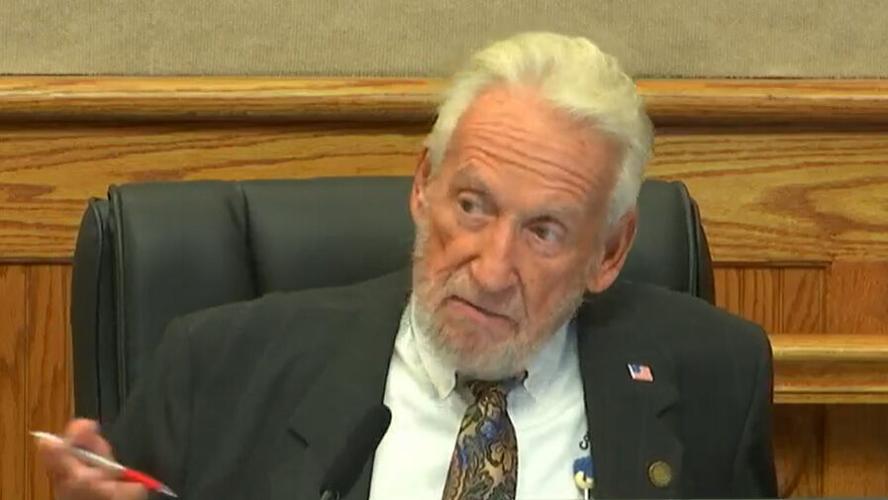


Charlotte County Commissioner Stephen R. Deutsch discusses mandatory utility connection notices during the July 23 commission meeting. He urged homebuyers to carefully review closing documents for potential utility connection requirements and other property-related costs.
Some of the more than 300 Charlotte County property owners who received letters requiring them to pay hookup fees to connect to the county’s sewer and water systems said they never received the notices. In response, commissioners on July 23 directed staff to resend the letters, include information about a loan program and roll back connection rates to those in effect before April 1, 2026.
Property owners who already paid the higher fees would receive refunds.
During her presentation, Engineering Business Services Supervisor Sandra Weaver said the notices informed residents that connection fees were $17,596 for wastewater and $9,118 for water.
Before the April 1 rate increase, the wastewater connection fee was $11,200 and the water connection fee was $6,792.
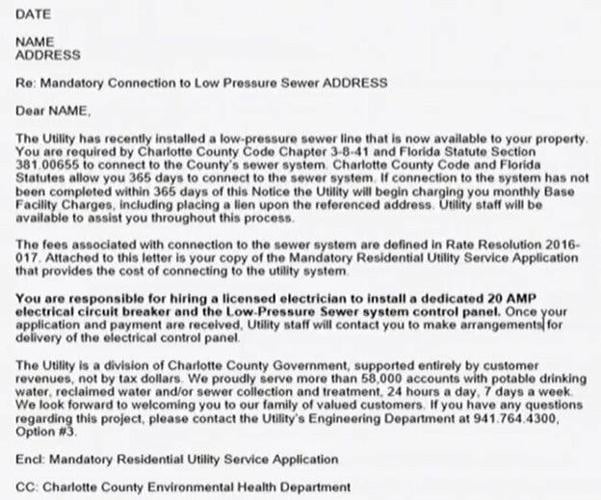
The original notices, mailed Sept. 24, did not include information about a loan program or an optional payment plan.
During the discussion among commissioners, Interim Utilities Director Claire Jubb and Weaver, officials also discovered the notices had not been sent by certified mail.
The letters informed property owners they had 365 days to pay the wastewater connection fee and 180 days to pay the water connection fee. If payment was not received within those timeframes, a lien would be placed on the property.
Weaver also presented a map of homes near Glen Avenue, but it did not clearly identify which properties were already connected to county utilities. Weaver said staff would verify the information and present an updated map later.
All five commissioners agreed to revisit the issue in September, when staff plans to present a loan program for residents unable to pay the connection fees upfront.

A sample notice sent to Charlotte County property owners outlines mandatory sewer and water connection requirements and payment deadlines. Commissioners voted July 23 to resend the notices by certified mail with updated rates and information about a loan program.
After that meeting, the county will resend the notices by certified mail with information about the loan program. Connection fees also will revert to the rates that were in effect before April 1.
Commissioner Stephen R. Deutsch said several residents had contacted him with concerns about the notices.
During the meeting, he urged homebuyers to carefully review closing documents during real estate transactions.
“If you’re dealing with a Realtor and member of the National Association of Realtors, their ethical practices require that they advise you of those types of things on your property.”
He added that closing agents or attorneys should disclose any additional costs, including mandatory connections to county utilities.
For now, the deadlines for paying the mandatory connection fees have been paused. The timelines will begin again after residents receive the revised notices.
(3) comments
It’s encouraging to see Charlotte County rolling back utility hookup fees and extending deadlines. Changes like these can ease financial pressure for homeowners and builders while giving people more flexibility to plan projects responsibly. Decisions that balance community growth with affordability usually create better long-term outcomes. I hope officials continue listening to residents and reviewing policies when needed, because practical adjustments like this show that local government can respond to real concerns in a positive, constructive way. This responsiveness builds trust across our growing community.
It’s encouraging to see Charlotte County rolling back utility hookup fees and extending deadlines. Changes like these can ease financial pressure for homeowners and builders while giving people more flexibility to plan projects responsibly. Decisions that balance community growth with affordability usually create better long-term outcomes. I hope officials continue listening to residents and reviewing policies when needed, because practical adjustments like this show that local government can respond to real concerns in a positive, constructive way. This responsiveness builds trust across our growing community.
There should a state law against new homes having a well or septic system. The cost for water and sewer installation in this article is less than what I paid for in 2002 when I built my home in the Estates. I will eventually have to redo my septic even though I have to have it pumped out every few years, only 2 people live here. My water system always need salt and the system always needs maintenance and repairs. Waking up at 5:30 AM to go to work and find out you don't have water due to one of the relays failing is a real bummer. Most important septic tanks are bad for the enviroment. My parents used to live in Tallahassee and whenever we went there we always went to Wukulla springs. About 20 years ago they started develping the surrounding area and although the spring itself is still clear the river it feeds is so murky they don't even have the glass bottom boat tour because the water is so murky do to leakage from all the septic tanks.
Welcome to the discussion.
Log In
Keep it Clean. Please avoid obscene, vulgar, lewd, racist or sexually-oriented language.
PLEASE TURN OFF YOUR CAPS LOCK.
Don't Threaten. Threats of harming another person will not be tolerated.
Be Truthful. Don't knowingly lie about anyone or anything.
Be Nice. No racism, sexism or any sort of -ism that is degrading to another person.
Be Proactive. Use the 'Report' link on each comment to let us know of abusive posts.
Share with Us. We'd love to hear eyewitness accounts, the history behind an article.