







Punta Gorda City Council convened an emergency meeting Dec. 9 after learning late last week that state Rep. Vanessa Oliver drafted legislation that would transfer potable water service for customers living outside the city limits to Charlotte County Utilities. The revelation prompted swift concern among city leaders, who questioned both the necessity of the proposal and the process behind it.
Council member Janis Denton, followed by Interim City Attorney Steven Leskovich, described the proposed transfer as “a hostile takeover.” City officials said they were caught off guard by the bill, which they fear could significantly alter the structure and financial health of Punta Gorda’s utilities system.
Utilities Director Tom Spencer told council members that removing customers outside the city limits would jeopardize the system’s revenue sufficiency and affect its ability to meet debt obligations. About 33% of the city’s potable water customers live outside municipal boundaries, Spencer said, making them essential to the system’s financial stability.

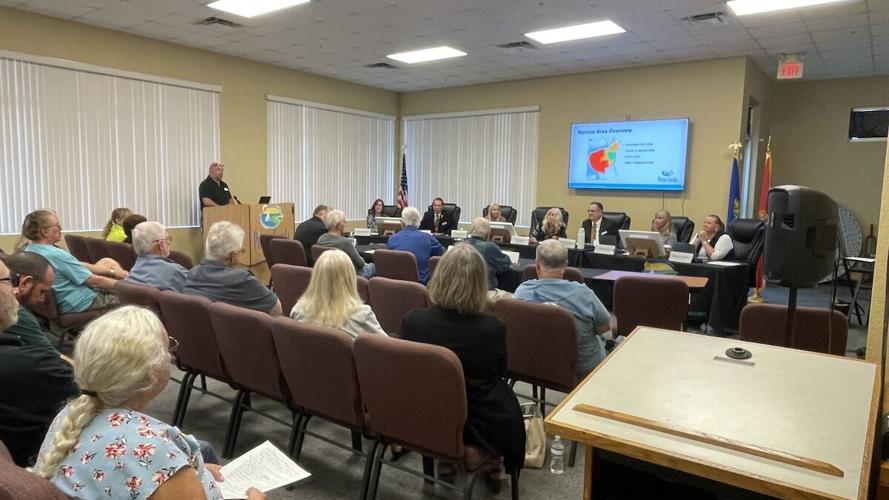
A Punta Gorda Utilities service-area map shown at the Dec. 9 emergency City Council meeting illustrates the regions affected by a proposed state bill. The orange and green sections — which include the city’s utilities plant, located in the orange zone — would be transferred to Charlotte County Utilities if the legislation advanced by state Rep. Vanessa Oliver is approved.
Vice Mayor Greg Julian said he contacted Oliver for clarification and was told that the Charlotte County Airport Authority and other entities believed development projects could not advance because of insufficient water capacity. But Leskovich, who serves on the airport authority, said he was unaware of any such concerns and had not heard of the airport pushing for the legislation. He also noted the city has not received complaints or requests regarding water supply shortages.
Spencer said Punta Gorda is prepared to meet the commercial and industrial demands expected in Enterprise Charlotte Airport Park and surrounding areas. He added that Charlotte County does not currently have the capacity or infrastructure to serve the areas that would be affected by the proposed legislation.

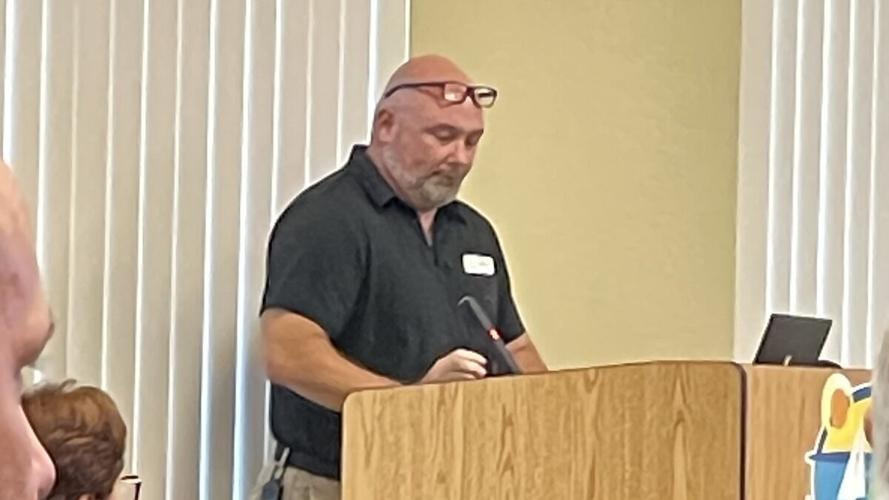
Punta Gorda Utilities Director Tom Spencer outlines how losing customers outside the city could jeopardize the utility system’s revenue and debt obligations.
Leskovich suggested that the initiative may be driven by special interest groups, developers or the county. But Julian said he had spoken with Charlotte County Commission Chair Joe Tiseo, who denied that the county initiated the effort. Council members, after contacting various officials, realized they were receiving conflicting explanations about the motivation behind the bill.
Denton said Punta Gorda has made substantial investments to upgrade water infrastructure, including expanding its Reverse Osmosis plant and increasing capacity by 200 million gallons per day. The proposed transfer, she said, contradicts the city’s long-term planning efforts and could undermine the stability of its utilities system.

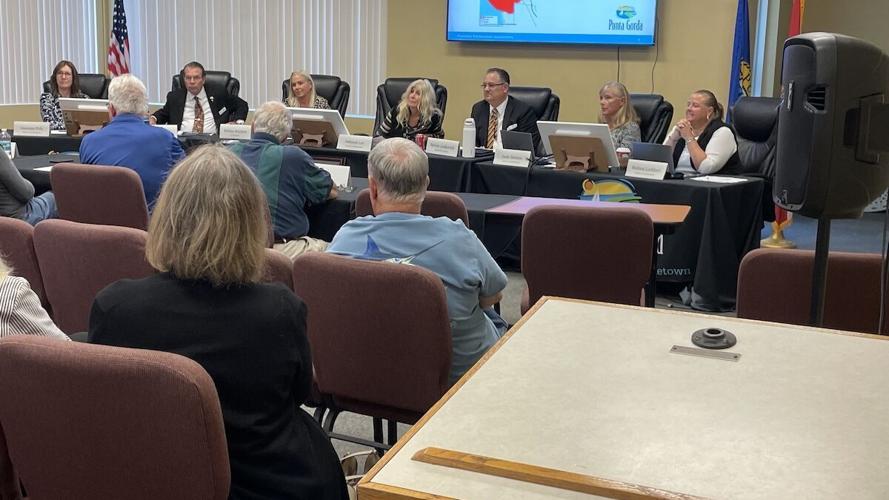
Residents filled the room at the Laishley Community Center on Dec. 9 as Punta Gorda officials detailed their concerns about proposed legislation transferring water customers to Charlotte County.
Council members and Leskovich discussed potential worst-case scenarios, including the possibility that Charlotte County could attempt to seize or purchase the city’s utility plant, which is located outside the city limits. Under such a scenario, the city could be forced to buy water from a facility it once owned.
Mayor Debi Lux said she believed the county wants control of the utility system by “taking over the plant,” calling the situation deeply concerning for the city and its residents. The debate comes as Punta Gorda continues to grapple with earlier legislation that shifted oversight of its 911 call center to the Charlotte County Sheriff’s Office, despite strong objections from residents and city leaders.

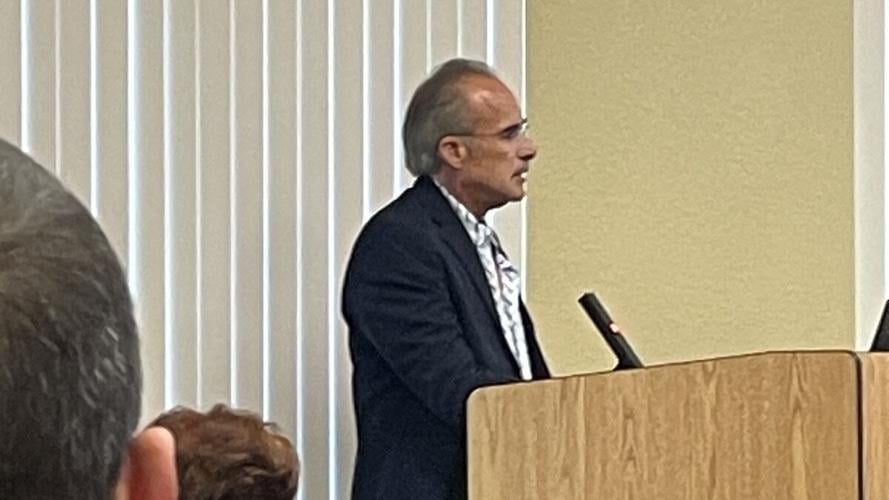
John Fleming, co-founder of the Burnt Store Corridor Coalition, urges Punta Gorda officials to oppose the proposed water service transfer, arguing Charlotte County has underfunded its utility system.
Despite the short notice, about two dozen residents attended the Dec. 9 emergency meeting at the Laishley Community Center to oppose the proposal. John Fleming, co-founder of the Burnt Store Corridor Coalition, criticized the county for failing to raise its tap fees — charges for new water or sewer connections — since 2018. He said Charlotte County’s tap fee is $2,900, among the lowest in Florida, and should be closer to $7,910. “Charlotte County is using you as a fall guy to bail them out,” Fleming told Council.
Resident Rick Perry, who said he spent two decades working for the federal government, questioned the speed and secrecy of the proposal. “When something comes up this fast and you are blindsided, there’s something going on,” he said.
Council members said they plan to meet with county leaders to continue discussions. The legislation remains in draft form and could change, council member Jeannine Polk said. She shared the current version of the bill, titled the “Punta Gorda Utility District Boundary Codification and Utility Transfer Act.”
A portion of the draft reads: “Charlotte County is prepared to assume responsibility for potable water utility operations within the district immediately, while the transition of wastewater utility functions will require additional time.”
(0) comments
Welcome to the discussion.
Log In
Keep it Clean. Please avoid obscene, vulgar, lewd, racist or sexually-oriented language.
PLEASE TURN OFF YOUR CAPS LOCK.
Don't Threaten. Threats of harming another person will not be tolerated.
Be Truthful. Don't knowingly lie about anyone or anything.
Be Nice. No racism, sexism or any sort of -ism that is degrading to another person.
Be Proactive. Use the 'Report' link on each comment to let us know of abusive posts.
Share with Us. We'd love to hear eyewitness accounts, the history behind an article.