







The outcome of Charlotte County’s Legislative Delegation meeting Dec. 17 delivered a setback for Punta Gorda and county officials who urged state lawmakers to withdraw proposed legislation that would redraw boundaries for delivering potable water to customers outside city limits.
Despite repeated pleas from local officials and residents, the legislative committee, chaired by state Rep. Danny Nix Jr., voted to advance the Punta Gorda Utility District Boundary Codification and Utility Transfer Act, drafted by state Rep. Vanessa Oliver. Under the bill, potable water service for customers outside Punta Gorda city limits would be transferred from Punta Gorda Utilities to Charlotte County Utilities, with wastewater facilities to follow at a later date.
The decision drew an emotional response from some residents in attendance, several of whom criticized lawmakers and vowed to work to remove them from office. Tensions were heightened by conflicting accounts from local officials and Oliver about how and why the legislation was introduced.

A Punta Gorda Utilities service-area map shown at the Dec. 9 emergency City Council meeting illustrates the regions affected by a proposed state bill. The orange and green sections — which include the city’s utilities plant, located in the orange zone — would be transferred to Charlotte County Utilities if the legislation advanced by state Rep. Vanessa Oliver is approved.
Punta Gorda officials have said they were “blindsided” by the bill, which they contend surfaced abruptly. During a special meeting called by the county Dec. 16, City Manager Melissa Reichert said she first became aware of the proposed legislation Dec. 4. At an earlier Charlotte County Commission meeting, Commissioner Stephen R. Deutsch said Oliver contacted him several weeks earlier and told him she had not reached out to other commissioners or county officials.
Oliver addressed those concerns directly during the delegation meeting, explaining how the issue came to her attention. Her father, Michael Grant, a former Florida legislator, sat in the audience as she spoke.
Oliver said she first met with the city’s lobbyist Oct. 2 and that “based on the gravity of what she shared with me, the very next morning I met with the city manager and the city’s utility director to better understand the situation.” Holding paperwork, she added, “The city subsequently followed up by sending me a former letter approved by a vote of the City Council detailing both the scope and the urgency of the issue and seeking state involvement.”

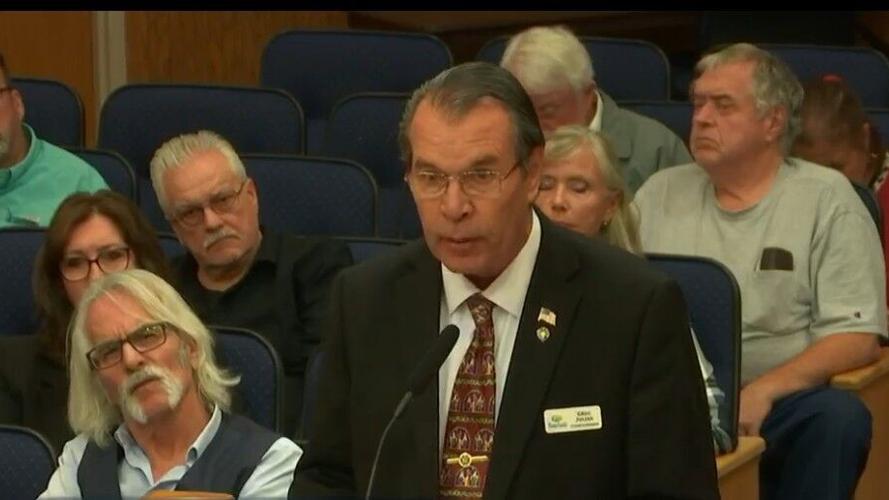
Charlotte County Commissioner Stephen R. Deutsch listens during the Dec. 16 legislative delegation meeting, where lawmakers advanced a bill despite objections from Punta Gorda officials.
Oliver said the city stated in that request that it was facing “an urgent challenge to maintain a safe, reliable and sustainable water supply for its residents.”
City officials disputed that characterization. Punta Gorda Utilities Director Tom Spencer told county officials the previous day that the city has “legally established a utility service area that includes land outside city boundaries.” He said the service area, which accounts for about 33% of Punta Gorda’s potable water customers, was codified by ordinance in 1984 and reaffirmed through Ordinance 1860-16 pursuant to Florida Statute Chapter 180.
The city’s authority to serve those areas, Spencer said, “is lawful, documented and has guided decades of infrastructure investment and regional planning.” That explanation prompted some county commissioners to pause and reconsider the bill, after several had initially expressed support.
Spencer said Punta Gorda has invested heavily in water infrastructure, including $197 million to build treatment facilities capable of producing 14 million gallons per day. However, he explained that the Southwest Florida Water Management District imposed minimum flows and levels restrictions on the lower Shell Creek reservoir, limiting how much of that capacity can be used during dry periods. As a result, the city cannot fully utilize the capacity it has already constructed.
City Council member Jeannine Polk said the system is capable of producing 14 million gallons per day, but only 4 million gallons per day can currently be drawn from Shell Creek, with another 4 million gallons per day produced by the city’s reverse osmosis plant. The city is in the process of expanding its reverse osmosis plant and other facilities to accommodate growth in its service areas.
Council member Greg Julian said he asked Oliver whether the city could receive relief from the limits placed on withdrawals from Shell Creek. He said Oliver told him she would look into it but was “skeptical” such a plan would be approved.

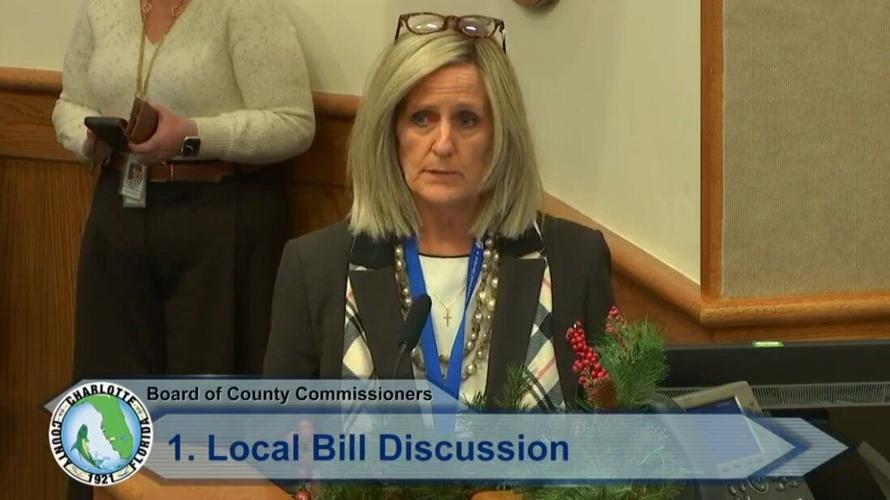
Charlotte County Assistant Administrator and Acting Utilities Director Claire Jubb outlines potential infrastructure and cost challenges if the proposed water utility transfer moves forward.
At the county’s special meeting Dec. 16, commissioners invited public comment along with input from Punta Gorda’s five City Council members and city officials. Both county and city leaders said they wanted clarity on how the legislation originated and what the financial consequences would be. Officials on both sides agreed the proposal would impose significant costs.
County Assistant Administrator and Acting Utilities Director Claire Jubb said there were many unknowns, but the county would be responsible for planning, designing and constructing interconnections, new lines and related infrastructure to ensure a smooth transition for customers.

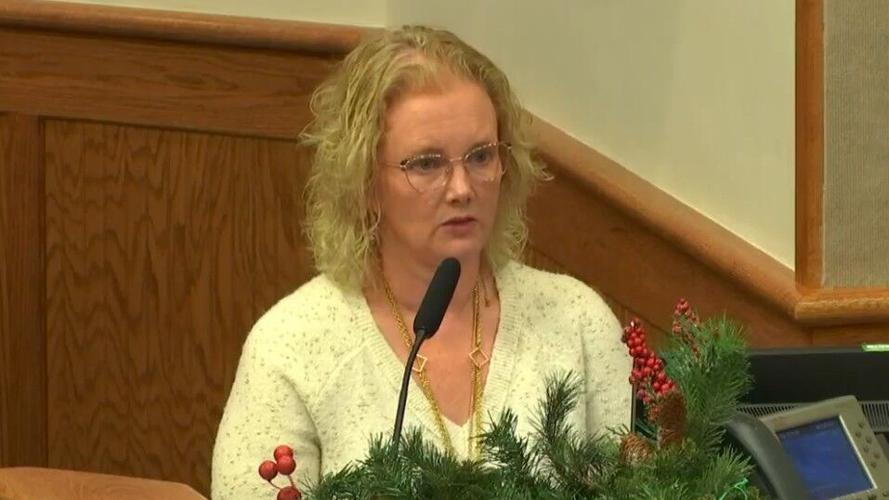
Charlotte County Economic Development Director Kay Tracy addresses lawmakers Dec. 16 while discussing concerns raised by property owners in the Enterprise Charlotte Airport Park area, which is served by Punta Gorda Utilities.
County officials denied initiating the legislation, but comments from the county’s Director of Economic Development Kay Tracy shed light on possible motivations. Tracy said her office had heard from large property owners in the Enterprise Charlotte Airport Park area — which is served by Punta Gorda Utilities — that services were not available. She said one large property owner reported inadequate water pressure that, at times, forced operations to shut down.
Julian countered that shifting service would severely impact Punta Gorda’s ability to meet its financial obligations, noting again that roughly one-third of the city’s utility customers live outside city limits.
As the meeting concluded, Nix said the legislation “was not a done deal,” signaling that debate over the bill is likely to continue as it moves through the legislative process.
(0) comments
Welcome to the discussion.
Log In
Keep it Clean. Please avoid obscene, vulgar, lewd, racist or sexually-oriented language.
PLEASE TURN OFF YOUR CAPS LOCK.
Don't Threaten. Threats of harming another person will not be tolerated.
Be Truthful. Don't knowingly lie about anyone or anything.
Be Nice. No racism, sexism or any sort of -ism that is degrading to another person.
Be Proactive. Use the 'Report' link on each comment to let us know of abusive posts.
Share with Us. We'd love to hear eyewitness accounts, the history behind an article.