
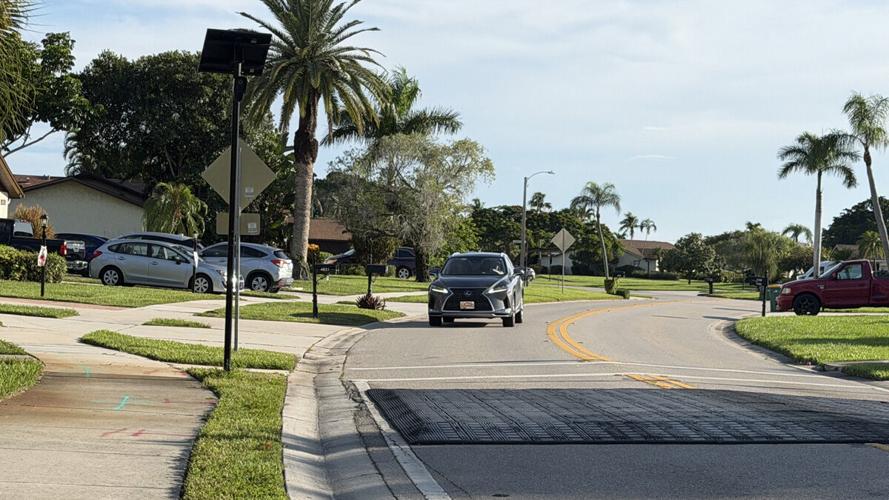


An automated license-plate reader monitors traffic on Lakewood Boulevard in East Naples. The Collier County Sheriff’s Office will remove 72 ALPR cameras located on state-owned property.
Due to pushback over privacy concerns, misuse and data breaches involving automated license-plate reader camera technology, the Florida Department of Transportation has ordered the removal of all ALPRs on state roadways and rights of way.
An Aug. 31 FDOT memo gives local law enforcement agencies 30 days to remove all operational ALPR cameras. If they aren’t removed within 30 days, FDOT will remove them. The agency also revoked all ALPR permit approvals in state rights of way.
Collier County Sheriff Kevin Rambosk told the Board of County Commissioners on Sept. 8 his agency will be removing 72 cameras on state-owned property, about 31% of all cameras on county roads, excluding streets in the cities of Naples and Marco Island. The cameras use computer algorithms to convert license-plate images into searchable, computer-readable data.
Rambosk assured commissioners there have been no data breaches, and no employees have misused the technology because safeguards are in place. This year, he said, ALPRs have helped solve more than 500 major cases, including those involving missing or endangered people, people with Alzheimer’s and homicides.
Data is stored for 14 days, he said, but if his agency’s ALPR manufacturers recommend shorter storage periods, they’d comply.
“You’re not able to see inside a vehicle, you’re not able to identify the driver of a vehicle, but the best you can do is maybe a color, maybe a type and the license plate itself,” Rambosk said, adding ALPRs don’t track the “intimate pattern” of a person’s life. “You can leave your house. Maybe you never go by one, maybe you go by one. We can’t tell if you’re going to Publix, we can’t tell if you’re going to the beach, we can’t tell where you’re going because it doesn’t do that.
“You can be driving all over the county. We’re not looking at anything. Nobody’s looking at anything. But if you call in and report that your car’s been stolen, we can then access that information and at least try and find its last location in the county.”
He pointed out that their use has been upheld by courts nationwide, including locally, and that ALPRs don’t track movements like cellphone data does.

Collier County Sheriff Kevin Rambosk addresses county commissioners Sept. 8 about automated license-plate reader cameras. The Sheriff’s Office will remove 72 cameras from state-owned property following an FDOT order.
Use is monitored
The agency’s internal affairs division conducts inspection-compliance investigations every 30 days to determine if the system is being used properly, he said, and staff is drafting state legislation it will bring to the Florida Sheriffs Association to submit to the Florida Legislature. Rambosk said the intent is to codify rules, regulations, limits, policies and procedures that will be as stringent as state and federal systems in protecting information yet allow law enforcement to access data when needed.
Collier owns the data and doesn’t share it unless requesting agencies adhere to similar standards. Due to strict policies and procedures developed over time, Rambosk said, many agencies have requested CCSO’s policies and procedures.
“And that’s good because we like doing that. We want to be on the forefront of how we protect our community,” Rambosk said.
After his presentation, 27 public speakers — many wearing “Get the Flock Out” emblems — spoke out against ALPRs, urging the sheriff and commissioners to remove them countywide. Most called them Flock cameras, although the sheriff said none are manufactured by Flock Safety. Others contended the cameras track drivers, despite the sheriff saying they aren’t live feeds that track drivers. Many suggested Collier was heading toward being like communist Russia or China, with county residents’ privacy being invaded.
“We’ve apparently decided that every time you drive to work or drive to the grocery store or drive to your doctor’s office, your church, your political meeting, or your friend’s house, your movements can be part of the surveillance system,” June Sanson told commissioners, questioning whether there are more cameras in Black or brown communities.
Commission Chair Dan Kowal, a retired sheriff’s detective, noted the county has installed hundreds of other traffic cameras. Transportation Management Services head Trinity Scott said the county uses 390 other cameras, 285 for traffic monitoring, while the rest are detection cameras that can detect accidents and speeders but don’t record. Employees monitor those for accidents and traffic congestion, she said, and adjust traffic signal timing to increase movement.

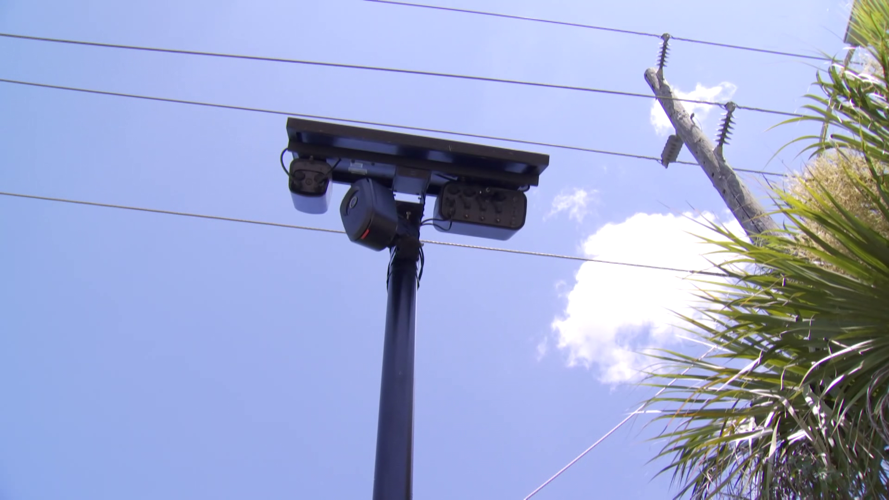
An automated license-plate reader camera is mounted along a roadway. The Florida Department of Transportation has ordered ALPR cameras removed from state roadways and rights of way.
State order issued
The state order came days after Gov. Ron DeSantis cited his concerns during a press conference, calling the increase in cameras “out of control.” News media have documented cases of officers misusing the data to stalk romantic partners and exes; officers were recently arrested in Sarasota, Haines City and Sumter County.
“While Florida law limits the issuance of permits for LPR systems to law enforcement agencies, the recent exponential increase in deployments along our roadways, coupled with concerning reports of misuse, data-privacy concerns and surveillance schemes merit immediate action to preserve Floridians’ sovereignty and quality of life,” FDOT’s memo and order said.
In response to the order, Flock Safety, the nation’s largest ALPR provider, issued a statement: “Rather than banning a critical public safety tool, we support thoughtful legislation and strong privacy, transparency and accountability guardrails that ensure technology is used responsibly while preserving law enforcement’s ability to use effective tools to keep people safe.”
Last month, Flock cut default data retention to seven days, made misuse detection mandatory for customers and urged other ALPR providers to meet the same standard.
Florida’s order only applies to public right-of-way installations, not city or county roads. It also doesn’t affect privately owned and operated ALPRs at businesses, commercial properties and private developments.
Some Florida law enforcement agencies are considering removing cameras or reconsidering contracts with Flock, Motorola Solutions and Axon, and Cape Coral discontinued its cameras after a decade of use. They’re not just used by law enforcement; The Moorings and Royal Harbor communities in Naples installed their own private ALPRs.
More than a decade of use
Naples and Collier County began installing ALPRs in 2015, and when cameras began recording countywide in 2021, Marco Island Police noted they were instrumental in helping the Sheriff’s Office find a missing autistic teenager. Others credit them with solving crimes and capturing fleeing murder suspects.
Naples Police have installed at least 154 cameras citywide, and the Sheriff’s Office has more than 230 Axon and Motorola Vigilant cameras in the county’s unincorporated areas. Under state law, the exact number of cameras that have been installed is confidential.
Rambosk has said they will comply with the order. Naples Police Lt. Bryan McGinn said the order only affects a “limited number of sites” citywide, and they will comply.
The City of Marco Island issued a statement, saying it uses ALPR technology on city roads at or near island entrances, so its cameras aren’t affected, and it doesn’t use Flock.
“Our police department uses a different ALPR system to help officers locate vehicles connected to crimes and other public safety concerns,” Police Chief Joseph Belardo said.
Three Marco Island residents who sued the city over its Motorola Vigilant Security Systems ALPRs and lost in U.S. District Court in Fort Myers appealed the case to the U.S. Court of Appeals for the Eleventh Circuit in Atlanta. They argue the cameras monitor residents’ movements, and the city retains the records for an extended period.
After the city posted the news on Facebook, many applauded police for not bowing to pressure and keeping the city safe, while a few questioned how long police were storing data and what agencies can access it.
To monitor where Flock and other ALPR cameras are, check deflock.org.
(1) comment
I recently noticed that ALPR's are in the Whole Foods parking lot at Mercato. Not sure if they are operated by Whole Foods or Mercato....but they are there.
Welcome to the discussion.
Log In
Keep it Clean. Please avoid obscene, vulgar, lewd, racist or sexually-oriented language.
PLEASE TURN OFF YOUR CAPS LOCK.
Don't Threaten. Threats of harming another person will not be tolerated.
Be Truthful. Don't knowingly lie about anyone or anything.
Be Nice. No racism, sexism or any sort of -ism that is degrading to another person.
Be Proactive. Use the 'Report' link on each comment to let us know of abusive posts.
Share with Us. We'd love to hear eyewitness accounts, the history behind an article.