
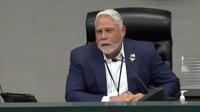

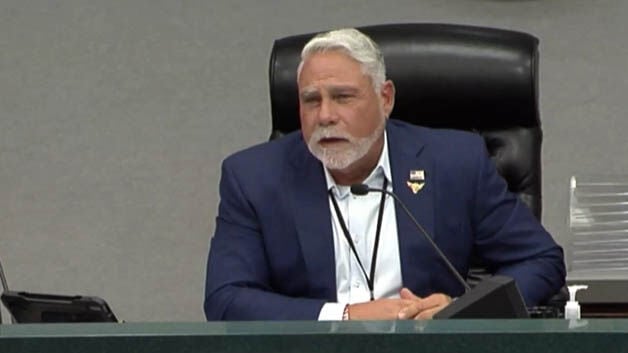
Collier County Commission Chair Dan Kowal speaks during the Sept. 17 budget hearing. Kowal supported reducing Conservation Collier’s millage rate, saying the county was lowering the amount collected from taxpayers rather than taking existing money from the conservation program.
Despite overwhelming opposition from environmentalists and residents, Collier County commissioners approved a $3.187 billion 2026-27 budget, averting a modest tax increase by reducing Conservation Collier taxes to reach the countywide rollback rate.
At its final budget hearing Sept. 17, the Board of County Commissioners voted 3-2 to reduce the Conservation Collier millage rate to 0.1772 to provide a countywide millage rate of 3.2125. One mill is equal to $1 for every $1,000 of a property’s taxable value after adjustments, including a homestead exemption. The fiscal year starts Oct. 1.
The $5,517,000 reduction in ad valorem taxes to Conservation Collier, a land-acquisition program, means funding will be reduced from $35,690,500 to $30,173,500, while land capital would drop from $37,396,300 to $32,155,200, according to a presentation by Christopher Johnson, the county’s director of Financial & Management Services. The fund stands at $22 million, with interest accruing.
Since its inception in 2003, Conservation Collier has preserved 6,672 acres across 28 project areas.
“Conservation Collier has never had a funding problem. It didn’t then, it doesn’t now, and it won’t ever,” Commissioner Chris Hall, who was behind the proposal, said of reducing taxes to the program. “The problem and the limiting factor with Conservation Collier … is a seller availability problem. We simply don’t have the willing sellers to sell to us … to match the amount of money that we’ve raised for the program.”
He noted $18 million was spent last fiscal year on acquisitions and more than $12 million this year, most on the Bonita Estero Rail Trail, or BERT.
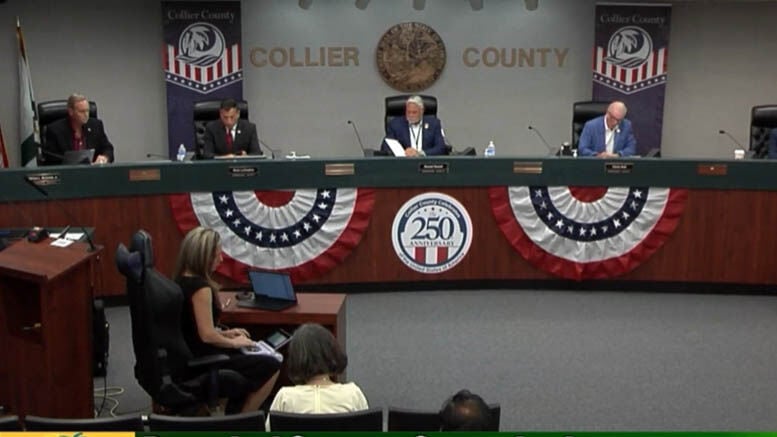
Collier County commissioners hold their final budget hearing Sept. 17. The board voted 3-2 to approve a $3.187 billion fiscal 2026-27 budget and reduce Conservation Collier’s millage rate to help reach the countywide rollback rate.
Commission Chair Dan Kowal told environmentalists and others who packed commission chambers that no funds were being taken from Conservation Collier.
“I’m not taking anything out of Conservation Collier, let’s just be clear,” Kowal said. “We’re just leaving it in the people’s pockets. We’re not taking it from the people. We’re just lowering their millage rate.”
In 2023, commissioners took $53.5 million from Conservation Collier and cut the program’s millage rates to cover a more than $60 million budget shortfall. Only $29.6 million was used, but it was never paid back, angering environmentalists and residents — and some commissioners. The next month, commissioners approved a resolution allowing them to take money from the land-conservation program at any time, if needed, for any use.
Commissioners struggled with the decision at the first budget hearing, asking for more data. The cut to Conservation Collier means a taxpayer with a $400,000 home would see a reduction of just $12.96 in taxes.
“The bottom line is prioritization of the available tax monies that we … collect from our taxpayers has to be put into infrastructure,” said Vice Chair Bill McDaniel Jr. “I don’t think any of us believe at all that conservation is not an imperative portion of our community. Infrastructure is where it’s at, and that’s what we have to really be focused on as we go forward.”
Commissioners Burt Saunders and Rick LoCastro voted nay, urging commissioners to leave taxes millage neutral, at the same tax rate as this year — not taxing more than 3.0107 mills for the general fund.
Saunders noted they’d made many improvements this year to ensure quicker land acquisitions, but that doesn’t justify reducing funding.
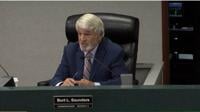
“This is not a program that’s just to benefit those of us that are here now,” Saunders said. “This is for future generations of Collier Countians. This is a program that is a method for us to make sure that we have the open space, the areas that need to be preserved are preserved for future generations. … It’s a program that goes on into perpetuity.”
They all want to go to the rollback millage rate, the “politically right thing to do. That’s sending a message to our taxpayers that we’re conscious of the struggles that folks are having. We want to do that, but I believe that can turn out to be irresponsible if we’re not careful.”
He pointed to Marco Island boasting about going to the rollback millage rate “year after year after year,” and now being forced to put a tax initiative on the ballot to fund road work because the city doesn’t have the funds for infrastructure. “We’re likely to get hit pretty hard in November,” Saunders warned.
He referred to Amendment 3, a November ballot referendum that, if passed, would increase the homestead exemption for nonschool property taxes to $150,000 in 2027 and $250,000 in 2028, with annual inflation adjustments beginning in 2029. It also would reduce the annual assessment cap on nonhomestead property from 10% to 5%. Because residents want lower taxes, Saunders predicted it would pass.
“If that happens, then we are looking at rolling the millage rate back again this year, having the exemptions increase because of a constitutional amendment, and we’re going to be in some financial difficulty,” Saunders said.
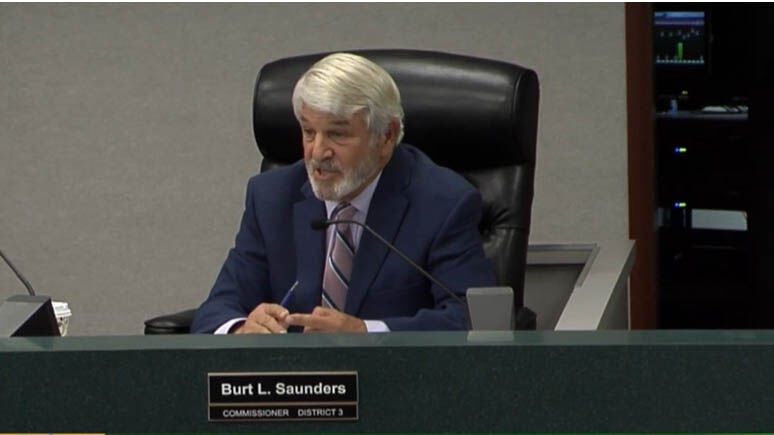
Collier County Commissioner Burt Saunders speaks during the Sept. 17 final budget hearing. Saunders opposed reducing Conservation Collier’s millage rate, warning that insufficient long-term funding could eventually affect the county’s quality of life.
“My concern is that if we don’t maintain proper funding, then over a period of time — I’m not talking about this year or next year or the year after, but down the road — you’re going to start to see that quality of life eroding,” he cautioned. “You’re going to see it eroding because we’re not going to be able to fund our libraries. We’re not going to be able to keep our parks the way they are if we’re not careful.”
LoCastro noted the county is fortunate to have the Conservation Collier fund, but “as we hear from a lot of constituents, it’s not really supposed to be a piggy bank. It’s not a discretionary fund.”
He noted they’d used the funding “in times of emergency, and maybe this is one,” but said the county should advertise what it intends: “We’re going to put less money in Conservation Collier, and that’s going to allow us to go to the rollback rate, or we’re just going to roll back the millage rate and not touch any other funds.”
Doing both is unique, he said, adding most residents he heard from feel Conservation Collier is an important program and that commissioners already tinkered with it. “We more than tinkered with it. We took from it. Is this another tax year where we should be doing that?” he asked.
He noted many constituents who emailed him believed they’d get a “major tax reduction” if commissioners reduced taxes to Conservation Collier, “but I think we know we have too many responsibilities on the table to be able to do that.”
The evening hearing lasted nearly 3½ hours, with 24 speakers representing 29 residents, conservationists and others, including environmentalists from Lee and Broward counties, Conservancy of Southwest Florida, Conservation Collier, Audubon Florida and Audubon Western Everglades. Only three speakers were in favor of reducing funds to Conservation Collier.
The supporters noted the county wasn’t taking from the program, just reducing taxes to residents because it’s a well-funded program.
“It seems every year we go through this same conversation about Conservation Collier and I am going to say it again, as I have in the past few years, that the voters in the November 2002 referendum voted to a property tax increase up to 0.25 mills and not just a blanket 0.25 mills to fund Conservation Collier,” said Kathi Meo, treasurer of the Collier County Republican Executive Committee. “So, the proposal to fund $30 million instead of $35 million … is not going against what the voters — yes, one third of the taxpayers who actually voted — voted for.
“I’m not against conservation whatsoever, but to be real, Conservation Collier has more than a healthy balance,” she added.
(0) comments
Welcome to the discussion.
Log In
Keep it Clean. Please avoid obscene, vulgar, lewd, racist or sexually-oriented language.
PLEASE TURN OFF YOUR CAPS LOCK.
Don't Threaten. Threats of harming another person will not be tolerated.
Be Truthful. Don't knowingly lie about anyone or anything.
Be Nice. No racism, sexism or any sort of -ism that is degrading to another person.
Be Proactive. Use the 'Report' link on each comment to let us know of abusive posts.
Share with Us. We'd love to hear eyewitness accounts, the history behind an article.