


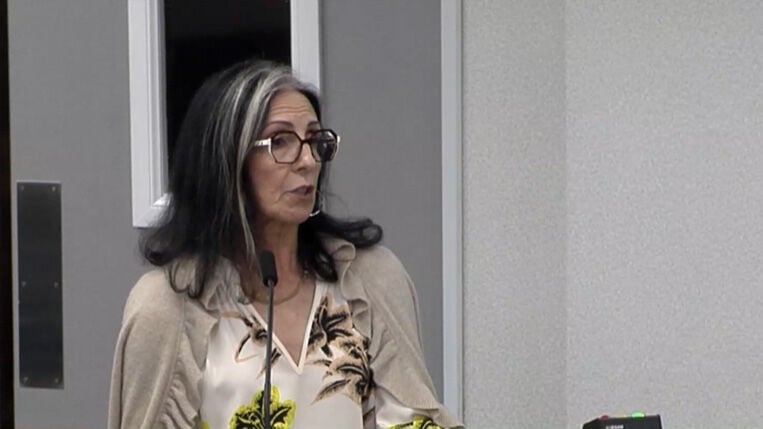
Conservation Collier Land Acquisition Advisory Committee Chair Michele Lenhard addresses Collier County commissioners Aug. 25. Lenhard urged commissioners to preserve the advisory committee’s role and allow it to review proposed changes before the board’s next vote.
After pushback from environmentalists and residents, Collier County commissioners agreed to take more time to consider amending the Conservation Collier program, while assuring the public they were not weakening its rules in an effort to end it.
After a roughly hourlong hearing, the Board of County Commissioners on Aug. 25 agreed to postpone a decision until October to allow staff to consider suggestions from the public and commissioners and ensure everyone is reading the same version of the proposed changes and can provide input.
“The intention is to keep the program, make it robust, make it better,” Commissioner Chris Hall said after some speakers accused commissioners of trying to end or weaken the program. “In no way, form or fashion are we looking to violate the voters and get rid of this program. … I want to make it very clear that we’re keeping this program, and the intention is to make it better.”
Hall said any “enhancements” to properties would give the county the ability to create horseback riding, a petting zoo and “things that have public benefit … just like hiking.” He maintained they’d keep the integrity of the program voters approved and denied they were removing the Conservation Collier Land Acquisition Advisory Committee’s authority.
“The CCLAAC never had authority, not one time, ever,” he said. “They’re an advisory committee to us, and we value that advice, and we’re not saying that they can’t bring that to us ever. We’re just streamlining the process so that we can get rid of the big bureaucracy and the slow timeline that it takes to act on purchasing property. … We will respect what the CCLAAC has to bring to us.”
Conservation Collier began in 2003 after county residents, in a November 2002 voter referendum, approved creating a taxpayer-funded land acquisition program, agreeing to a property tax increase of up to 0.25 mills — $25 per $100,000 of taxable property value — for up to 10 years and bonding for up to $75 million. Residents overwhelmingly supported it during three referendums, most recently in 2020, when 77% of voters approved it.
Since then, 2,333 more acres have been acquired, resulting in 6,672 acres as of this month, including lands for recreation and hiking. The program helps protect water quality and wildlife habitat and provides recreation areas, including Freedom Park, Pepper Ranch and Gordon River Greenway.
Up to 75% of all revenues collected were initially used for land acquisition, while 25% was used to manage properties. But in 2020, commissioners changed that to 65% for acquisition, 25% for maintenance and 10% for amenities, including boardwalks, parking and programming.
What upset the public and conservationists was the county dipping into Conservation Collier funds and using the money for a different purpose than voters approved.
In September 2023, commissioners “borrowed” $53.5 million from Conservation Collier and cut the program’s millage rates to cover a more than $60 million budget shortfall — prompting an outcry from residents and environmentalists. In the end, $29.6 million was used, but it was never paid back, and Hall contended it wasn’t intended to be a loan.
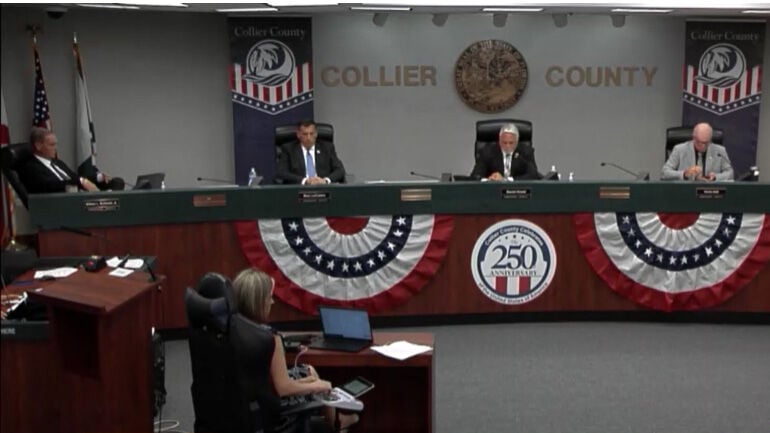
The Collier County Board of County Commissioners considers proposed changes to the Conservation Collier program during its Aug. 25 meeting. Commissioners postponed a decision until October to allow more time for public and staff input.
The next month, commissioners approved a resolution allowing them to take money from the land conservation program at any time, if needed, for any use.
But the land acquisition process had always been slow, wending through voluntary submissions, the CCLAAC public hearing process, staff recommendations, a public hearing and County Commission approval. Commissioner Rick LoCastro pushed to speed the process, and now, instead of a ranking of A, B and C properties, there’s only an A ranking for properties recommended for purchase.
Last fall, commissioners approved several amendments, including revising the program’s purchasing policy to use the lower appraisal value instead of an average when multiple appraisals are obtained, allowing appraised values to serve strictly as a ceiling rather than a required offer amount. Offers must account for verified lower listing prices. New zoning and location criteria were added to property evaluations while maintaining flexibility for parcels with exceptional conservation value.
Proposed amendments include removing the issuance of bonds as an authorized disbursement from Conservation Collier funds, allowing conservation easements to be vacated or allowing an easement-use agreement, simplifying language to allow any person or organization to nominate a parcel for consideration and removing a requirement for commissioners to vote on the active acquisition list before obtaining appraisals or making offers.
What prompted the greatest outcry was removing the CCLAAC’s responsibility if there weren’t enough funds to acquire properties and removing a provision that permanently extinguished all development rights on the properties, which could allow future development.
Brad Cornell, policy director for Audubon Florida and Audubon Western Everglades, thanked Commission Chair Dan Kowal for meeting with them to discuss the changes but said clarifications were still needed, such as defining “enhanced program” and explaining the easement vacation process.
“Why would we have bought an easement if we’re going to turn around and vacate it?” Cornell asked. “That scenario … would be for some sort of conservation gain that they were going to trade for another parcel that was more valuable. … That’s not what this says, so if that’s what you intend … that ought to be stated in the amendment.”
He also urged them to keep the CCLAAC in the process, as Audubon recommended, citing its valuable experience and expertise. He objected to sunsetting the program, noting it doesn’t have to go to another voter referendum because commissioners have the authority to continue it.
CCLAAC Chair Michele Lenhard cited some needed changes and clarifications and said the working document didn’t show redlined changes. She urged commissioners to keep the advisory committee even after the program sunsets and asked staff to allow the CCLAAC to review the proposed changes and provide input before their next vote.
“While final authority rests with the board, we feel an advisory committee review provides an opportunity for public input and an early public reaction to critical aspects and direction of this program, and we do not feel it should be removed,” Lenhard added.
Dylan Scott, a prescribed fire specialist and conservationist who plans and coordinates fire operations for the Everglades ecosystem, called some changes “extremely alarming,” such as vacating easements and removing the provision that prohibits development.
“It seems like the Commission wants to really trend down the effectiveness of Conservation Collier, similar to how in the state legislature, we’ve seen Florida Forever be defunded and the adequacy of that conservation program is pretty much nonexistent given this year’s budget allocations,” Scott said.
He contended it was extremely important to prioritize land conservation as the county develops and faces more impacts from extreme weather events and drought.
“It seems like we want to keep pushing into the wildlands and developing more of these untouched natural areas, but I want to reiterate the importance to prioritize purchasing these conservation properties in order to buffer the community from these impacts of climate change and changing conditions,” he added.
Commissioner Burt Saunders commended LoCastro for streamlining the program but said he had some “very serious concerns” about the direction they were going in now. He noted there were three different drafts, different line numbers and copies that have caused confusion.
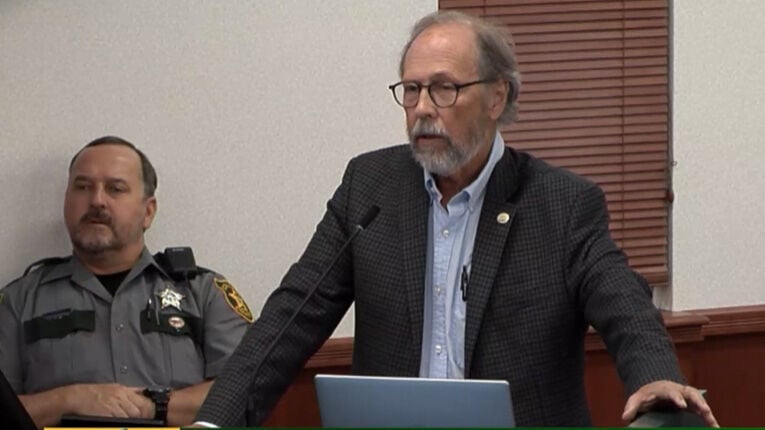
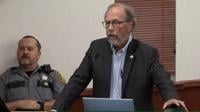
Brad Cornell, policy director for Audubon Florida and Audubon Western Everglades, addresses Collier County commissioners Aug. 25 as Jaime Cook looks on. Cornell sought clarification on proposed Conservation Collier changes involving conservation easements and urged the county to retain citizen advisory review.
“I don’t consider this to be gutting the program or anything of that nature, but I don’t consider it fixing the program,” Saunders said. “I am very concerned about taking the public comment out of this process. … I think having that citizen committee is absolutely critical to our decision-making.
“Sure it slows things down, but Commissioner LoCastro and the board have gone a long way to fixing that problem with the slowness of us being able to decide on a parcel,” he said. “I like continuing to fix that process. I just don’t like taking the position that we’re taking the citizens out of the process.”
He also cited concern over an amendment that would allow commissioners to nominate parcels, which would then be evaluated by staff. Commissioners have a lot of influence on staff, he said, and that could create potential conflicts or abuse, maybe not with this board but in the future. He suggested staff create a draft of redlined amendments so everyone could easily see the proposed changes.
An exact date hasn’t been set for the next public hearing.
(0) comments
Welcome to the discussion.
Log In
Keep it Clean. Please avoid obscene, vulgar, lewd, racist or sexually-oriented language.
PLEASE TURN OFF YOUR CAPS LOCK.
Don't Threaten. Threats of harming another person will not be tolerated.
Be Truthful. Don't knowingly lie about anyone or anything.
Be Nice. No racism, sexism or any sort of -ism that is degrading to another person.
Be Proactive. Use the 'Report' link on each comment to let us know of abusive posts.
Share with Us. We'd love to hear eyewitness accounts, the history behind an article.