





Suffolk Construction’s Jobsite of the Future space supports the company’s AI work on the $1.2 billion Phase 2 Terminal Expansion project at Southwest Florida International Airport. The RSW project is one of eight Suffolk jobsites nationwide with the designation.
The next wave of large-scale construction projects across the area will be among the first of a new era. Artificial intelligence hasn’t just arrived on the fringes of construction; some of Southwest Florida’s largest builders already are putting it to work.
Suffolk Construction, Stevens Construction and DeAngelis Diamond are among the national and local companies investing heavily in AI.

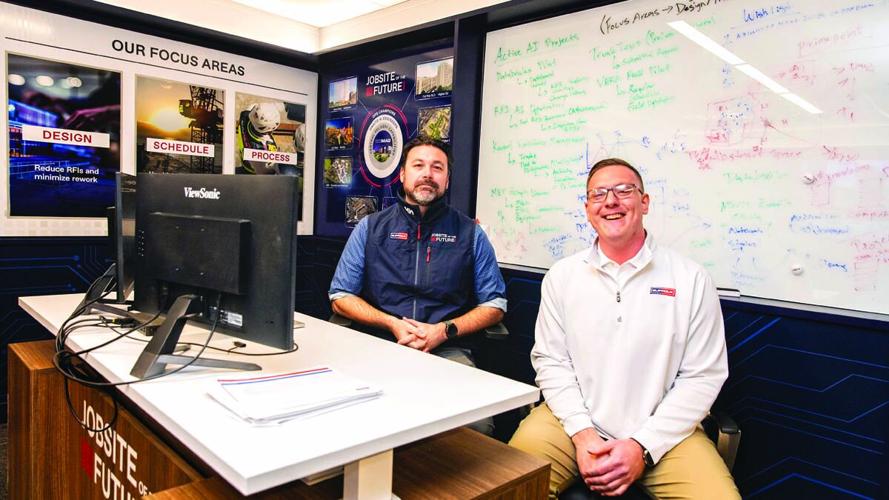
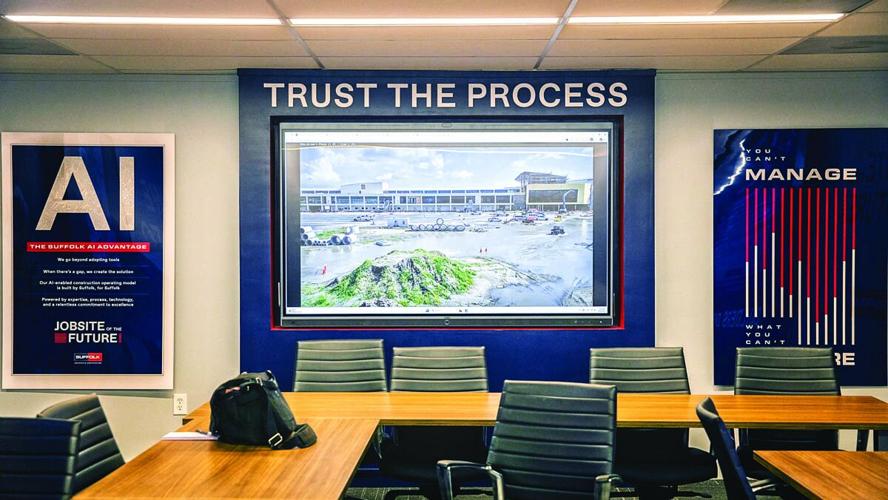
Suffolk Construction’s Jobsite of the Future space supports the company’s AI work on the $1.2 billion Phase 2 Terminal Expansion project at Southwest Florida International Airport. The RSW project is one of eight Suffolk jobsites nationwide with the designation.
A Job Site of the Future
On the southwest side of Southwest Florida International Airport, where an estimated $1.2 billion worth of work continues on Phase 2 of the Terminal Expansion project, Suffolk Construction spotlights its innovation. Of the company’s 275 active jobsites across the country, the airport project — with an on-site software engineer and conference room inside a temporary building dedicated to its AI efforts — is one of eight with Suffolk’s Jobsite of the Future, or JOF, distinction. It will help shape Suffolk’s future incorporation of AI best practices.
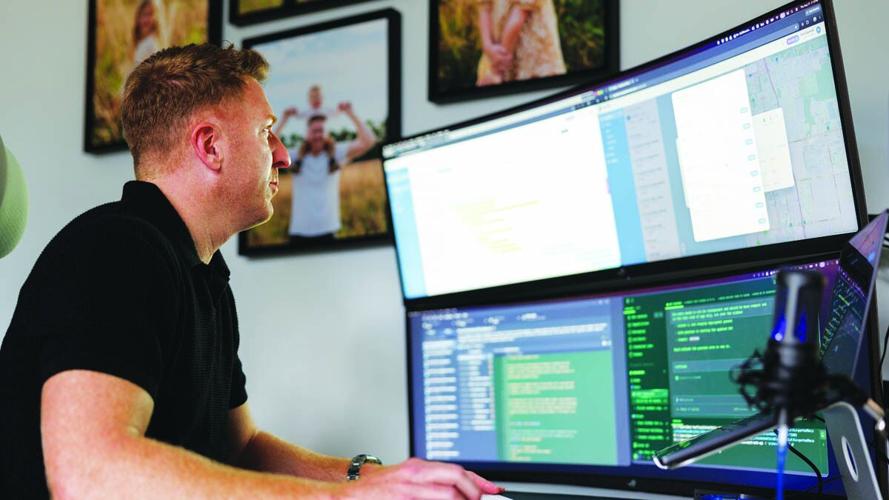
Cary Greenwood of Suffolk comes from a background in software engineering, not construction. He previously worked as a data architect for NV5, performing government contract work for the Army Corps of Engineers and NASA. Prior to that, he worked for Raytheon as a senior software engineer.
Greenwood is optimizing the data from Requests For Information — paperwork exchanged between contractors and engineers when questions arise about plans or specifications — with custom-built AI software. The results have been swift, said Dwight Moe, Suffolk’s assistant project manager.
“There was a pretty noticeable difference when Cary got here,” Moe says. Before Greenwood joined the project in February 2026, preparing an RFI could take six to eight hours. Six months later, with AI tools in place, the process takes as little as 10 to 15 minutes.
“The project teams and myself work closely together in order to really find the best solutions for the project,” Greenwood says. “The company overall is focusing on finding those synergies to work together for our company’s benefit and all future projects, too.
“It’s a large amount of data — definitely gigabytes of data. There are a lot of data points, from RFIs to submittals and different back-end data silos that get integrated. We essentially mine it. We built it into customized AI solutions.”

Brett Diamond, principal of DeAngelis Diamond & Co., works at the Naples-based construction firm. DeAngelis Diamond launched Future Bylt in 2025 to develop AI-powered tools for construction project management, staffing and recruiting.
From Blueprints to AI
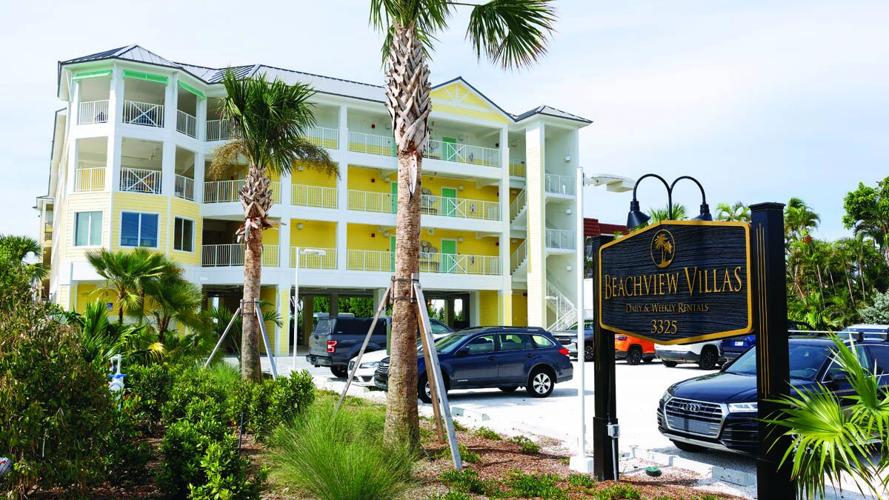
In south Fort Myers, Stevens Construction has integrated AI efforts throughout its office and across its construction projects, including the recently completed Beachview Villas on Sanibel Island.
AI first appeared on the company’s radar several years ago, founder Mark Stevens said, but its use has accelerated significantly during the past two years. The company is seeing improvements across departments as employees devote more time and attention to the technology.
“The young folks in our industry have forced me to embrace it and get behind it,” Stevens says. “Pretty much everyone in the office has been trained in AI. We’re not using it irresponsibly or depending too much on the information, because it’s so new.”
The shift is particularly striking to Stevens, who founded the company in 2003, when he wasn’t even viewing construction plans on a computer screen. Today, just about everyone in the field works from tablets and can access the company’s AI platforms.
“I’m still the only one in the office who likes to touch and feel a set of blueprints,” Stevens says.
He said every department uses AI in some capacity, from project estimates and plan coordination to preparing requests for information and daily correspondence. The accounting department uses it to create reports, comparisons and financial forecasts, track key performance indicators and better monitor predictive indicators.

Beachview Villas on Sanibel Island is among the projects where Stevens Construction has incorporated artificial intelligence into its work. The Fort Myers-based contractor uses AI across departments for tasks ranging from project estimates and plan coordination to financial forecasting.
Building an AI Business
In Naples, DeAngelis Diamond isn’t just using AI. It founded an offshoot company, Future Bylt, in April 2025 that’s devoted to it.
Future Bylt already has grown from six to 18 employees and is developing AI-powered software. Its initial purpose is to improve construction practices for DeAngelis Diamond, and the plan is to eventually scale those practices and work for other construction companies as an AI expert and subcontractor.
“It allows us to have our own brand, folks and culture,” says Brett Diamond, chief innovation officer of DeAngelis Diamond. “When you have a separate company, you have a better way to track the financials of it and do a lot more research and development. We have larger budgets that we’re working with. It’s our beta model. Once we have these platforms in place, we’re looking to offer these services to the outside world.”
Future Bylt has developed software and gives the programs unique names. The team has used Anthropic’s Claude Code, an AI coding tool, to accelerate software development. One new program is tentatively being called “Bolt,” and at the time of this interview with Diamond, it was all of 2 days old.
“We’re building out our own in-house, proprietary AI model that allows us to track everything in a project through one system,” Diamond says. “How is this project doing on financials? On scheduling? On the latest RFI? It will aggregate the data into one solo platform that will find answers faster and more accurately.”
Future Bylt also used AI to develop Squads, workforce-tracking software.
“We track our projects, active and upcoming, on this platform,” Diamond says. “When we need to staff the project, Squads recommends the best team members for the roles using an AI-based algorithm. It also allows us to have intelligent dashboards for our recruiting team to track the upcoming needs months down the pipeline.”

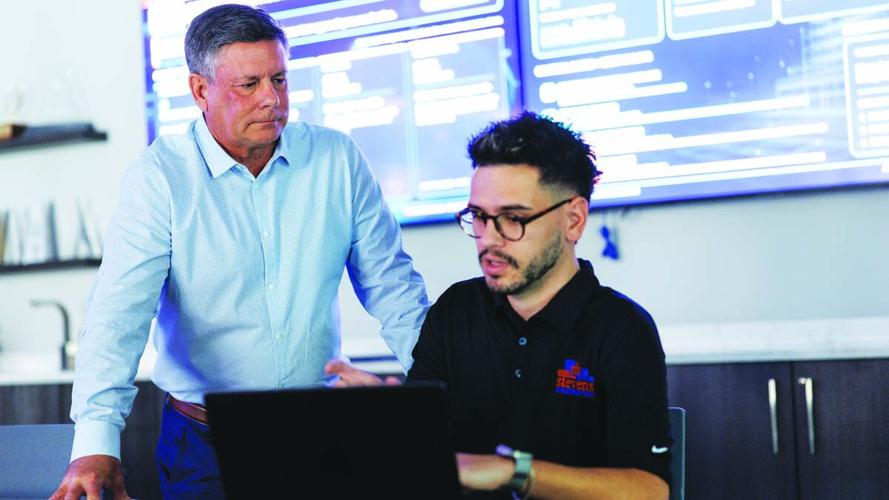
Stevens Construction founder Mark Stevens, left, and IT Manager Alex Quattrone work at the company’s Fort Myers office. Stevens Construction uses AI across its operations, including estimating, project coordination, accounting and financial forecasting.
Another program is called “Scout.”
“It’s helping us scout the next talent to put on our team,” Diamond says. “It’s utilizing AI to search the web and different databases for our recruiters. Talent in construction is very scarce. We’re trying to figure out how to overcome that with this platform. There’s some really cool stuff that’s happening.”
DeAngelis Diamond has 326 employees, is approaching about $700 million in revenue this year and has about 70 active job sites, including a new Naples Comprehensive Health hospital in Collier County and the new Harry Chapin Food Bank headquarters in Lee County.
Diamond said the parent and offshoot companies aren’t finished with innovating. Up next: exploring advanced robotics for construction.
“We’re invested in those, as well,” Diamond says. “We do think there’s a combination of human experience and expertise along with robotics we can use. It’s no different than the assembly line with cars.”
(0) comments
Welcome to the discussion.
Log In
Keep it Clean. Please avoid obscene, vulgar, lewd, racist or sexually-oriented language.
PLEASE TURN OFF YOUR CAPS LOCK.
Don't Threaten. Threats of harming another person will not be tolerated.
Be Truthful. Don't knowingly lie about anyone or anything.
Be Nice. No racism, sexism or any sort of -ism that is degrading to another person.
Be Proactive. Use the 'Report' link on each comment to let us know of abusive posts.
Share with Us. We'd love to hear eyewitness accounts, the history behind an article.