
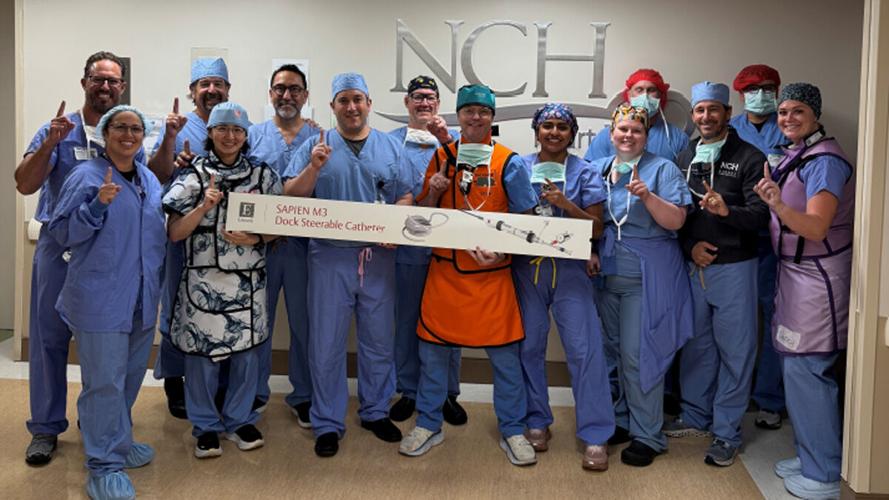

NCH Rooney Heart Institute performed Florida’s first Sapien M3 transcatheter mitral valve replacement in June, with the structural heart team led by Dr. Robert Cubeddu (front row, second from right); Dr. Dee Dee Wang (front row, second from left) and Dr. Robert Pascotto (back row, second from left).
For Naples resident Bob Dickemper, the ability to have a lifesaving heart procedure close to home — while helping pioneer a new technology — made a big difference in both his treatment and recovery.
Naples Comprehensive Health made history in early June as the first healthcare system in Florida to perform a Sapien M3 transcatheter mitral valve replacement, a minimally invasive alternative for patients who are not candidates for surgery or other transcatheter repair options.
Dickemper was the first patient to undergo the M3 transcatheter mitral valve replacement at NCH Rooney Heart Institute, and he said he was glad to have the procedure on his home turf.
Eight years earlier, Dickemper traveled to Florida's east coast for treatment of an aortic valve condition.
“It's just not the same as being here, with family,” he said. “It's a big deal.”
The procedure was performed by the NCH structural heart team led by Dr. Robert Cubeddu, president and Brynne and Bob Colletti Endowed Chair of the Rooney Heart Institute; Dr. Dee Dee Wang, section head of cardiac imaging; and Dr. Robert Pascotto, cardiothoracic surgeon.
NCH officials said the procedure recently approved by the U.S. Food and Drug Administration marks a significant advancement in structural heart care and expands access to a treatment option for patients with severe mitral valve disease.

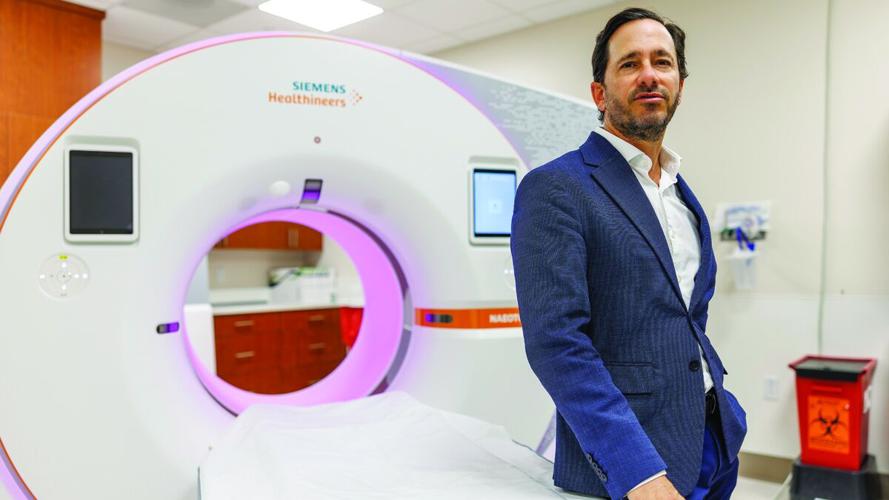
Dr. Robert Cubeddu, president of the Rooney Heart Institute at Naples Comprehensive Health, helped lead Florida's first Sapien M3 transcatheter mitral valve replacement. The minimally invasive procedure offers a new treatment option for patients with complex mitral valve disease.
Cubeddu said the Rooney Heart Institute's structural heart program focuses on therapies delivered through a catheter-based approach.
He said the program is one of the busiest structural heart programs in Florida and has performed a high volume of transcatheter aortic valve replacements and mitral clip procedures. It also was the first in Florida to perform a transcatheter tricuspid valve replacement.
“Different from open heart [surgery], the way we treat and repair valves is through a catheter approach through the peripheral arteries and veins, and these are innovative therapies and technologies that have made it to market over the last 10 to 20 years,” he said. “The M3 valve is the most recent addition of these therapies and we have different types of tools in the box to treat different types of valve conditions.
“The M3 is just another innovative solution that solves an unmet need for patients that are otherwise inoperable with complex mitral valvular disease.”
Unlike traditional heart surgery, Cubeddu said, the procedure is performed through a catheter inserted into the femoral vein in the leg, allowing the diseased mitral valve to be replaced without opening the chest.
Cubeddu, Wang and Pascotto were joined by a multidisciplinary team of interventional cardiologists, cardiac imaging specialists, anesthesiologists, surgeons, nurses and cardiovascular professionals.
“Procedures like this are only possible when every member of the care team works together seamlessly,” Wang said.
She said patients at NCH benefit from a multidisciplinary approach that combines expertise in advanced imaging, structural heart intervention, cardiac surgery and perioperative care.
Technology creates options
Mitral valve regurgitation occurs when the heart's mitral valve does not close properly, allowing blood to flow backward into the heart. Untreated, the condition can lead to heart failure, shortness of breath, fatigue and other complications.
Cubeddu said there are multitudes of patients with mitral valvular disease who are not good candidates for conventional open-heart surgery.
“They're either too old, too sick, too frail or their mitral valve anatomy is too complex to tackle through a conventional open-heart approach,” he said. “It is precisely in these patients where this technology prevails and where a lot of these patients can now benefit from a transcatheter mitral valve replacement.”
He said being the first in Florida to offer the M3 technology underscores the heart institute's mission to provide innovative treatments that improve quality of life and long-term outcomes.
NCH transplant program on horizon
In addition to strengthening the heart institute's structural heart program and its focus on innovative technologies, NCH announced in March that it would launch an advanced heart failure and solid organ transplant program. The healthcare system also expects to complete construction of the $295 million, 200,000-square-foot R.M. Schulze Family Heart & Stroke Critical Care Center — which will house the existing Rooney Heart Institute and Wingard Stroke Institute — in late 2027.
Asked about the timing of the transplant program, Cubeddu said it would take a year or two to launch, and recruitment efforts are already underway.
“We've recently recruited a few heart failure cardiologists, and we're actively recruiting transplant coordinators and team members,” Cubeddu said. “We're excited about this initiative, and we think it's important for the region and for patients in need of a heart transplant.”
Opening doors for other patients
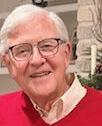
Bob Dickemper
Dickemper's mitral valve condition had been monitored for years before he underwent a five-way bypass and open-heart surgery 15 years ago. The difficult recovery left him determined to avoid another open-heart procedure.
He said he eventually consolidated his heart care at the Rooney Heart Institute and has been impressed with Cubeddu and his team's approach, as well as with his experience during and after the June procedure.
“After the procedure, when he (Cubeddu) came into the hospital room, he had a smile on his face a mile wide and he said it was perfect,” Dickemper recalled. “He said it was absolutely perfect, and that was a special moment.”
Dickemper said he spent one night in the hospital after the procedure and, after four weeks of recovery, was feeling strong and regaining energy.
He said he is grateful for the opportunity to have participated in a pioneering procedure and hopes his experience will help other patients as they evaluate their heart care options.
“Right after getting back into the hospital room from the surgery area, I really thought that this may open some doors to other folks, to other patients like myself that see this as a good opportunity,” he said. “I was really, really happy with helping to open that door.”
(0) comments
Welcome to the discussion.
Log In
Keep it Clean. Please avoid obscene, vulgar, lewd, racist or sexually-oriented language.
PLEASE TURN OFF YOUR CAPS LOCK.
Don't Threaten. Threats of harming another person will not be tolerated.
Be Truthful. Don't knowingly lie about anyone or anything.
Be Nice. No racism, sexism or any sort of -ism that is degrading to another person.
Be Proactive. Use the 'Report' link on each comment to let us know of abusive posts.
Share with Us. We'd love to hear eyewitness accounts, the history behind an article.