
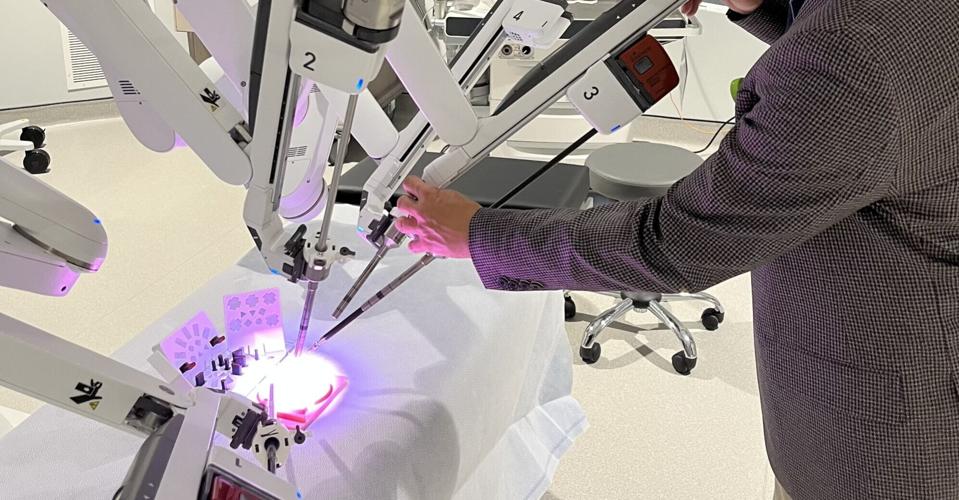
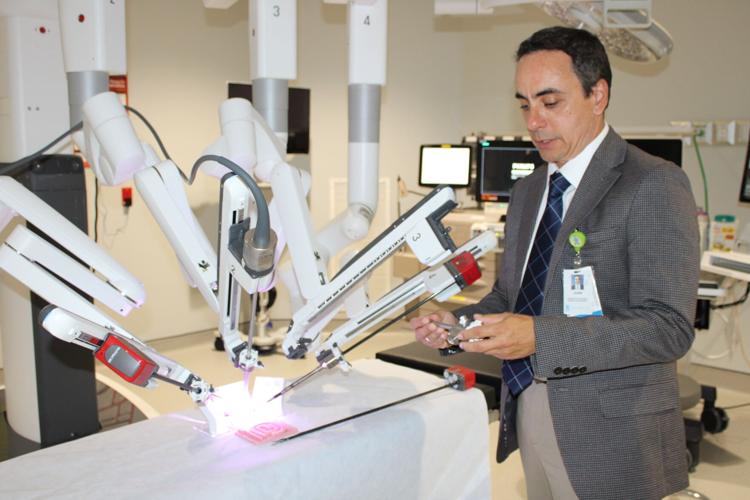
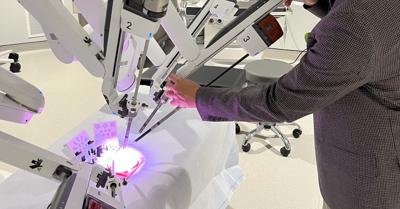


Watching the Da Vinci Xi surgical robot in action at the new Lee Health Surgery Center in Fort Myers may feel like stepping onto a sci-fi movie set — but the technology is very real.
In one of the three operating rooms in the new stand-alone ambulatory surgery facility that opened this week at 6201 Alliance Lane, across Metro Parkway from Lee Health’s Gulf Coast Medical Center, a preview of the robotic surgical system showed how surgeons use the technology for a wide variety of general surgical procedures.
Four arms on the Da Vinci robot descending from an overhead platform had almost a video game feel during a demonstration, hovering above an operating table —without a patient — while being guided in super-precise movements by a surgeon sitting at a nearby console.
During an actual procedure, at least one surgical technician assists with the robotic arms and camera, guided by the surgeon, who views the magnified surgical site in 3D from a console.
This particular Da Vinci robot surgical system from Intuitive is one of 31 surgical robots now in use across Lee Health hospitals and the ambulatory surgery center, said Dr. Juan Ibarra, robotic surgery program manager for the health care system who provided the tour and demonstration.
He said the Da Vinci robots are used for minimally invasive procedures such as prostatectomies and other urologic surgeries, gynecological surgeries including hysterectomies and colon surgery. They can also be used for general, thoracic and head and neck procedures.
Robots across the health care system also are used in other specialties, including orthopedic surgery and neurosurgery.
Ibarra, who arrived in 2022 to manage the robotics program, said the volume of robotic surgeries has increased 175% since he arrived, growing from about 2,200 procedures to more than 7,000 so far this year. The robotics program is largely funded by the donor-supported Lee Health Foundation, according to the system.
And it’s not about growth of the program for growth’s sake, Ibarra said. Lee Health data shows that robotic-assisted procedures lead to shorter hospital stays, faster recoveries and better patient outcomes, including a lower chance of post-surgical infections.

Dr. Juan Ibarra guides the Da Vinci Xi surgical robot during a demonstration at Lee Health’s new ambulatory surgery center, where the technology is used for thousands of minimally invasive surgeries each year.
“We believe that robotic surgery standardizes procedures and improves outcomes,” Ibarra said. “For surgeons, there is better visualization, there is more control; there is a lot to gain from the procedure itself to improve outcomes.”
Robotic technology allows surgeries — many on an outpatient or ambulatory basis — to be performed through small incisions, as opposed to open incisions, which Ibarra said can mean less pain, smaller scars, lowered chance of infection and less blood loss.
He cited a robotic prostatectomy, a procedure to remove all or part of the prostate gland, as an example of how the technology can change a patient’s experience.
“Many years ago, to do a prostatectomy, the patient would require maybe two or three bags of blood just to do a simple prostatectomy,” Ibarra said. “Today, the blood loss could be 50 [cubic centimeters]; almost none. And that is a huge change that came with robotic surgery. What the patient gains is a better procedure and better outcomes.”
Ibarra said robotic surgeries can also lead to shorter hospital stays — which can lower costs to patients — shorter recovery times and fewer readmissions. For example, he said patients undergoing robotic-assisted hysterectomies are typically discharged within eight to 13 hours after arriving for the procedure. Data from Lee Health shows the 90-day readmission rate for robotic-assisted hysterectomies has been 0.2% over the past two years.
Lee Health also recently added the Maestro Platform from Moon Surgical, which the system said provides an enhanced version of traditional laparoscopy (minimally invasive abdominal surgery).
In announcing the addition of Maestro, Lee Health said it has completed more than 100 laparoscopic procedures with the surgical platform, including bariatric and general cases, assessing its impact on workflow, setup efficiency and surgical focus.
After those 100 procedures, Lee Health said that to date no adverse outcomes have been linked to the use of Maestro and that in the first 25 bariatric procedures alone, the platform saved the equivalent of 8.3 full working days of surgical tech time.
(0) comments
Welcome to the discussion.
Log In
Keep it Clean. Please avoid obscene, vulgar, lewd, racist or sexually-oriented language.
PLEASE TURN OFF YOUR CAPS LOCK.
Don't Threaten. Threats of harming another person will not be tolerated.
Be Truthful. Don't knowingly lie about anyone or anything.
Be Nice. No racism, sexism or any sort of -ism that is degrading to another person.
Be Proactive. Use the 'Report' link on each comment to let us know of abusive posts.
Share with Us. We'd love to hear eyewitness accounts, the history behind an article.