


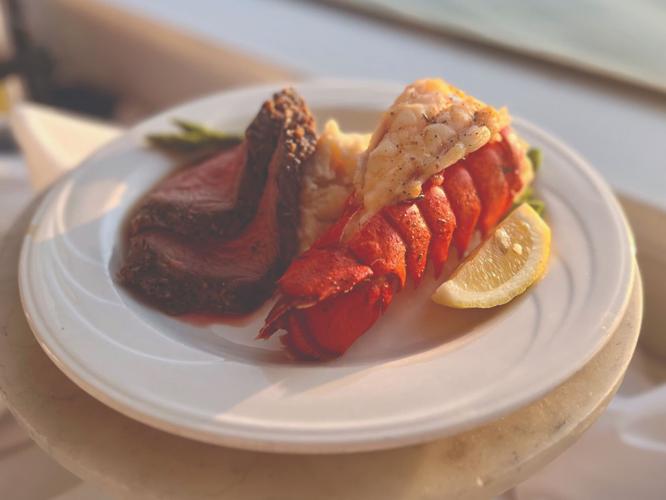

Geoff Thomas paid attention to what his grandmother did when she made her beloved fried corn. On hot Sunday afternoons in San Antonio, Texas, the future executive chef for Naples Princess would watch as his grandmother cooked for the post-church crowd that gathered in her home every weekend.
“She makes great corn pudding too, but everybody loves the corn pudding,” Thomas said in a recent interview with The Naples Press. “But I like the fried corn. She cooks it, sautés it in the pan, hits it with a little bit of cream on the end. Yeah, it’s nice, man. And it’s fresh corn she cuts right off the cob, you know?
“And that, when I was a kid, was one of the first real fresh vegetables that I had. So many other things were canned or frozen, but it was that flavor of the fresh, sweet corn that introduced me to vegetables when I was a kid. And as you get older, you come to find out that that freshness, those nutrients, is really what gives food flavor.”
Thomas, 38, took what he learned from his grandmother back home to Cleveland, Ohio, where he grew up with both his mother and father upholding family traditions in the kitchen. He began to make the connections that every great chef starts to see in their food. He saw the commonalities between foods of different cultures, and the importance of local ingredients in the origin stories of favorite dishes.
“You know chili is the gumbo of Texas, right?” Thomas said. “Because it’s not really Mexican, but it’s got that cumin, it’s got that chili powder, and really, you know, even the beans and so many other additions that you add to chili started just as ‘whatever we had.’”
Almost without exception, regional American cuisine is the result of local ingredients combining with the traditions brought by immigrants or established by native populations. Adaptations are made based on what can be grown or obtained, but certain things remain as part of tradition or even ritual, such as the rolling of cornmeal into a neat ball.
Thomas’ family in West Texas absorbed local flavors while also contributing to the tastes and smells of their San Antonio neighborhood.
All of his experience around family stoves started paying off after a first year of college did not pay off at all. Thomas characterized that year studying early childhood education at Missouri’s Johnson C. Smith University as a “$20,000 party,” but classmates cited his frequent domination of the kitchen during gatherings as a sign of what he would become. A year after his college experiment, Thomas enrolled in Connecticut Culinary Institute, where he earned a degree in advanced culinary arts. Several years later, he graduated from Le Cordon Bleu College of Culinary Arts in Scottsdale, Arizona.
Thomas quickly built a career as a restaurateur, opening two restaurants in the Cleveland area, serving as an executive chef at a retirement community and starting a meal-prep company. He then did the calculus that many Midwesterners make as they brace for lake-effect snow, and realized he wanted to live in a place where people take vacations. He and his wife Hillary Thomas, an educator, moved in 2021 to Naples, where Thomas worked as executive chef for Aston Gardens at Pelican Marsh, then later at Moorings Park.
Thomas recently placed 10th in the semifinals for Favorite Chef, a competition for emerging chefs benefitting the James Beard Foundation, which works to educate the public on American cuisine and support creative talents working in the food industry. While he did not win, Thomas will use the exposure he received from Favorite Chef to promote his work in the kitchens and galleys of Naples, as well as the cookbook he is currently writing, Grandma’s Hands.
Named after Bill Withers’ classic 1971 song about a woman bringing her community together through her work and love, Grandma’s Hands will showcase the kitchen specialties of many grandmothers, making meatballs with nanas and arepas with abuelas. He knows it will resonate, because he still calls his grandmother in San Antonio for tips.
“I call her now, I’m like, ‘How did you do that?’” Thomas said. “I’m a whole caterer, you know, I’m a whole chef. I do this for a living. And I’m like, ‘Mama, how did you do this,’ you know? She made it look so simple and taught me so much about, you know, cleaning as you go and just putting the love and the care into it … flavors, spices and just taking your time; taking your time and caring for people through food.”
(0) comments
Welcome to the discussion.
Log In
Keep it Clean. Please avoid obscene, vulgar, lewd, racist or sexually-oriented language.
PLEASE TURN OFF YOUR CAPS LOCK.
Don't Threaten. Threats of harming another person will not be tolerated.
Be Truthful. Don't knowingly lie about anyone or anything.
Be Nice. No racism, sexism or any sort of -ism that is degrading to another person.
Be Proactive. Use the 'Report' link on each comment to let us know of abusive posts.
Share with Us. We'd love to hear eyewitness accounts, the history behind an article.