

Picture living off the grid, outside the energy infrastructure most people are connected to. Images of a regressive, reclusive lifestyle likely come to mind: cooking by a fire, hunting or living off the land to survive. James Richmond described going off the grid, instead, as the future of public energy utilities and part of a power renaissance.
“I think where we’re headed is a whole new utility model,” says Richmond, founder and CEO of Bonita Springs-based e2Companies.
The electric power grid and the public utilities that control it are becoming overextended, Richmond contends, less capable of handling the present and future’s growing energy needs — especially in the age of artificial intelligence and increasingly severe storms. Not unlike landline telephone infrastructure, he envisions a near future in which the grid is phased out, or only one of many sources from which we draw power.
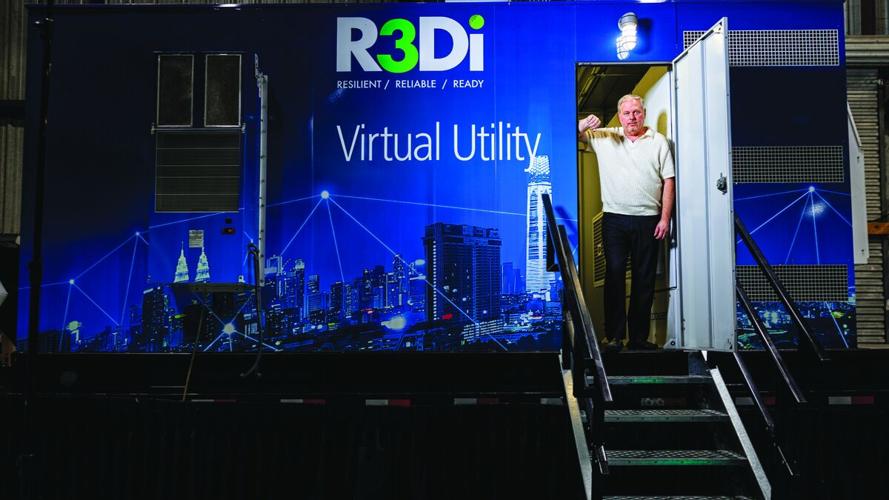
Instead, individual home or business owners will source, store, generate and distribute their energy using an all-in-one system such as Virtual Utility manufactured by e2Companies. It’s designed to provide a more flexible, reliable, cleaner and ultimately cheaper source of power than traditional public utilities can offer.
“We do everything the (public) utility does, behind the meter,” Richmond says.
Richmond started e2 in 2009 in Peoria, Illinois, to help companies comply with Environmental Protection Agency regulations for diesel generators. He began work on what would become Virtual Utility in response to the need for ultra reliable power sources for companies that could lose significant revenue from power outages or even blips.
In 2018, he moved the company’s headquarters to Bonita Springs, near his home.
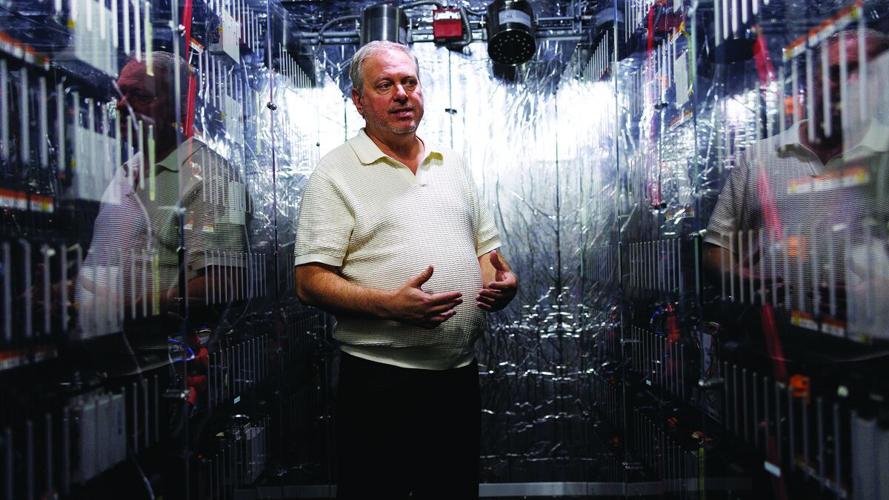
At the time, e2 was preparing Virtual Utility for the market. The system is powered by a patented natural gas generator and lithium iron phosphate battery combo called R3Di (“ready”). Each system, which comes in a modular shell, produces about one megawatt and can be paired to produce more power. It can draw energy from any or every available source, whether traditional or renewable, or even the fictional flux capacitor that powered a time machine in the 1985 movie Back to the Future, Richmond jokes, if it ever becomes available — a “vertically integrated,” stand-alone utility.
Along with meeting daily power needs, R3Di is made for switching to backup power generation — for example, during a severe storm — without a blip. It can last through extended outages.
To complete the system, Virtual Utility is monitored by a round-the-clock software-based service called Grove 365.
Since 2023, e2 announced the use of its Virtual Utility at Titusville, Pennsylvania-based manufacturer Oil Creek Plastics; grocery chain The Kroger Co. in Los Angeles County; and the Edward A. Rath County Office Building in Buffalo, New York.

Virtual Utility is still costly, but James Richmond expects a $15,000 residential version within five years — positioning it to challenge utilities and power AI data centers.
In 2025, Richmond was selected as a finalist for Ernst & Young LLP Entrepreneur of the Year; e2Companies was named the 2025 Tech Catalyst of the Year by Lee County Horizon Foundation; and Virtual Utility was selected as one of the winners of a Best New Product Award at the Edison Awards in the Critical Human Infrastructure category.
This year the company is growing its manufacturing operation and hiring new employees, according to LeeAnn Werner, e2’s marketing operations manager — and Virtual Utility is just starting to prove itself in the marketplace.
“I think it’s because we’re still a small company,” Werner says. “We’re still under 100 employees. And we have this new patented tech. We’re still getting the word out. It’s more about getting these installations done and proving ourselves, proving that Virtual Utility works and it can do what we say it does.”
Right now, Virtual Utility is also too expensive to be practical for widespread residential and business use. Richmond said he is focused on bringing cost down in coming years. He estimates the company is five years away from rolling out a residential version for around $15,000, enough to ultimately save most homeowners money with a product that lasts 20 years.
“That’s significantly cheaper than Florida Power & Light will ever be able to do power at your house for,” Richmond claims. “But that’s where we’re headed … It’s a whole new way of thinking.”
Along with disrupting public utilities, Richmond said Virtual Utility, with its ability to handle large, volatile power loads, could provide an answer to the power needs posed by AI data centers.
That will help the U.S. compete with China, he adds: “Right now, China is winning the war on power. They are about two times what we are in power delivery. The reality is we can catch them with products like R3di, [which] allows us to jump the line in the power battle.”
If that’s not enough, then Richmond intends to use Virtual Utility as an energy source in impoverished, underdeveloped regions that have little or no energy infrastructure to begin with.
“It’s easy to drop one on the ground at a hospital in Africa or Malaysia where power infrastructure isn’t so easy to do,” Richmond says. “I think the overall goal here is that this product isn’t just good for the United States. A third of the world doesn’t have reliable power at all.”
(0) comments
Welcome to the discussion.
Log In
Keep it Clean. Please avoid obscene, vulgar, lewd, racist or sexually-oriented language.
PLEASE TURN OFF YOUR CAPS LOCK.
Don't Threaten. Threats of harming another person will not be tolerated.
Be Truthful. Don't knowingly lie about anyone or anything.
Be Nice. No racism, sexism or any sort of -ism that is degrading to another person.
Be Proactive. Use the 'Report' link on each comment to let us know of abusive posts.
Share with Us. We'd love to hear eyewitness accounts, the history behind an article.