
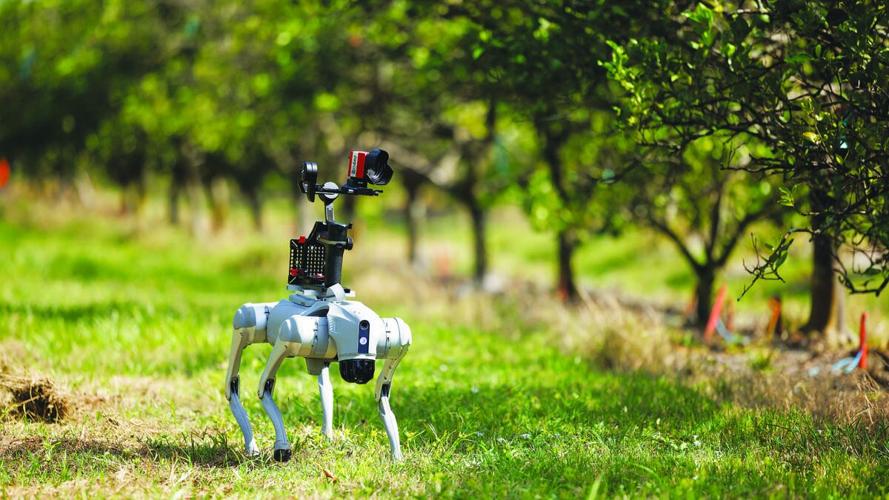
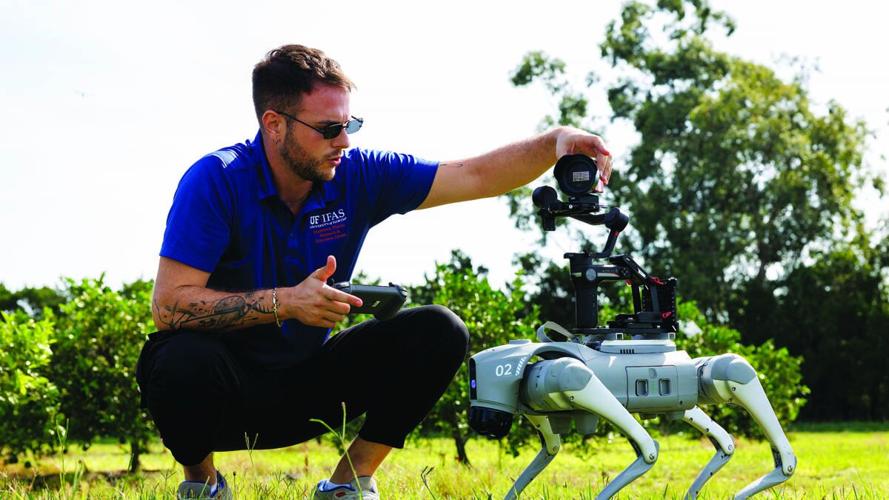

A robotic device operates in an agricultural setting as UF/IFAS researchers explore how artificial intelligence and robotics could help Florida growers reduce labor costs and analyze crops. Researchers envision eventually pairing AI tools such as Gaia with robots capable of working in the field.
Nikolaos “Nikos” Tziolas completed his doctorate in soil science and artificial intelligence at Aristotle University in Thessaloniki, Greece, in 2022. It was the same year ChatGPT introduced millions of people to conversational artificial intelligence.
But Tziolas had been thinking about the problem AI might solve for agriculture long before generative AI became widely available. How could researchers turn vast amounts of technical data into information farmers could actually use?
As generative AI advanced, he saw a way to bridge that gap.
“The goal was to develop intelligence systems that help people make better decisions, [to] transform environmental data into usable information,” says Tziolas, 37. “This is the milestone that completely changed the interactions between the end user and the researchers.”
Shortly after completing his doctorate, Tziolas moved to the U.S. and took a post as an assistant professor at the University of Florida’s Institute of Food and Agricultural Sciences, or UF/IFAS.
Based at the UF/IFAS Southwest Florida Research and Education Center in Immokalee, Tziolas began creating an AI agent for farmers. He calls his signature model Gaia Bot, or simply Gaia, after the Greek word for “earth.”
Gaia is trained on information such as Florida-based academic datasets and satellite mapping that would otherwise be inaccessible to many farmers, especially smaller growers. It puts vast amounts of data at their fingertips, allowing them to access the information through conversational language.
“The grower can easily go and ask, ‘What is the crop damage assessment in my field after Hurricane Milton?’” Tziolas says, citing just one example.
The potential extends beyond storm damage. Researchers envision AI tools that could help growers make decisions about irrigation, pesticide use, soil conditions and other costly inputs — bringing sophisticated agricultural analysis within reach of operations that may not have the resources to hire consultants to interpret the data.
Tziolas arrived at UF as the university was making a significant investment in artificial intelligence.

UF/IFAS Ph.D. student Giannis Gallios works with a robotic device in an agricultural field. UF researchers are exploring how artificial intelligence and robotics could help Florida growers analyze crops, reduce labor needs and improve efficiency.
In 2020, UF alumnus Chris Malachowsky and Nvidia, which he co-founded, committed $50 million toward the university’s AI initiative and expansion of its HiPerGator supercomputing system. UF added another $20 million and committed to hiring more than 100 faculty members to incorporate AI across disciplines ranging from the humanities to the sciences.
For UF/IFAS, that broader investment includes a 40,000-square-foot facility at its Gulf Coast Research and Education Center in Hillsborough County. Initially called the Center for Applied Artificial Intelligence in Agriculture, it was recently renamed the Institute for Agricultural Innovation.
“We wanted to see if we could utilize AI as a tool to help our stakeholders, our growers, our farmers in Florida,” says Jack Rechcigl, a professor and director of the Gulf Coast Research Center.
UF broke ground on the project in fall 2025 with completion expected in spring 2027.
The Agricultural Innovation hub is expected to focus on key challenges such as labor costs, with researchers exploring how AI and robotics could reduce growers’ reliance on manual labor. Tziolas and his colleagues envision eventually combining Gaia with “swarm” robots capable of picking vegetables and analyzing crops with human-level dexterity.
More immediately, AI could help growers reduce operating costs by making more precise decisions about pesticides, irrigation and other inputs.
“If you can reduce input costs, which have skyrocketed ever since COVID, that’s one way to make farms profitable,” says Nathan Boyd, a professor and associate Gulf Coast Research Center director.
The center and its researchers may even play a role in U.S. food security, Boyd said. “We shouldn’t forget that Florida feeds much of the U.S. with fresh fruits and vegetables during the winter months, and that’s a key role when it comes to food security.”
Ultimately, Boyd said, scientists at the center will work with startup companies to produce economically viable products that help growers. “To me, that’s the model of what we want to do with the rest of the AI agents; making sure they address real needs and provide real benefits.”
Florida farmers have yet to widely adopt many AI programs, which remain in experimental stages. Boyd believes broader adoption could take another five to seven years or more.
“I wouldn’t say it’s been deployed and adopted widely on farms yet, but it’s only a matter of time,” he says. “And we’re still very early in the development stage.”
How quickly that technology could evolve remains difficult to predict.
“We may be doing a lot of things we’re not even thinking about now,” Rechcigl says.
In 2025, Tziolas received a $297,000 USDA grant to develop Gaia’s ability to help farmers assess storm damage in their fields. The technology could eventually have a broader industry impact by narrowing the information gap between large agricultural operations and smaller farms.

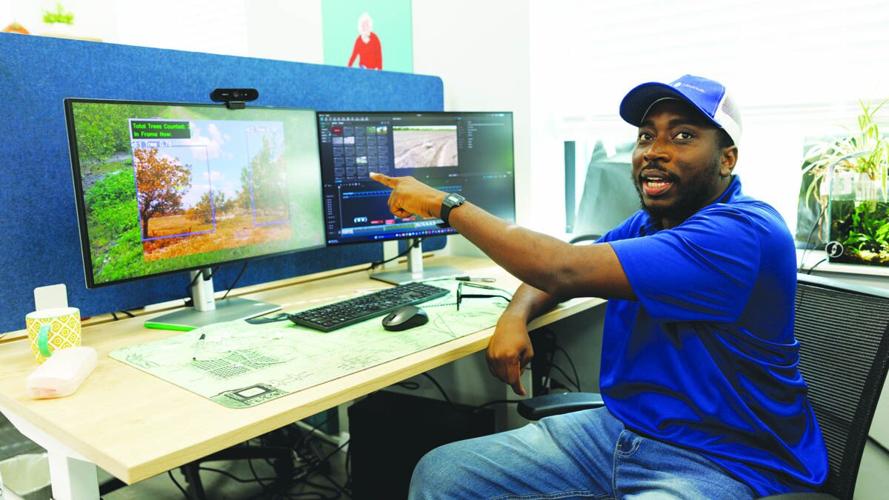
Samuel Aregbesola demonstrates technology used in agricultural research at the University of Florida. Aregbesola is part of the university’s expanding investment in artificial intelligence and agricultural innovation.
“He is trying to make sure that every farmer has access to the best information in the world,” says J. Scott Angle, UF/IFAS senior vice president of agriculture and natural resources. “Right now, if you’re a really big farmer, you can probably hire consultants who can comb through the literature and come up with good recommendations. But if you’re a small farmer, you can’t do that. It (Gaia) will give everyone access to the same level of information.”
For Tziolas, making science useful to farmers is rooted in his childhood in Larissa, Greece, where his parents worked in environmental and agricultural fields.
“I have, I think, from the first years some insights about environmental protection, agricultural productivity, why this is important [and] why we have to consider ways to optimize it,” he says. That curiosity now informs the advice he gives his students: “Be curious in your life.”
(0) comments
Welcome to the discussion.
Log In
Keep it Clean. Please avoid obscene, vulgar, lewd, racist or sexually-oriented language.
PLEASE TURN OFF YOUR CAPS LOCK.
Don't Threaten. Threats of harming another person will not be tolerated.
Be Truthful. Don't knowingly lie about anyone or anything.
Be Nice. No racism, sexism or any sort of -ism that is degrading to another person.
Be Proactive. Use the 'Report' link on each comment to let us know of abusive posts.
Share with Us. We'd love to hear eyewitness accounts, the history behind an article.