








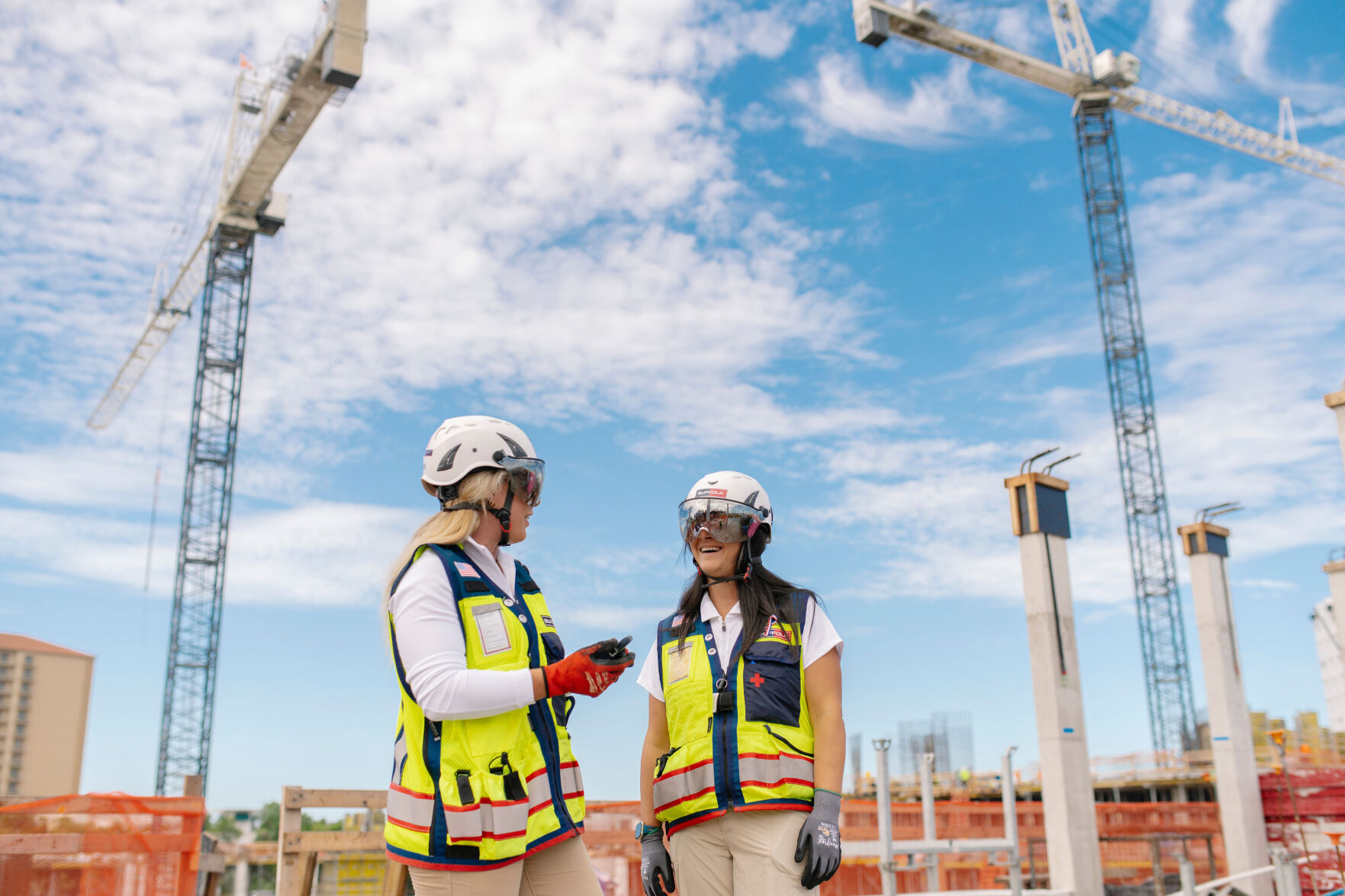
Southwest Florida needs more tradespeople. That’s a reality Ben Wilson faces every day in his role as general manager of the Estero office for national contracting firm Suffolk’s Gulf Coast region.
Especially as more and more people continue to flock to the Sunshine State. “What’s happened over the last five years has been pretty exceptional in our area,” he says. “And I can tell you definitively that in that time, the workforce has never once caught up to the amount of available opportunity that there is in the area for skilled tradespeople. This is a constant, growing pinch point.”
Wilson knows firsthand about the career advancement possibilities in the construction industry, having started out as a framing carpenter. “The good fortune that that I’ve had over the years, combined with some hard work, has presented more opportunities than I ever dreamed,” he says.
Lisa DeCarlo, director of human resources for Naples-based medical device manufacturing company Structure Medical, can tell a similar story about opportunities for graduates of machining technology programs. “For every student that graduates, they can have multiple job offers on the table,” she says. “People don’t realize how much opportunity there is in Southwest Florida for machinists, and that it is a potential lifelong career for them.”
So why don’t they realize it? That’s a combination of multiple factors. Many students are still being pushed toward traditional four-year college programs after high school, even if that isn’t the best path for them. And while the stigma around career and technical education, or CTE, has lessened over time, it’s still there to a degree.
Wilson and DeCarlo are working to change that, and they are not alone. Southwest Florida school districts understand the value of career and technical education, and are continuing to enhance existing programs and add new ones, giving students the opportunity to earn credentials and certifications — in such fields as carpentry, plumbing, aerospace technologies and robotics — both in high school and in post-secondary programs at local technical colleges.
People might finally be starting to pay attention. According to a recent survey from ResumeBuilder.com, 42% of Gen Zers are currently working in or pursuing a blue-collar or skilled trade job, with the factors of job security, earning potential and avoiding student debt serving as primary motivators.
“Acceptance and awareness is going up,” says Harris. “The stigma of not going to a four-year college is going away, and I think it truly has to do with money. Back in my day, if you did go into a trade, you really didn’t make a lot of money. But we know now that the students coming out of the trades now are making good money.”
Another important piece of the puzzle is that their parents are starting to understand that more, too.
“What we’re seeing across the district is parents being more open to the CTE track,” says Ed Mathews, associate superintendent, adult, career, technical and alternative education at The School District of Lee County. “A lot of parents who went to college and ‘did all the right things’ are now finding themselves working in a career field totally unrelated to what they majored in and paying off student loan debt. They look at that as a challenge and see their student and say, ‘Learn from me. Let’s try to make your pathway a little more focused so you’re not incurring any type of debt that might bog you down.’”
Reaching for the stars
If you’ve been to Cape Canaveral on Florida’s east coast lately, you know that it’s no longer just the domain of NASA. The commercial space industry is booming, with major facilities for Blue Origin, SpaceX and other firms in the area.
Space Florida, the state’s aerospace finance and development authority, is working to address a major component needed for the industry’s success. “Without a viable workforce, all of that means nothing,” says Mike Miller, vice president of external affair and workforce integration for Space Florida.
In August 2024, Space Florida signed a memorandum of understanding with 23 Florida school districts to begin implementation of the Space Florida Academy Program. The goal: Connect students with high-demand credentials and skills necessary to work in the aerospace industry in expected fields such as aviation, as well as advanced manufacturing, cybersecurity and other areas.
Charlotte County Public Schools is one of those districts. “We launch rockets in Cape Canaveral, but many of the parts for those rockets and spacecraft are built all around the country,” says Brian Granstra, director of career and technical education for Charlotte County Public Schools. “We want to have more of those made in Florida. And specifically, we want to help those be made in Charlotte County.”

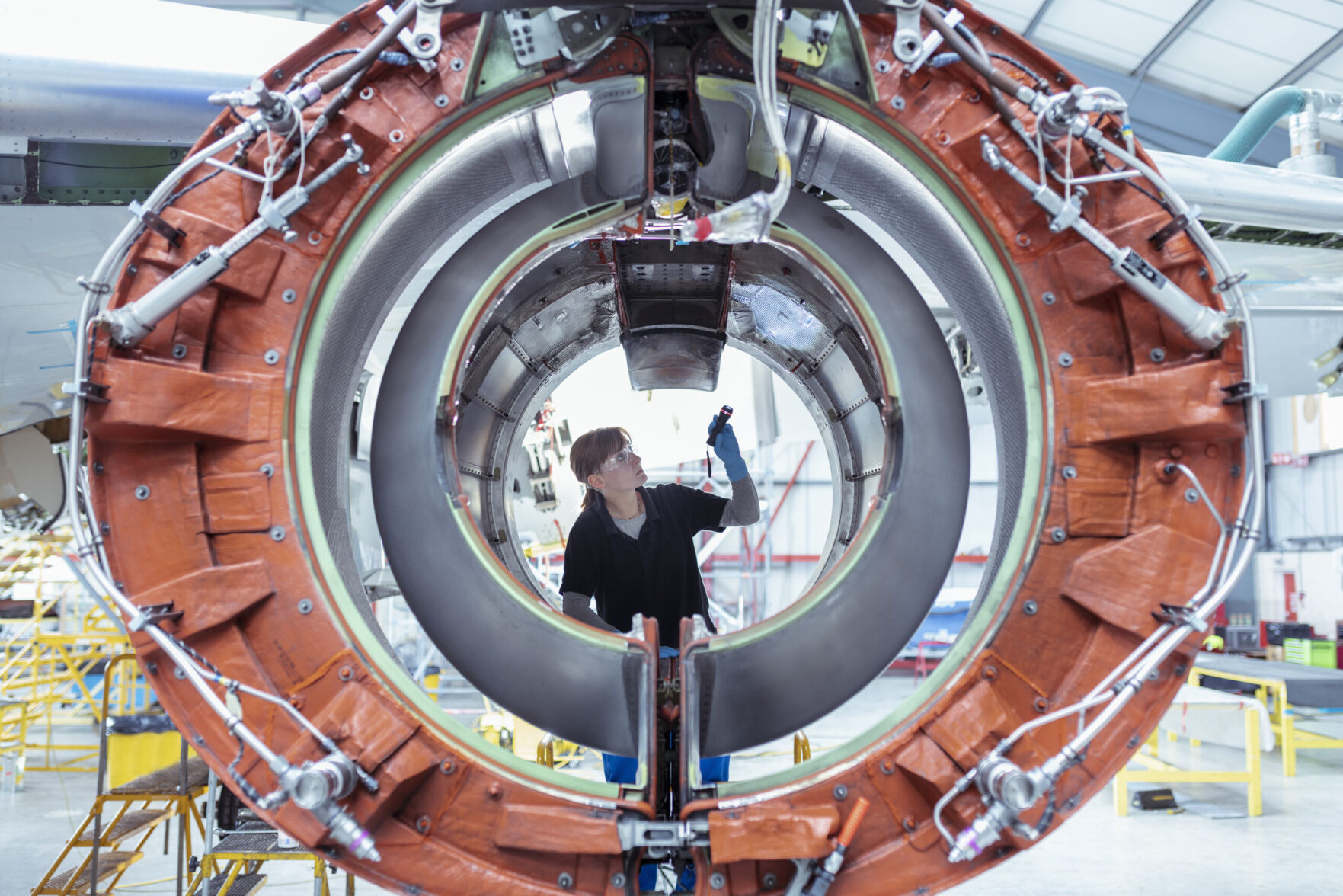
High-school-level programs in Charlotte County that are part of the Space Florida Academy Program include new programs in aviation assembly and fabrication, avionics systems, applied cybersecurity and advanced manufacturing. Additional programs are available at Charlotte Technical College, a second campus of which is planned for 10 acres near the Punta Gorda Airport.
Space Florida is then creating a “talent feeder map” to illustrate where students are earning these credentials and certifications. “We’re trying to show the industry that if you want to expand or get some of your supply-chain companies to move or expand in Florida, you don’t have to go to Cape Canaveral or even somewhere on the east coast,” says Miller. “You can create supply-chain opportunities anywhere in the state of Florida based on the talent being produced by each school district.”
This kind of proactive approach is addressing a common issue SRMA’s Harris has noticed. “When you’re trying to lure employers to the area, the debate used to be if employers came, we would set up programs for students to train to go to work for those employers,” he says. “I’ve learned that’s not the way it works. You’ve got to have the education first; you’ve got to have the skilled workforce first.”
“I confer with the economic development office weekly to identify what are the needs for our county,” says Granstra. “What are the phone calls they are getting? What are employers saying they need to relocate or expand in Charlotte County? It’s so important that we align all together and that we’re all on the same page, so we can magnify our efforts and help drive the economy.
“We want to make sure what our students are preparing for is directly aligned to the industry needs, so that students can go right into the workforce,” he says. “We want to make sure our employers have a steady supply of employees, and we also want to make sure our students have the opportunity to earn these high-paying jobs.”
According to FutureMakers Coalition’s 2024 Workforce Employer Survey, 41% of the businesses and organizations surveyed said they would pay a higher starting salary to potential employees who have a post-high school credential, certificate or industry-recognized certification. “Generally speaking, we know that by 2031, 72% of jobs in the state of Florida are going to require a credential beyond high school,” says Tessa LeSage, chief impact officer at Collaboratory, which has been the backbone for the regional collective FutureMakers Coalition for the last 10 years.
The coalition’s goal is to make sure 55% of adults between the ages of 25 and 64 in the region have education beyond high school, and CTE programs help provide that. “In order to have a strong economy; to have businesses that are thriving and growing; and to have individuals in well-paying jobs and having the kind of income that allows us to have a high quality of life in our region, we need people to be able to get credentials in a cost-effective and quick way that is aligned to workforce needs,” says LeSage.
Ready to work
All of the Southwest Florida school districts are focusing on making sure students are prepared for their next steps after high school, whether that’s attending a four-year university, enrolling at a technical college, enlisting in the military or entering the workforce. “Our focus is on redefining readiness,” says Carlos Artime, executive director of secondary/postsecondary CTE and adult and community education for Collier County Public Schools.
The districts are introducing students to career options in middle school and even earlier, so that when they enter high school, they have a plan for their next four years and beyond. And if those careers don’t require a bachelor’s degree or more, the districts are working to help students get the training and experience to segue from high school into those fields.
“By 2031, 32% of the jobs in the state of Florida are going to require a minimum of a high school degree but between a high school and bachelor’s degree,” says Lee County’s Mathews. “That’s a third of the workforce. Some jobs can be very, very high paying, and students do not need to go to college. They need to be on the job site, getting experience with internships and on-the-job training. We at the school district need to be thinking more along those lines.
“When we have students who are purposeful in their education, it allows our schools to be more successful,” he continues. “The more that we can get kids connected to a purpose with their career field, the better it is for everybody.”
The districts also constantly evaluate their CTE programs and get insight from local businesses, rolling out new offerings to meet local demand. Collier County, for example, has a new LPN to RN program at its technical colleges to help address nursing shortages in the area. “By August of 2026, we anticipate having 36 RNs successfully integrated into our local workforce,” says Artime.
Charlotte’s County’s new advanced manufacturing program at Charlotte High School and applied cybersecurity program at Lemon Bay High School are seeing a lot of interest from students. And Lee County is introducing a new solar energy program at Estero High School, a new applied robotics program at Island Coast High School and a new environmental water and reclamation program at Cypress Lake High School.
Many of these careers that local CTE programs prepare students for aren’t the manufacturing or skilled trade jobs of days past, or the kinds of work Mike Rowe famously highlighted on his show “Dirty Jobs.” Space Florida’s Miller said many of the jobs in the aerospace industry involve working in clean rooms on multimillion-dollar aircraft and spacecraft. “It’s a physical job with a nice work environment — and higher pay than you’d realize,” he says.
“The skill set that is needed is not what it was when I went to high school,” says Artime. “It’s completely different. This is highly technical stuff.”
The construction field, for example, is increasingly using artificial intelligence and data analytics on projects. “I think part of the challenge with the narrative is [that] a lot of times it sounds like we’re just trying to promote people that are willing to work with their hands, right?” says Suffolk’s Wilson. “That’s part of it. But the other part of it, which is growing, is the digital component of design and construction that I think most people don’t realize exists.”
“The way we work is changing; the workforce needs are changing dramatically,” says LeSage. “AI is changing everything, and also the workforce ebbs and flows with economic shifts. We have to embrace a culture of continuous learning, and getting a credential at a technical school or CTE program can be viewed as one step along a lifetime of learning and upskilling to stay on track in a productive career pathway.”
Building on success
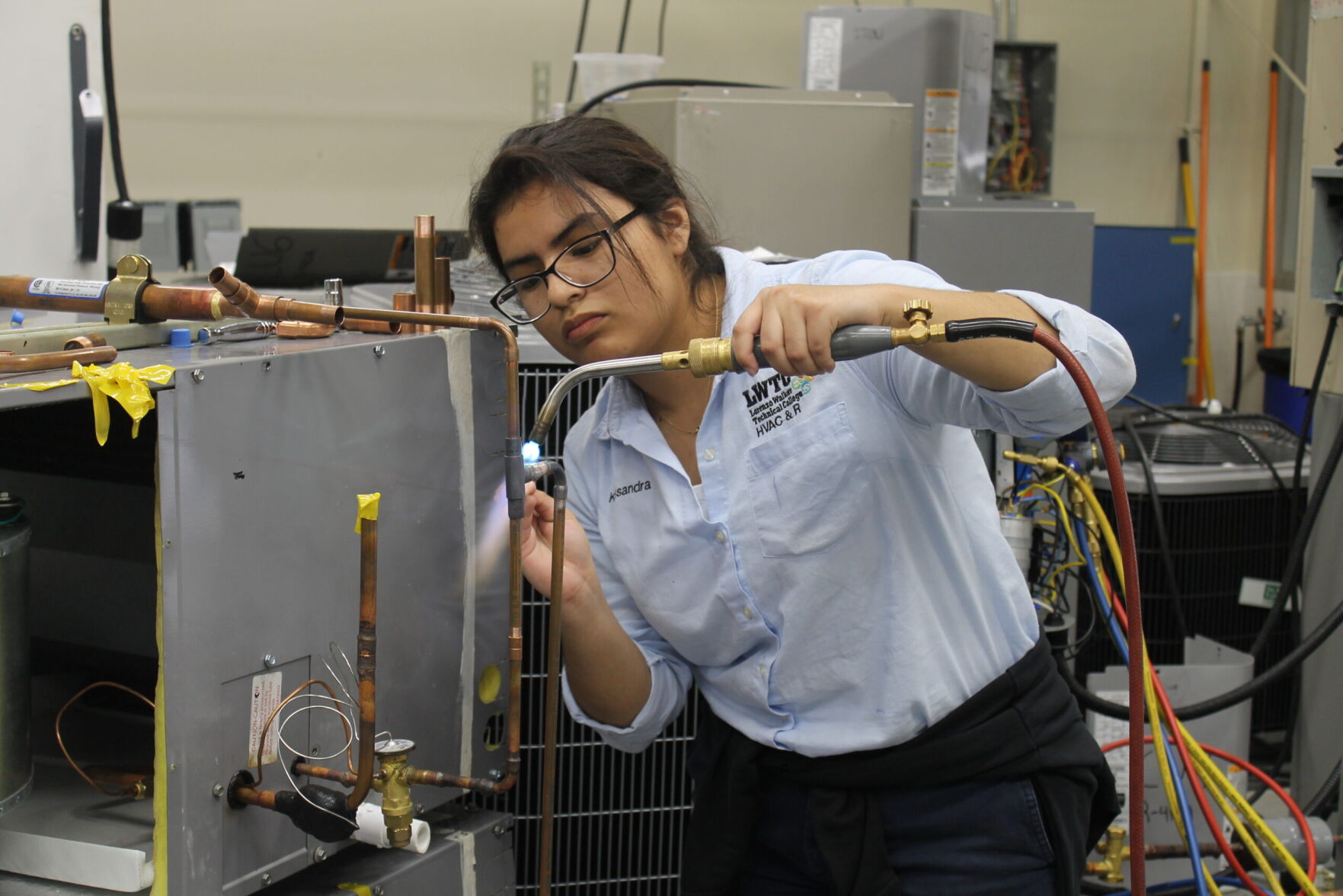
DeCarlo has hired several local graduates of CTE programs at Structure Medical. “They come to us with a very solid understanding of machining basics and certainly have the aptitude we’re looking for,” she says. “And we have some great success stories.” That includes a graduate of Immokalee Technical College, or iTECH, who started as an entry-level machinist and is now a shift supervisor. (DeCarlo has been a business adviser for iTECH for about 10 years.)
The company’s workforce is predominantly male, but there are several female CNC machine operators. “I would love to see more females participate,” she says. “It’s a great career for anybody who has that mechanical/technical aptitude.”
In Lee County, Mathews is starting to see some of that traditional gender disparity breaking down a little. “We’re seeing more and more women getting interested in being a firefighter, welder, electricians, blue-collar types of jobs,” he says. “What we’re seeing in Lee County is that the gender role in regard to a career pathway is not even really a concern anymore. It’s just whatever the student is interested in and what they’re excited about.”
For many local businesses, there are two things they would like to see when it comes to CTE: more programs to help meet their workforce needs and more students coming out of these programs. They think the school districts are doing a good job with their current offerings, but would like to see even more.
“Do I think that the number of programs out there is adequate? Absolutely not,” says Suffolk’s Wilson. “The fact is, we still are consistently losing more of our workforce to retirement than we are adding from other industries or education. If you consider the fact that the demand and the number of projects or opportunities in the skilled trades continues to grow, but we’re in a declining basis as far as the personnel that are attaching themselves to this industry, then right now you can say we’re kind of losing the race.”
According to the Southwest Florida Regional Housing Report from the Florida Housing Coalition and the Home Coalition, it’s estimated that the region’s population will increase by 294,461 people by 2035. To keep pace with that growth, some 13,330 homes will need to be added each year to the existing housing stock over the next 10 years. “All those new homes are going to need plumbers, electricians … all the things that really make our community work,” says Lee County’s Mathews.
Strong career and technical education programs are needed not only to supply the workforce for the related industries but also to keep the region as a whole functioning. It takes fabricators, machinists, mechanics, IT experts, electricians and other trades to keep cars on the road, planes maintained and ready to fly at the airport, bank transactions safe, the lights on at your favorite restaurant.
They also help fuel business growth in the region. Some students who come out of local CTE programs go on to start their own businesses, whether those are barber shops or plumbing companies. “We’re not only training individuals to go right into the workforce,” says Collier County’s Artime. “We’re training them so they can start their own small businesses … The impact that we have on our local workforce makes technical education such a valuable commodity within our community.”

Builders on a construction site
Meeting the future hands-on
With demand for construction trades high in Southwest Florida as the region’s population continues to grow, it’s never too early to prepare for jobs that can be well paid — with or without a college degree.
High school students in The Immokalee Foundation’s Career Pathways Construction and Engineering Learning Lab are gaining firsthand experience by helping build 18 homes in an Immokalee subdivision. As paid interns, the students work directly with contractors and subcontractors, including electricians and plumbers, who also get the opportunity to evaluate the students’ skills and potential as future project managers.
The Immokalee Foundation partnered with Naples-based BCB Homes on the project, which is being built on 8 acres of donated land. Twelve homes already have been completed and sold, according to Foundation President and CEO Noemi Perez; she estimates it will take another two years to finish the remaining homes. The project offers students experience in all aspects of residential construction.
“The students are able to have real hands-on exposure,” Perez says. “Through their internship, they’re working alongside subcontractors, who now get to see whether a student could be a potential employee.” Everyone is recognizing that this investment benefits them, she said, because these students may help fill high-demand positions in the future.
In addition to construction, students learn about land development, marketing and sales. The completed homes are sold at market rate to help fund construction of additional homes, according to the foundation.
The Career Pathways program launched in 2019 after The Immokalee Foundation, using data from the Florida Department of Economic Opportunity, identified career tracks in Southwest Florida that offer strong growth and opportunity, often without requiring a four-year degree. In addition to construction and engineering, Pathways include business management and entrepreneurship; education and human services; and health care.
Since its inception, the program has served more than 3,300 students. Dozens of local employers — including the Collier County Sheriff’s Office, Naples Comprehensive Health, Healthcare Network, Artis—Naples, The Naples Players, Arthrex, MHK Architecture and Ave Maria Utility Company — have provided internships and paths to industry certifications. Businesses also offer mentoring, guest lectures, career panels, networking events and field trips.
— Therese McDevitt
(0) comments
Welcome to the discussion.
Log In
Keep it Clean. Please avoid obscene, vulgar, lewd, racist or sexually-oriented language.
PLEASE TURN OFF YOUR CAPS LOCK.
Don't Threaten. Threats of harming another person will not be tolerated.
Be Truthful. Don't knowingly lie about anyone or anything.
Be Nice. No racism, sexism or any sort of -ism that is degrading to another person.
Be Proactive. Use the 'Report' link on each comment to let us know of abusive posts.
Share with Us. We'd love to hear eyewitness accounts, the history behind an article.