






Each time Southwest Florida resident Randy Badras returns from her morning bike ride, she steels herself. Her 97-year-old father, whom she cares for at home, has Alzheimer’s, and any day could be his last. “And then it’s over,” she says. “That’s really what we’re waiting for.”
What began as occasional help has become a full-time obligation. Her mornings are her only moment of pause, as her husband feeds her father breakfast while she pedals alone with her thoughts.
As Alzheimer’s cases rise across Florida and nationwide, more people are juggling caregiving alongside work and family life. Nationwide, more than 11 million Americans provide unpaid care for loved ones with dementia, according to the Alzheimer’s Association. Many are also raising children, managing careers and trying to stay afloat mentally, emotionally and financially.
Badras’ world has shrunk. Even casual conversations feel draining, a sign of the burnout many full-time caregivers experience.
“The first thing people ask is, ‘How’s your dad?’” she says. “Not, ‘How are you?’”
The cost of care
There’s no “happy ending” with cognitive decline and added dependency, said Eric Brown, president of the in-home care agency Assisting Hands Naples.
Brown runs the company from a client-focused mindset after helping his mother as she experienced Alzheimer’s. Assisting Hands provides relief to family caregivers through comprehensive services from trusted employees, not contractors. Nurse registries use independent contractors, which can lead to limited oversight and potential risks, Brown said, while direct-employee agencies maintain control over caregiver quality, training and supervision.
Brown urges people seeking care to determine whether caregivers are direct employees or independent contractors, and to be proactive in searching for the right fit rather than waiting for a crisis and scrambling for relief.
“There have been so many cases where, if people had called us before, their mother or father wouldn’t have fallen and broken their hip and changed their whole life as a result of that catastrophic fall,” he says. “Don’t wait until there’s a crisis. The right support can prevent life-altering injuries or emergencies,” which can help financial stability and protect a family caregiver’s peace in an uncertain time.

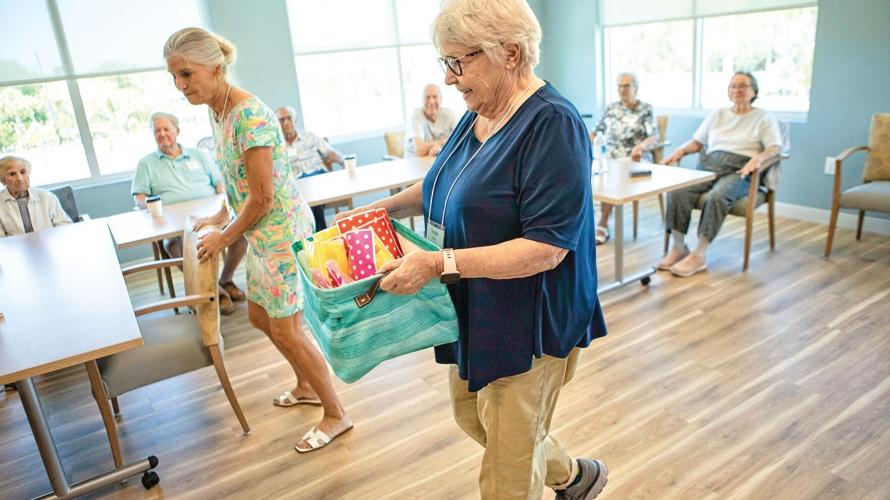
Baker Senior Center Naples’ Dementia Respite Program provides four hours of meaningful engagement for participants while easing the load on caregivers.
A public health emergency
“Caring for someone with dementia really upends your life,” says Jaclynn Faffer, president and CEO of Baker Senior Center Naples. “Everything changes.”
That can significantly affect the well-being of Southwest Florida’s community, as Alzheimer’s is projected to increase by 30% in Florida over the next decade.
To help lighten the load for family caregivers without full-time help, Baker Senior Center offers three tiers of support: caregiver education, community training and its signature Dementia Respite Program — a four-hour day event that keeps individuals with dementia engaged while offering caregivers a vital break.
“It’s not day care,” Faffer says. “Participants are involved from the moment they walk in. They eat lunch together. And those four hours give caregivers a chance to go to the doctor, run errands or just take care of themselves.”
Families must seek the appropriate level of assistance as loved ones’ Alzheimer’s and dementia cases escalate, even if there’s initial resistance, backed by either guilt or overestimated ability.
“I didn’t want to use a facility,” says Stacie Ricci, whose husband of 46 years developed Alzheimer’s and vascular dementia. “I thought I could manage with a little help.”
But as his condition worsened, he became paranoid and aggressive. He accused her of stealing, and police were called. Eventually, he was moved to a memory care facility.
“I just feel like he was taken away from himself,” she says. “He can’t ever be who he was again.”
Now, she visits him often, bringing treats and supporting him as she can, and therefore tending to her heart, as well. “Your spouse is still your spouse,” she says. “Just different. You have to keep showing up. Be present. Let them hear your voice.”

Baker Senior Center Naples’ Dementia Respite Program provides four hours of meaningful engagement for participants while easing the load on caregivers.
A culture of support
Organizations such as Alzheimer’s Support Network provide another layer of aid. The Naples-based nonprofit has operated for 44 years, offering more than 30 free monthly support groups, educational programming and one-on-one family consultations. Services are provided in-person and online, covering a range of cognitive diagnoses, including Lewy body and frontotemporal dementia.
Home health care, adult day care and memory care placement can range from $6,500 to $10,000 monthly, staff member Karen Rodino estimated. Very few families have long-term care policies, and Medicare doesn’t cover placement in a memory care community. As a result, families often end up self-funding these expenses, depleting savings, retirement funds, inheritances and other financial resources in the process.
For Badras, caregiver support groups offer rare emotional refuge. “I walk out of there smiling, feeling supported and heard,” she says. “It’s the only place where I don’t feel like I have to explain myself.”
For caregivers, self-care is less a luxury and more of a necessary way to recharge to continue meeting another person’s needs. It’s not a responsibility meant to be carried alone.
“You can’t be afraid to ask for help,” Badras says. “It’s hard for people to admit that there’s a problem. I know that’s where we were at. We had no idea what we were dealing with for the longest time. But, when you finally start talking to people, you start to understand more.”
With the proper care, relationships can still last, even if they look different.
(0) comments
Welcome to the discussion.
Log In
Keep it Clean. Please avoid obscene, vulgar, lewd, racist or sexually-oriented language.
PLEASE TURN OFF YOUR CAPS LOCK.
Don't Threaten. Threats of harming another person will not be tolerated.
Be Truthful. Don't knowingly lie about anyone or anything.
Be Nice. No racism, sexism or any sort of -ism that is degrading to another person.
Be Proactive. Use the 'Report' link on each comment to let us know of abusive posts.
Share with Us. We'd love to hear eyewitness accounts, the history behind an article.