






In Collier County, the arts are more than culture; they’re a catalyst for business, health care, education and community resilience.
They see the synergy between arts and business, improving outcomes from boardroom presentations to preparing a workforce primed with the social negotiation skills that role-playing with professionals can provide.
Even when life and death hang in the balance, the arts make a difference.
— The Naples Players has been at the vanguard of community collaboration, with actors simulating touchy patient interactions for medical training, or playing disaster victims for first responders. Some of its longest-running work has been creating business readiness for people who need to develop social transaction skills, such as STARability students and development students in Collier County Public Schools.
— Gulfshore Playhouse has developed corporate classes that use theater skills to create effective presentations, build teamwork and conduct negotiations.
— Individual artists have partnered with local businesses, providing their own art and availability at events. The artist may sell a work, and attendees learn something about the artist and their creative process.
To expand these initiatives, United Arts Collier, the county’s state-approved umbrella organization, is creating an arts and business advisory committee to explore partnerships.
“It’s not just us supporting, putting up luxury art images and experiences, but it’s about the community impact. We are providing community services in very real, very important and very effective ways,” says Elysia Dawn, UAC CEO.
Often the work of the arts community outside traditional fields is practically invisible, worries Bryce Alexander, CEO and executive artistic director of The Naples Players. People know how business supports the arts: They see sponsorship names on programs and even on buildings. But the arts return the favor by enriching the workplace in many ways. The Naples Players even has a term for it: applied arts.
“People need to understand how arts means big business here, how deeply it impacts our economy,” Alexander says.
“In many ways, it’s the exceptional programs we do that most people don’t consider ‘the arts’ that keep us deeply tied to the community in a way that helps us deal with uncertain times.
“We’re trying to demonstrate that arts truly connect so many different parts of our community. Whether you’re relying on the sheriff’s office in a crisis, going to the hospital for the best treatment or have a child with a disability who needs exceptional services, the arts can connect all those organizations and provide tools to make each area more effective.”

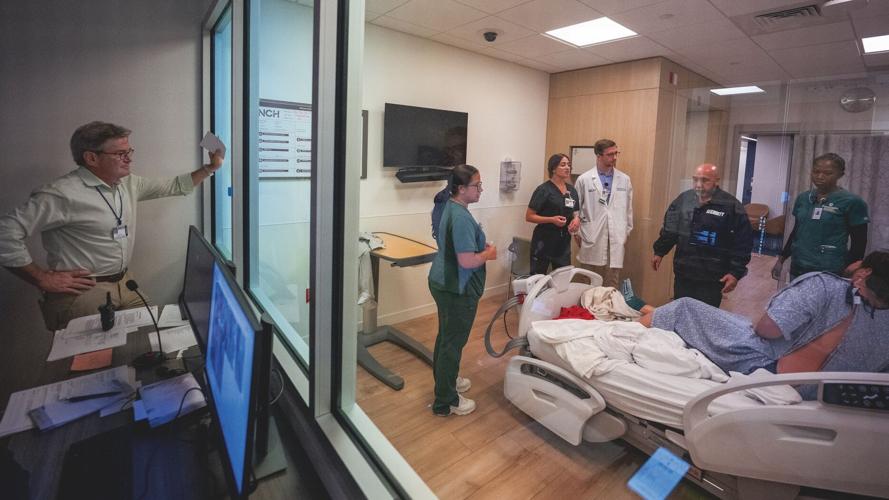
Medical Director Douglas W. Harrington keeps a close eye on the NCH staff and students works in a real life training simulation of its emergency room. Naples Players provides the "patients" who range from defiant to screaming in pain and the NCH staff-in-training works to calm and situate in a simulated training.
Taking care of business
Actors from The Naples Players are part of what keeps the two-year-old Judith and Marvin Herb Family Simulation Center at NCH busy, even apart from training its own employees and medical residents. Emergency response teams, Collier County Public Schools, universities and vocational institutes all contract to send employees and students here.
It has a level of training few other simulation centers offer. Trained actors from The Naples Players, known as the Trauma Troupe, play everything from the seriously wounded — a makeup artist applies realistic wounds — to combative or delusional patients.
Operations manager Hope Goodwin, RN, one of the small number of Certified Healthcare Simulation Educators in the world, noted that the Herb Center handled 20,000 learning hours from more than 5,000 professionals in training last year. While not every simulation involves a live actor, she and Douglas Harrington, DO, the center’s founder and medical director, see The Naples Players’ participation as critical.
“They’ve been instrumental in our success in training our doctors and nurses, making it very realistic by portraying real-life conditions like cardiac or psychological [crises],” Goodwin says. She credits the actors with “saving thousands of lives” because of the sense of reality they create: “It’s pretty amazing.”
On a recent afternoon, that brand of amazing materialized as a hostile patient who had ripped out his IV and was circling his bed like a caged tiger as two nurses and two residents tried to calm him enough for a sedative. It was well-polished theater for the actor, but a trial by fire for the attending staff.
“This kind of communication often isn’t taught to the full potential in medical school,” Harrington says. “In medical school, they’re learning about details, right and wrong. Here, this is more about soft skills, which are very important in modern medicine.”
Members of the Trauma Troupe also perform in large-scale simulations for the Collier County Sheriff’s Office, including potential active shooter situations or disasters such as structural collapses.
On a more everyday level, about 2,500 STARability and Collier County Public Schools students with developmental delays receive training each year with The Naples Players that puts them directly into situations they will face as employees. Craig Price, director of community enrichment, and Summer Pliskow, director of arts access, work with students at Sugden Community Theatre and on school campuses as needed.
“We’re just one of the classes they take to help them in those environments,” Price says. Their improv scenarios focus on critical people skills, teaching everything from body language to nonverbal cues and, of course, emotions — their own, their co-workers’ and their customers’.
“There’s a whole emotional game, where different customers will come up to them using different emotions, and they deal with those customers in a fun and interactive way,” Price says.
There’s even a session on resumes and job applications. It’s working, they believe. Price attended the 2025 graduation of the Life group at Barron Collier High School, one of these special-student programs: “There were probably all but one in a job.”

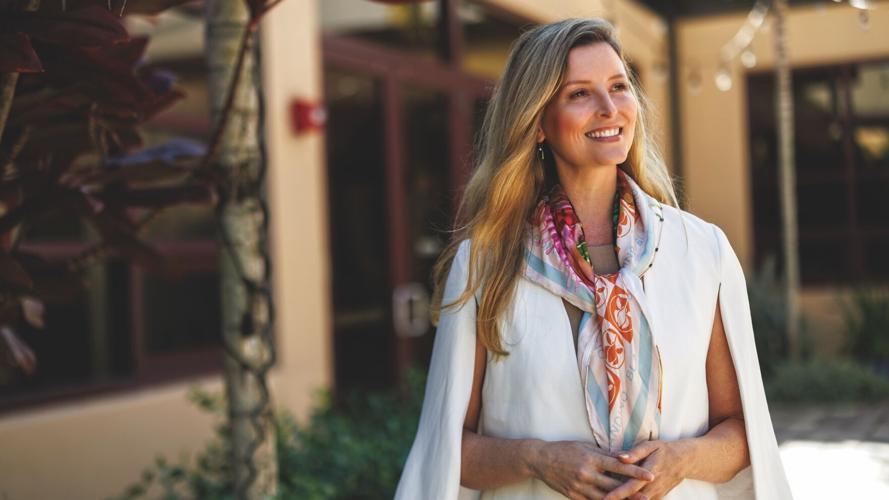
Elysia Dawn, CEO of United Arts Collier, says the organization is “providing community services in very real, very important and very effective ways.”
To make your case
Theatrical drama demands understanding the dynamics of group communication — a perfect fit for corporate conference rooms and meetings. With that in mind, Gulfshore Playhouse, in its new facility at 100 Goodlette-Frank Road, has begun offering Drama-Based Corporate Training.
“People aren’t jumping at it yet,” says Kristen Coury, founder, CEO and producing artistic director of Gulfshore Playhouse. “In our defense, we hadn’t planned on starting this until January of this year. Once we put it on our website and through connections with Leadership Collier, someone reached out to me and asked if I knew anybody who offers corporate training. I said, ‘We do — of course we do.’”
The team then scrambled to solidify a program aimed at enhancing team building, communication, leadership and creative problem-solving. They’re happy with it, and the reviews from Arthrex Co. employees confirmed they’re on the right track, pulling participants inside themselves to identify their strengths and use them.
“It exceeded our expectations,” says participant Janet Chow, of the company’s marketing technology department. Chow conquered one of her own demons — relying on notes for presentations: “It was a real security blanket having notes typed out to whatever specificity.”
She found confidence from Coury’s account of her own path to public-speaking success, and Chow promoted the class to her co-workers, who went one step further: “They decided to take the acting class,” she says.

Gulfshore Playhouse is taking the stage to the workplace with its new Drama-Based Corporate Training program, designed to sharpen communication, collaboration and leadership skills.
Creativity in the office
On a national level, Americans for the Arts has advocated arts-business synergy through its pARTnership Movement, following research showing 64% of the working population believes the arts make them more creative, which helps them in the workplace. Further, 55% said their jobs require creativity.
The pARTnership Movement highlights success stories such as an Adobe Systems project inviting employees to create book covers for teenage writers in its community and murals at Jiffy Lube shops in Indiana that both showcase regional talent and make the buildings instant landmarks.
In Naples, several businesses in the Bayshore Arts District have made locally produced murals their calling cards. Collier County Museums has celebrated creativity with an exhibition of county employees’ art.
In January, Moran Wealth Management hosted an exhibition of local art expressly themed to stage performances. A Raymond James end-of-season mixer for clients and friends swapped the art on its walls for works by local artist Joan Sonnenberg. She was invited to share her art stories with guests in what became a pop-up gallery.
“It was because I have an account there. Maybe that helps a little,” jokes Sonnenberg, but she was underrating herself. Several of her pieces were part of the Raymond James office design long before the mixer.
It was a two-for-one. Both the financial analysts and the artist met new people. “And I sold a painting!” Sonnenberg says.
‘Just a Pint’
“I don’t want any medicine. I want my vape. I want my vape. Please. Somebody give me my vape. I need it. You don’t understand. It’s the only thing that’s going to calm me down. It’s in my pocket. Please help me!”
Dale, the “patient” at the Judith and Marvin Herb Family Simulation Center at NCH, is an agitated man in his mid-40s, set against any medication but with a stomach in flames and a nervous disposition that favors alcohol and nicotine as sedatives.
He paces the room, shedding a simulated IV and ripping up the freshly made bed in a vain attempt to find his vape pen. Rasmussen nursing students and two residents in training speak distinctly and firmly, and they do not send away the assistant who has come in with restraints.
“He’s here because we don’t feel safe right now,” one resident explains. As they work to calm Dale, they know they’re being watched by Douglas Harrington, DO, the pulmonologist who is medical director of the center and who championed its establishment. What they likely don’t know is that Dale — in real life, James Duggan of The Naples Players Trauma Troupe — is receiving earbud prompts from Harrington, speaking from behind a one-way mirror.
At Harrington’s behest, Dale begs for a drink. When asked about his alcohol consumption, his reply even takes Harrington by surprise and nearly makes the doctor chuckle.
“I don’t drink that much,” Dale declares earnestly. “Maybe just a pint. Every day.”
After a tense 10 minutes, a recorded announcement breaks the cycle: “End of scenario.” Duggan pops up, all smiles. The team in training will go through a debriefing with Harrington, who reports, pleased, that one of the residents forgot they were in a simulation and thought they were dealing with an actual patient.
(0) comments
Welcome to the discussion.
Log In
Keep it Clean. Please avoid obscene, vulgar, lewd, racist or sexually-oriented language.
PLEASE TURN OFF YOUR CAPS LOCK.
Don't Threaten. Threats of harming another person will not be tolerated.
Be Truthful. Don't knowingly lie about anyone or anything.
Be Nice. No racism, sexism or any sort of -ism that is degrading to another person.
Be Proactive. Use the 'Report' link on each comment to let us know of abusive posts.
Share with Us. We'd love to hear eyewitness accounts, the history behind an article.