





Southwest Florida’s warp-speed development of expanding roads, home communities, retail centers and commercial parks creates thousands of jobs. Planners, architects, landscapers, bricklayers, carpenters and roofers are among the most obvious; people who relocate and maintain gopher tortoise habitat aren’t on that list. But there’s money to be made, even if it’s not a get-rich-quick proposition.
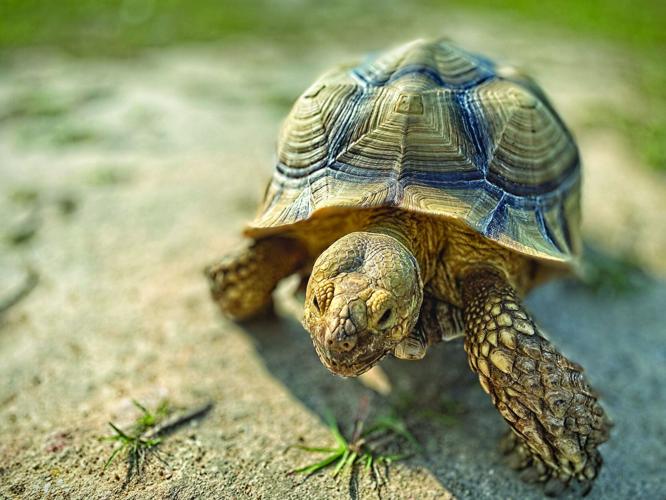
Because gopher tortoises are listed as a threatened species in Florida — the tortoises and their burrows are protected, so when they are found on a construction site they must be relocated, usually off-site — there are two parties that can make that money: companies that move the tortoises, and the landowners who give the tortoises a home.
Only agents licensed by the Florida Fish and Wildlife Conservation Commission can move gopher tortoises. Most agents work for firms that help builders get environmental permits and restore properties; Southwest Florida had 352 licensed agents through July, according to the FWC. The number of tortoise removal permits doubled to 100 in 2022 and then remained steady until this year, when 77 sites were permitted through July.
Jeremy Sterk, partner and principal environmental consultant for Earth Tech Environmental based in Bonita Springs, said his company doesn’t charge a lot for the service, and there’s not a lot of money to be made. Removing gopher tortoises is about 5% of Earth Tech’s business.
Business is fairly brisk, but it’s nothing compared with what was happening during the pandemic, said John Suleski, a registered agent who works for Natives of Corkscrew, now located in Buckingham.
“During the COVID boom, we were out there weekly moving tortoises. We did a couple of permits every week and were doing two to three relocations in a day,” Suleski says. “During the pandemic year we permitted about 100 sites.”
The company permitted about 40 sites last year, and expects to do the same this year.
The slowdown is most noticeable with single-family homes in Cape Coral, said Paul Owen, owner of Owen Environmental Consulting — but Lehigh Acres has kept him busy, along with some commercial projects.
Earth Tech removes tortoises from single-family half-acre lots to hundred-acr
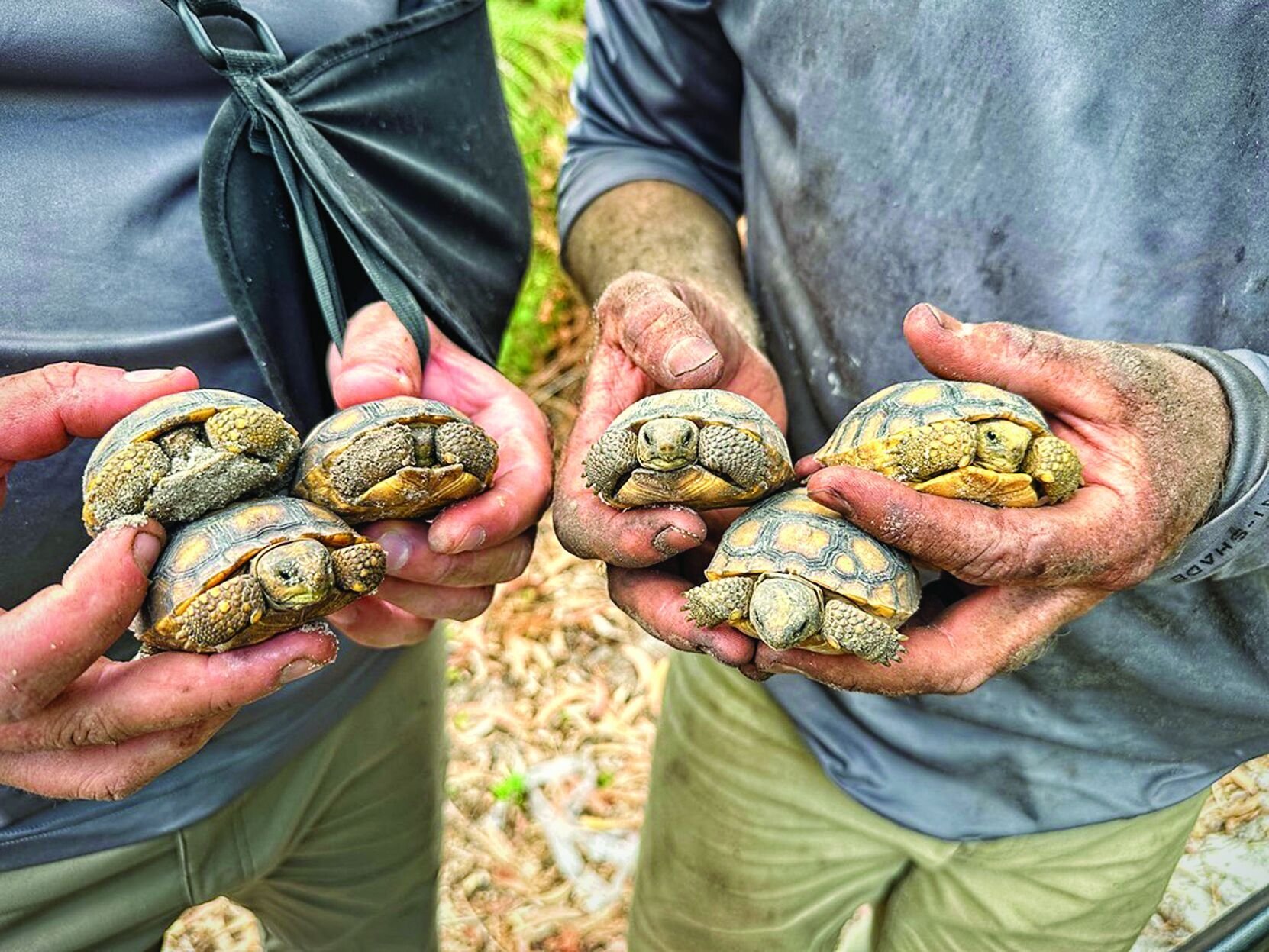
Earth Tech partner and principal environmental consultant Jeremy Sterk says the burrows are typically tied to the water table. Where the water table is closer to the surface, burrows will be shallower.
e projects, Sterk said. Natives of Corkscrew mostly works on quarter-acre to 2-acre lots and attempts to keep the tortoises on-site.
The owners of a single-family lot with only a few burrows can relocate the tortoises on their property if they take an online course. FWC has become more lenient, allowing on-site relocations because costs have increased, Sterk said; the agency requires recipient sites to be at least 25 acres.
The cost of moving tortoises varies with the size of the property and the number of burrows. Suleski said on-site relocation can cost between $8,000 and $10,000; the survey costs about $200, the permit is about $1,500 for 10 burrows or fewer. If the tortoises stay on-site, silt fencing is needed.
Using a backhoe to remove tortoises costs $3,500 to $5,000 a day, Sterk said. Backhoes are more efficient and cheaper than bucket trapping tortoises. A backhoe can dig out 10-25 burrows a day, he said. FWC requires an agent to visit a burrow for 28 days, twice a day in the summer, if using a bucket trap.
None of those costs include moving tortoises to recipient sites, which charge from $5,000 to $6,000 per tortoise. That price has almost tripled since the pandemic. Sterk said part of it is supply and demand, but it’s also true that creating a recipient site and maintaining it to FWC standards is challenging. There are 95 recipient sites in the state and 34 of them are in Southwest Florida, said Ryan Sheets, a FWC spokesperson.
“There was a rush several years ago to buy land for recipient sites, and then people realized with all the costs and everything you can’t make money just buying land and putting a conservation easement on it. The math doesn’t work,” says Josh Gamblin, who manages sites at five ranches. He also acts as a consultant to agents and works with large and small home builders and utility companies.
FWC permitting can take more than a year, said Betsy Clayton, Lee County’s communications director. The county has two recipient sites.
The sites must be upland; they can’t be placed in a jungle, Gamblin said.
The sites must have suitable soils and provide greater than 30% herbaceous plant cover, less than 60% canopy plant cover and less than 5% exotic plant coverage, Clayton said.
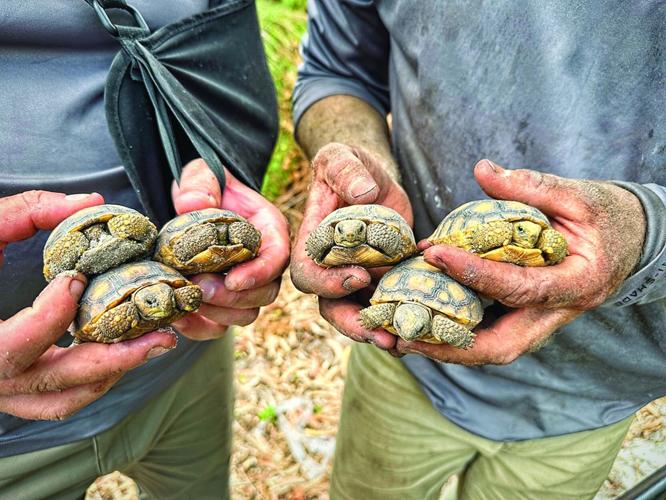
Getting the sites ready is just the start. Gamblin checks the health of each tortoise and collects data such as the sex, weight and length. Each tortoise gets a unique number before being taken to the burrow.
Temporary silt fences need to be put up and starter burrows dug for each tortoise released. Silt fences need to be kept for six months before being removed. The site has to be maintained in perpetuity, even if it no longer receives tortoises.
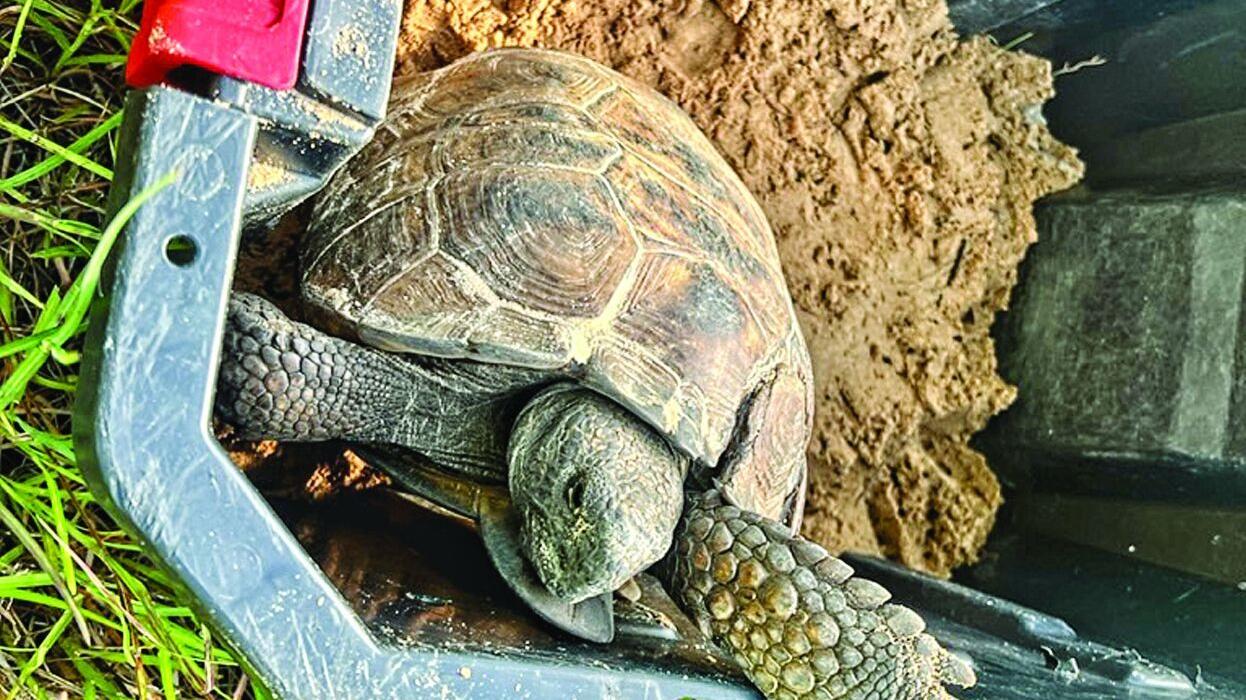
Earth Tech partner and principal environmental consultant Jeremy Sterk says the burrows are typically tied to the water table. Where the water table is closer to the surface, burrows will be shallower.
Lee County will spend about $34,000 a year to maintain the recipient site at Bob Janes Preserve. Lee County said it can save more than $2 million by placing tortoises on its own site.
Charlotte County has its own site, but it is filled to capacity with 46 tortoises. Sanibel had a recipient site, but Hurricane Ian damaged it. Manatee County has a couple of sites; and Disney World has one of its own. Most of the recipient sites in Southwest Florida are in DeSoto and Highland counties. There are no sites in Collier County, and the only Lee sites are owned by the county.
“I’ve been trying to get a client to do a recipient site (locally) for a decade,” Sterk says. “But the reality is unless it’s very large land holdings and they had them for a very long time where your cost basis is low, it’s hard to make those numbers work.
“You can’t go out at today’s land rates and buy [300] and 400 acres and do the permitting and do the management it takes to set up a site, even at $6,000 a tortoise. The numbers don’t work.”
The costs do work if you are an established ranch or landowner, however. Ranches already are maintaining the environment through controlled burns, tree cutting and other conservation work, so recipient sites are getting bonus cash for something already being done.
“The recipient sites, they do turn a profit, but they’re not making a lot of money off it,” Gamblin says.
Sterk takes the tortoises he removes to Lykes Bros., and said creating recipient sites on its land makes sense. The large Florida-based agriculture company started its program in 2010 and now has about 10,000 acres. The FWC maps show about 25 sites scattered along U.S. Route 27 between LaBelle and Lake Placid in the Fisheating Creek conservation easement.

Earth Tech partner and principal environmental consultant Jeremy Sterk says the burrows are typically tied to the water table. Where the water table is closer to the surface, burrows will be shallower.
Lykes is permitted for 19,000 tortoises, with the potential for expansion, according to a company brochure. The company charges $6,000 per adult with a juvenile; $5,500 for a single adult; and $2,750 for a single juvenile.
The extra cash makes a difference for the Tiger Bay Ranch in DeSoto County, said Parker Hall, whose family has owned the ranch since 1938. More than 1,000 relocated tortoises call the ranch home.
“It’s a great deal for family ranches like ours because we’ve always had to come out of pocket to work on our habitat,” says Hall, who’s a full-time, Naples-based attorney. “It’s getting harder and harder to maintain.”
The family wouldn’t have been able to plant 3,000 pine trees last year without the extra money, or rebuild a fence they hope will last 30 years. “Without the [tortoise] money we would have had to save for 10 years to do it,” Hall says.
How to Remove a Gopher Tortoise
With bucket traps
Dig a hole in front of the burrow that fits a 5-gallon bucket; drill holes in the bucket to allow water to drain out. Place tin foil over the barrel, then sprinkle sand over it and then shade with palm fronds or other vegetation. The tortoise falls into the bucket when it leaves the burrow. Agents must check the buckets daily for 28 straight days, twice a day in the summer, and must start over again if a day is missed.
With excavation equipment
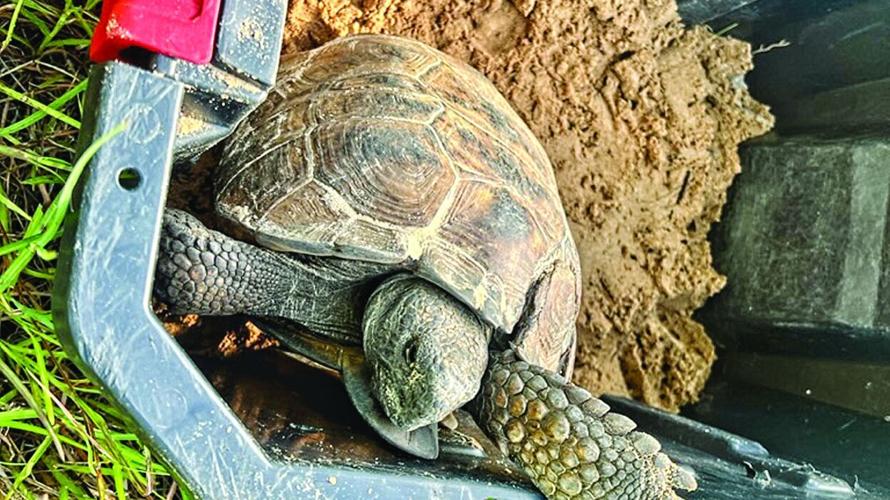
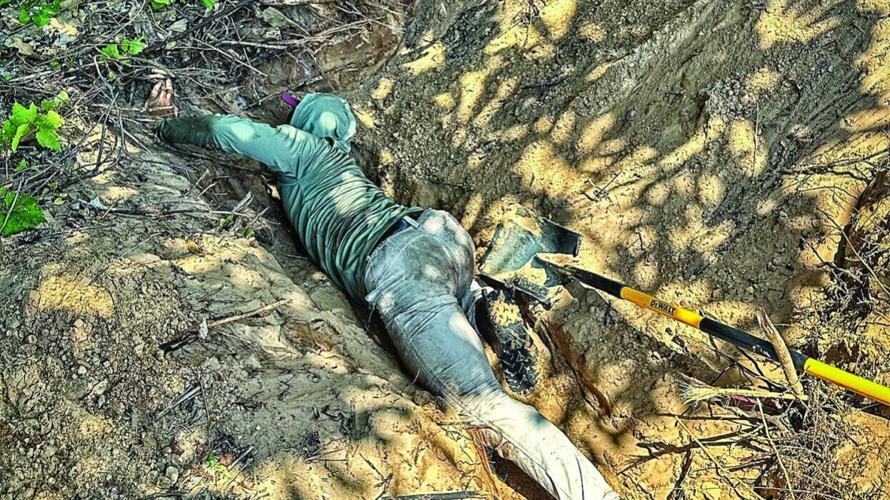
Excavation equipment is more efficient. Agents use a PVC pipe to get the tortoise to move to the back of the burrow so it’s out of the way, then the excavator takes one scoop at a time until you get down to the tortoise. The tortoise usually locks its legs against the sides of the burrows, and the backhoe has to keep digging around it until it can be picked up.
Source: John Suleski and Jeremy Sterk
(0) comments
Welcome to the discussion.
Log In
Keep it Clean. Please avoid obscene, vulgar, lewd, racist or sexually-oriented language.
PLEASE TURN OFF YOUR CAPS LOCK.
Don't Threaten. Threats of harming another person will not be tolerated.
Be Truthful. Don't knowingly lie about anyone or anything.
Be Nice. No racism, sexism or any sort of -ism that is degrading to another person.
Be Proactive. Use the 'Report' link on each comment to let us know of abusive posts.
Share with Us. We'd love to hear eyewitness accounts, the history behind an article.