






Florida voters will decide Amendment 3 on Nov. 3, a proposed constitutional amendment that would expand the homestead exemption and reduce the annual assessment cap on nonhomestead property. The measure would take effect Jan. 1, 2027, if approved.
A tax cut for Florida resident homeowners emerged early in 2026 as one of Gov. Ron DeSantis’ major legislative priorities. Some reasoned that its passage would be straightforward: Who wouldn’t vote to lower their annual property tax bill, potentially by hundreds or thousands of dollars?
“I’d vote for it,” Cape Coral City Council member Joe Kilraine quipped at a city meeting earlier this year, after suggesting that the Cape begin preparing early for budget shortfalls.
Amendment 3 could also force local governments to spend more wisely, supporters claimed. And ideologically, homeowners should be “free and clear,” DeSantis said, of paying what he described as a form of rent to the government.
DeSantis championed the proposal and the Florida Legislature in June approved adding Amendment 3 to the ballot. But they offered scant solutions for how local governments would make up the resulting revenue shortfalls, or the tax cut’s broader effect on the economy.
“I don’t think the homework was done,” Fort Myers Mayor Kevin Anderson said after a city budget meeting in August.
It was one of many such meetings across the state in which the potential pitfalls of Amendment 3 were discussed.
The measure has faced growing opposition from government leaders, economists, real estate professionals, police and fire associations and other groups. But voters will have the final say on Nov. 3. Like all proposed constitutional amendments in Florida, it needs approval from at least 60% of voters to pass.
Its central provision increases the homestead exemption on nonschool taxes up to $150,000 in 2027 and $250,000 in 2028. It also caps assessments on nonhomestead properties at 5% per year.

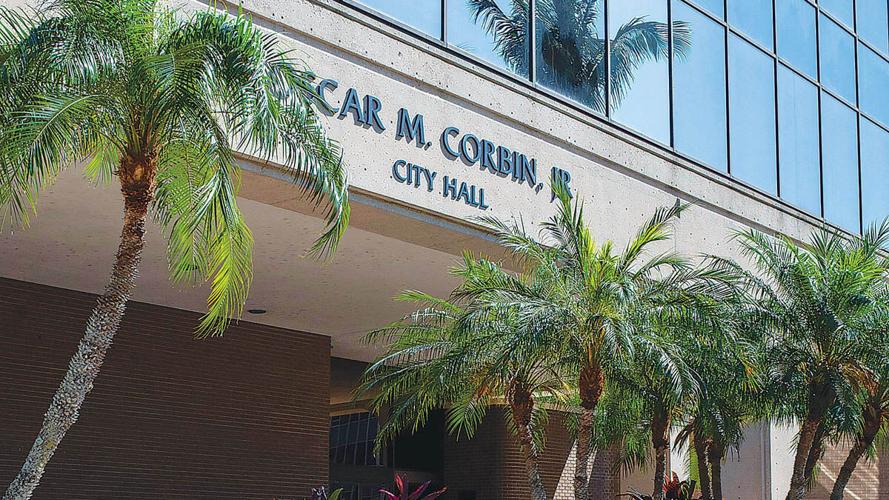
Fort Myers City Hall. City officials are among local government leaders considering how Amendment 3 could affect future revenue and spending if Florida voters approve the property tax measure in November.
The measure would reduce property taxes for qualifying homesteaded homeowners, and limit assessment increases on rental and commercial properties. But critics have raised concerns that it would merely shift the financial burden to renters, tourists or other groups.
Under increasing criticism, political enthusiasm for Amendment 3 has waned. DeSantis distanced himself from the measure, saying that he plans to vote “yes” but won’t campaign for it because the Legislature made several changes to his original proposal.
DeSantis wanted to make the measure even stronger by cutting school taxes and ultimately eliminating taxes for homeowners. His version also included a fund to help governments maintain services as taxes were phased out.
State legislators, too, have remained largely uncommitted to Amendment 3.
“It’s not up to us,” State Rep. Tiffany Esposito said in June during a panel discussion at a Real Estate Investment Society luncheon. “We simply said [that] you get to vote in November whether you want to get rid of property taxes or not.”
State economists estimate the amendment would reduce local-government ad valorem revenue by about $5 billion in its first year, with the annual loss growing to roughly $12 billion on a recurring basis by year five.
“Property taxes are the fiscal foundation of our local governments, accounting for nearly 79% of statewide municipal fund tax revenues,” the Board of Lee County Commissioners wrote to state legislative leaders in opposition to Amendment 3.

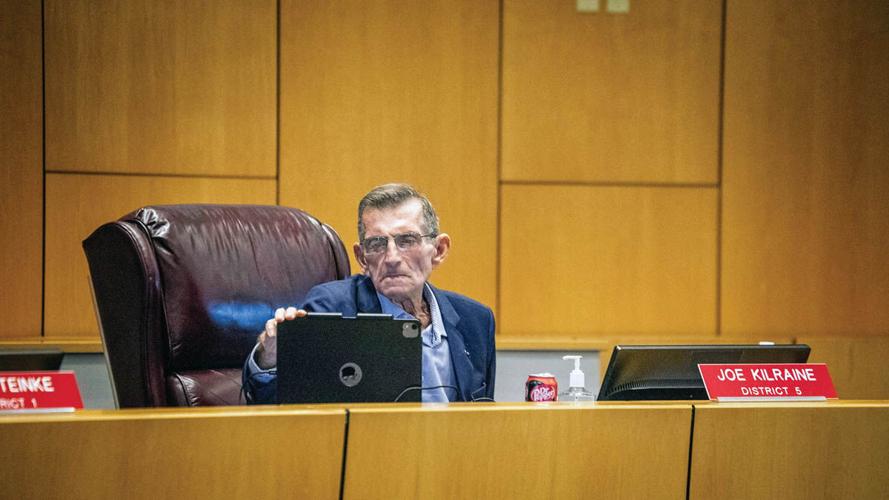
Cape Coral City Council member Joe Kilraine attends a council meeting. Cape Coral is among Florida local governments preparing for potential revenue losses if voters approve Amendment 3.
The Lee commission added that the cuts would affect public safety spending, “the largest expenditure category for most local governments.”
Lee County projected that it would lose $240.8 million in revenue per year starting in fiscal 2028-29. Cities such as Cape Coral and Fort Myers, along with others across the state, also forecasted steep losses.
For local governments, the options available to make up shortfalls include raising property tax rates, increasing or creating new fees for services, depleting reserve funds and making cuts to services.
Other potential revenue sources have been discussed, including higher sales taxes, expanded uses of tourist-development taxes and even a personal income tax.

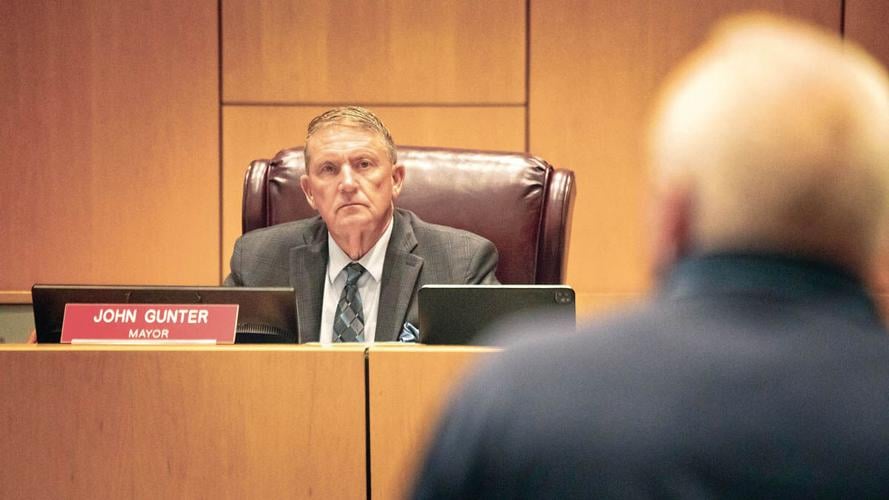
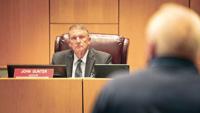
Cape Coral Mayor John Gunter attends a City Council meeting. Amendment 3 would expand Florida’s homestead exemption while reducing property tax revenue available to local governments.
Florida Gulf Coast University economics, finance and real estate professor Shelton Weeks has questioned whether Amendment 3 will really meet the goal of improving housing affordability in the long term.
Weeks argues that the measure could shift the tax burden to part-time residents and visitors, among other outcomes. And he points out that the blanket tax cut is a one-size-fits-all solution while Florida is made up of a patchwork of governments with different needs.
Weeks said the measure is intended to rein in governments that have been fiscally irresponsible, but would affect responsible ones just the same. Wealthier coastal counties may be in a better position to weather a shortfall than some inland counties where revenue comes almost entirely from property taxes.
“The idea of being able to enforce some fiscal discipline on any element of government sounds promising and worthy of investigation,” Weeks says. “But I don’t think we’ve given this quite enough thought with respect to those second- and third-order outcomes. Those are the ones that are likely to bite us.”

Shelton Weeks is a Lucas Professor of Real Estate and director of the Lucas Institute for Real Estate Development & Finance at Florida Gulf Coast University’s Lutgert College of Business.
Amendment 3
Official Ballot Language
A Florida circuit court ordered a rewrite of Amendment 3’s original ballot language after finding that some of its phrasing, including the title, was misleading and in violation of state law.
The revised ballot language is as follows:
Increased homestead exemption; lower cap on increases in nonhomestead property assessments
This amendment increases the homestead exemption, for all nonschool taxes, to $150,000 in 2027 and $250,000 in 2028, and adjusts for inflation thereafter.
It requires the Legislature to prescribe a uniform procedure for counties and municipalities, for their respective levies, to increase the homestead exemption up to full assessed value, and allows special districts, subject to referendum approval, to do the same.
Persons who are not Florida residents on December 31, 2026, will receive the existing homestead exemption upon qualifying for a homestead exemption, with the increased homestead exemption beginning with the fifth year of exemption, to the extent permitted by the U.S. Constitution.
This amendment reduces the annual cap on assessment increases for nonhomestead properties from 10% to 5%.
This amendment requires counties and municipalities to use property taxes solely for public safety, education and schools, infrastructure, natural resources, bond debt service, retirement benefits for employees, and operations and administration. Other expenditures may be approved by county officers or county or municipal governing bodies unless prohibited by general law, notwithstanding Article VII, Section 9(a) of the Florida Constitution, which allows counties and municipalities to levy property taxes for their respective purposes.
This amendment takes effect January 1, 2027.
The Other Proposed Amendments
While Amendment 3, the proposal to lower property taxes for homesteaded Florida residents, has drawn much of the attention, two other constitutional amendments will appear on the Nov. 3 ballot.
Amendment 1, listed as the Budget Stabilization Fund on the ballot, would increase the amount of money the state can retain in its “rainy day” account and require annual transfers to build the fund. Amendment 2 would exempt tangible personal property used for agricultural purposes and agritourism, such as farm equipment, from property taxes.
The Legislature overwhelmingly approved putting both amendments on the ballot. The House voted 100-1 for Amendment 1 and 110-1 for Amendment 2. The Senate voted 29-4 for Amendment 1 and 37-0 for Amendment 2.
The amendments need 60% approval by voters to become law.
Amendment 2
State economists estimate Amendment 2 would reduce local-government revenue by about $31 million annually, a fraction of the roughly $12 billion recurring annual reduction projected if Amendment 3 passes.
Amendment 2 would have little effect on Lee County’s budget, said Property Appraiser Matt Caldwell. “We have very little farm tangible remaining in Lee County,” he says.
Hendry and Collier counties have more agriculture, but property appraisers didn’t have budget numbers on how the amendment would affect property taxes if passed.
Amendment 1
The Budget Stabilization Fund was created as part of constitutional budget reforms approved by voters in 1992. The Florida Constitution currently requires the fund to maintain at least 5% of the previous fiscal year’s net general-revenue collections and caps the balance at 10%.
Amendment 1 would increase the maximum amount that may be retained in the fund from 10% to 25% of general-revenue collections. The Legislature generally would be required to transfer the lesser of $750 million or the amount needed to reach the 25% cap each year, although the amendment allows transfers to be suspended under certain circumstances.
Supporters argue the amendment would better prepare the state for an economic downturn or other revenue shortfall. Opponents argue the money required for annual transfers could be better spent on other priorities in the state budget.
The Budget Stabilization Fund reached about $4.9 billion in fiscal 2025-26 after the state added roughly $430 million, bringing it to its current constitutional limit.
— Sheldon Zoldan
(0) comments
Welcome to the discussion.
Log In
Keep it Clean. Please avoid obscene, vulgar, lewd, racist or sexually-oriented language.
PLEASE TURN OFF YOUR CAPS LOCK.
Don't Threaten. Threats of harming another person will not be tolerated.
Be Truthful. Don't knowingly lie about anyone or anything.
Be Nice. No racism, sexism or any sort of -ism that is degrading to another person.
Be Proactive. Use the 'Report' link on each comment to let us know of abusive posts.
Share with Us. We'd love to hear eyewitness accounts, the history behind an article.