
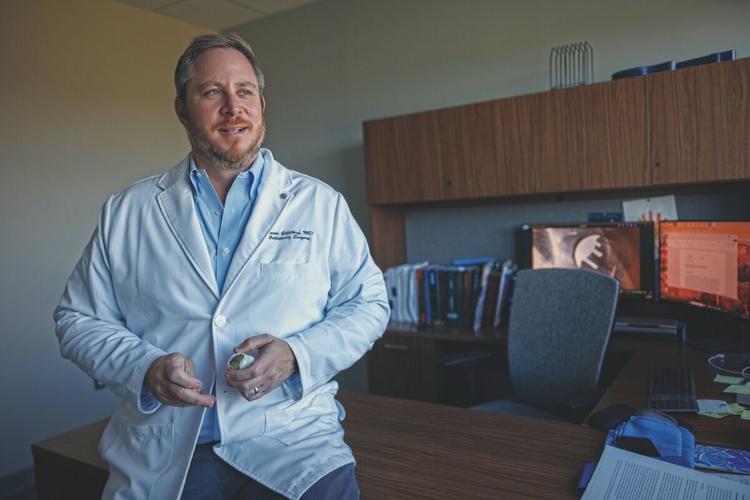


Naples orthopedic surgeon Dr. Steven Goldberg created a new model of shoulder implant shown to be more efficient for surgeons and less invasive for patients. That was the easy part.
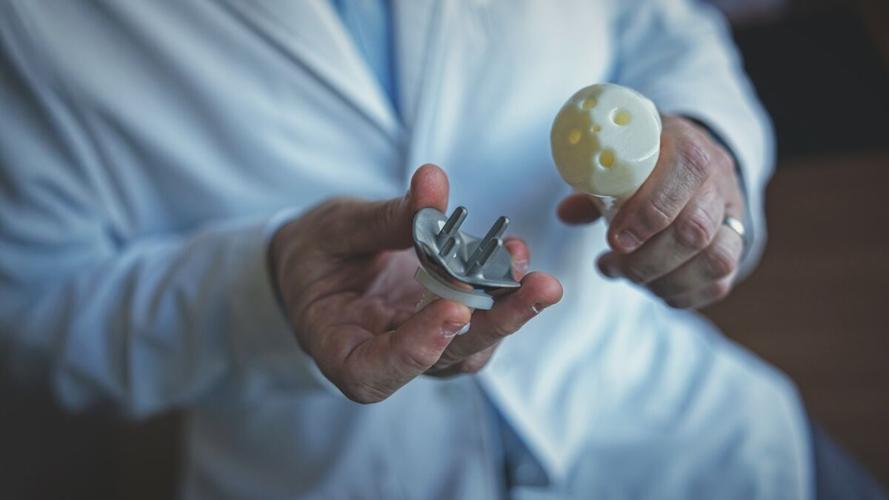
Goldberg excelled at designing ovoid-shaped shoulder implants to fit human bodies better than traditional ball-and-socket counterparts. He sketched early prototypes on paper, printed 3D models and even carved ideas into an onion. Approaching the design from a surgeon’s perspective, he created a prosthesis and surgical method intended to streamline operating room procedures while preserving more of a patient’s natural bone and tissue.
That part came naturally, but the marketplace demanded far more. To make his vision a reality required financial backing and business expertise beyond his scope. He finally found it, in part, with a group of Naples angel investors. They offered crucial startup funding for Catalyst OrthoScience, the company Goldberg founded in 2014 to manufacture his implants. Through that group, and among his own patients, he found expert advice on human resources, legal issues, FDA regulations and fundraising efforts that proved vital to Catalyst’s survival.
“Many of those things I found through my own patients or contacts here in Florida,” he says. “They’re right here in our backyard, and I was able to tap into their expertise. [Catalyst] was not a one-person project. It’s the collective contribution of many people.”
A second-generation doctor, Goldberg grew up in the 1970s and ’80s in Clifton, New Jersey. He studied chemistry at the University of Virginia before turning to medicine.
“It was neat to see the impact of the science on real people,” he says.

Catalyst’s anatomically correct, stemless implants streamline surgery, cutting 20–30 steps compared with traditional methods.
After medical school at Rutgers University, he headed west for a residency at the University of Southern California in Los Angeles before returning east for a fellowship at Columbia University in New York, one of the nation’s oldest and most prestigious schools for shoulder replacement surgery.
Despite his elite training, he was frustrated with the traditional process. “I thought my surgeries were technically more challenging than they should be,” he says.
Teachers and mentors encouraged him to pursue his new anatomically correct, stemless implant designs, but orthopedic companies turned him away. As a relative unknown, gaining credibility was difficult.
He took the advice of engineers who suggested seeking FDA approval and starting his own manufacturing company. Goldberg cited raising money as among the most difficult tasks — painstaking, time consuming and humbling. He gathered early funds from friends, family and orthopedic surgeons he asked to critique his design.
After nearly a year of full-time work and dozens of conversations and conference calls, he secured FDA approval and his first major source of startup capital from Naples-based Tamiami Angel Funds. The group invested $930,000 in Catalyst in August 2016, at the time its single largest investment.
“When we met Dr. Goldberg and he described his device back in 2016 it was revolutionary, not evolutionary,” says Angel Funds founder and chair Timothy Cartwright. “We said, ‘This is exactly what the Tamiami Angel Funds was meant to do.’”
To date, the group has invested $2.7 million in Catalyst. Angels invest what Cartwright calls “patient capital” in early-stage companies with the hope of a payoff down the line. Among its members, the group pools both financial and intellectual capital.
Catalyst now makes Goldberg’s signature Catalyst Complete Shoulder Restoration Total Shoulder System, along with four other product lines devoted to shoulder arthroplasty. CEO Carl O’Connell said that since 2014 the company’s products have been used in about 14,700 procedures by 480 surgeons. In addition to their anatomically correct, stemless design, Catalyst implants are promoted as more efficient in the operating room, with 20 to 30 fewer steps than traditional methods.
“We’re able to provide a very best-in-class, if not superior, product in a very cost-effective and efficient way without compromising quality,” O’Connell says.
The implants and surgical procedure have helped patients regain range of motion more quickly than traditional surgeries, and patients reported satisfaction over time, according to a study led by Goldberg and published in the Journal of Shoulder and Elbow Surgery in April. It followed more than 200 patients for five or more years.
This year, Goldberg stepped back from his leadership role as Catalyst’s chief medical officer and remains an owner-investor. He now devotes his time to his private practice in Naples, where he lives with his wife and three children. They chose the city for its weather and proximity to family. “Because it is such a nice place to retire,” he says, “there’s a huge amount of very smart and interesting people who have moved here and have incredible careers.”
(0) comments
Welcome to the discussion.
Log In
Keep it Clean. Please avoid obscene, vulgar, lewd, racist or sexually-oriented language.
PLEASE TURN OFF YOUR CAPS LOCK.
Don't Threaten. Threats of harming another person will not be tolerated.
Be Truthful. Don't knowingly lie about anyone or anything.
Be Nice. No racism, sexism or any sort of -ism that is degrading to another person.
Be Proactive. Use the 'Report' link on each comment to let us know of abusive posts.
Share with Us. We'd love to hear eyewitness accounts, the history behind an article.