
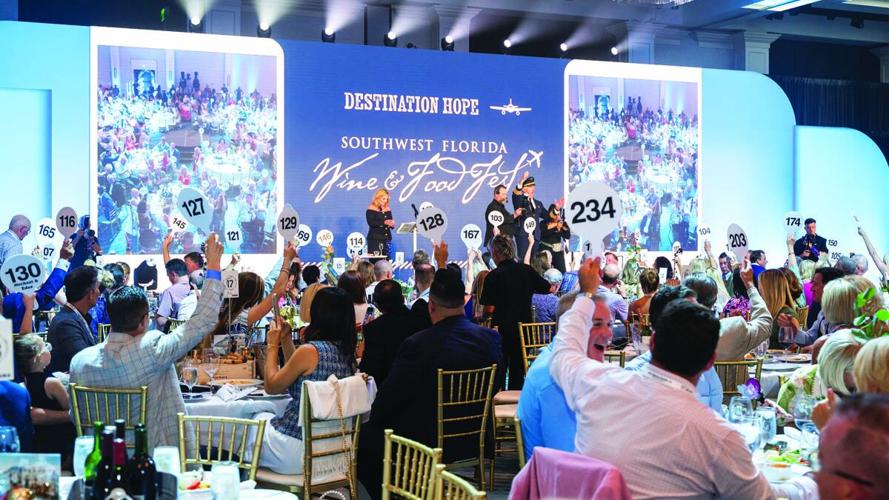




Guests raise their bidding paddles during a live auction at the Southwest Florida Wine & Food Fest’s Destination Hope fundraising event. The festival illustrates the philanthropic activity supporting nonprofit organizations across Southwest Florida.
When we think about the organizations that make Southwest Florida work, we often focus on businesses and government. Yet there is a third group that is just as important: nonprofit organizations.
As we drive through Southwest Florida, we see the region growing everywhere — new subdivisions, new schools, new traffic. What’s easier to miss, though, is the quieter infrastructure that helps to hold a growing community together: the food banks, shelters, youth programs, land trusts and community foundations that make up the region’s nonprofit sector.
Nonprofits provide services that neither the private sector nor government can always deliver effectively, filling gaps in the market and in our community’s infrastructure. They support families in crisis, expand access to healthcare and education, protect the environment, prepare communities for disasters, strengthen the arts and create opportunities for young people. In many cases, they address needs that would otherwise go unmet.
In a recent analysis at Florida Gulf Coast University’s Regional Economic Research Institute, we found that Southwest Florida’s nonprofit sector is substantial and growing. Using data from February 2026, the region had approximately 6,975 nonprofit organizations, up from 6,075 as of April 2020. Together, these organizations reported roughly $6.4 billion in revenue. Philanthropic and grantmaking organizations topped the list, followed by religious groups, human services, education and recreation.
But the raw growth numbers can be misleading in a region adding residents as fast as Southwest Florida is. What matters is whether nonprofit capacity is growing in step with the people who need it. On that score, the picture is less reassuring.
Southwest Florida had about 428 nonprofit organizations for every 100,000 residents, placing it near the bottom among Florida’s workforce regions. Put differently, each nonprofit in our region serves, on average, more residents than nonprofits in most other parts of the state. That suggests local organizations carry unusually large responsibilities relative to their number.
As new residents pour into the region, the nonprofit sector isn’t expanding fast enough to keep pace on a per-person basis. Fewer organizations per resident generally means thinner capacity to respond when people need help, whether that’s after a hurricane, during a housing crunch or simply in keeping up with routine demand for services.
Where Southwest Florida does stand out is telling. The region has an unusually high concentration of nonprofits focused on the environment, housing and shelter, recreation and animal welfare relative to their share across Florida. That’s not a coincidence. These issues reflect both the assets and the vulnerabilities of Southwest Florida — from its natural amenities to its exposure to hurricanes and housing pressures. They also illustrate both the amenity-driven appeal that draws people here and the challenges that follow.

Amir B. Ferreira Neto, Ph.D., director of the Regional Economic Research Institute at Florida Gulf Coast University.
When for-profit markets can’t keep pace with housing costs or environmental stewardship, nonprofits often step into the breach. That they’re doing so here in greater numbers than elsewhere in Florida says something about local need and local resolve.
As leaders, funders and residents think about what comes next for Southwest Florida, the nonprofit sector deserves a prominent place in that conversation — not just as a beneficiary of the region’s prosperity, but as essential infrastructure that needs investment to grow alongside it. Supporting nonprofits requires more than generosity during fundraising campaigns. It requires long-term investment in organizational capacity: professional development, data systems, collaborative networks, strategic planning and reliable operating support. Funders should consider not only which programs they support, but whether the organizations delivering those programs have the resources needed to remain effective.
Southwest Florida’s nonprofits are already doing essential work. The question is whether we will equip them to meet the demands of a larger, more complex and rapidly changing region.
Our community’s future also depends on the institutions capable of ensuring that economic growth produces opportunity, resilience and quality of life for everyone.
(0) comments
Welcome to the discussion.
Log In
Keep it Clean. Please avoid obscene, vulgar, lewd, racist or sexually-oriented language.
PLEASE TURN OFF YOUR CAPS LOCK.
Don't Threaten. Threats of harming another person will not be tolerated.
Be Truthful. Don't knowingly lie about anyone or anything.
Be Nice. No racism, sexism or any sort of -ism that is degrading to another person.
Be Proactive. Use the 'Report' link on each comment to let us know of abusive posts.
Share with Us. We'd love to hear eyewitness accounts, the history behind an article.