

Estero River Park and eco-spiritual Happehatchee Community Center, a 31-acre public preserve on the Estero River at U.S. 41 and Corkscrew Road, has been largely inaccessible since Estero acquired the property in 2019.
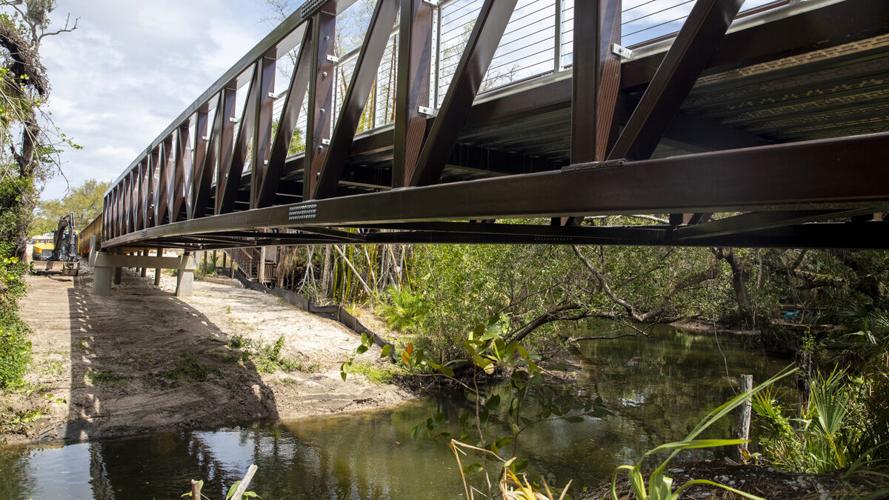
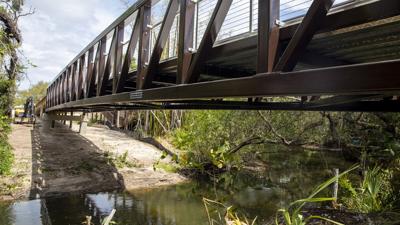
That is set to change in the coming months, with construction nearly complete on a new parking facility and pedestrian bridge on the north side of the river. The improvements will allow visitors to cross into the park and Happehatchee Center campus on the south side.
The 31-acre preserve is part of a larger 62-acre property divided almost evenly by the Estero River. It is among the village’s most prized acquisitions but remains largely hidden along one of the area’s busiest roadways.
On the portion north of the river, opposite the park, Estero officials are considering early plans for a 32-acre residential and commercial development. A village consultant said during a March 18 workshop the project could generate an estimated $400,000 to $600,000 annually to help fund park maintenance and programming.

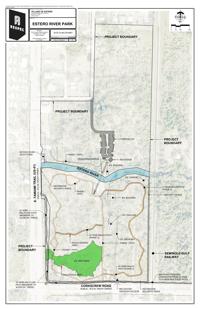
A site plan shows proposed trails, bridge access, parking and preserved natural areas within Estero River Park and the Happehatchee Center campus.
“We do believe there is a possible scenario that will allow us to generate an annual revenue stream from those potential relationships … to offset expense of the park to the south,” said Michael Comparato, CEO of Vieste.
Estero purchased most of the 62-acre property for $24.5 million in 2019. Included within it was a nearly 5-acre parcel owned by the nonprofit Happehatchee Community Center Inc.
That same year, the organization agreed to donate the parcel to the village to prevent development and honor the legacy of its founder, environmentalist Ellen Peterson.
Village leaders and Happehatchee officials signed an agreement to preserve the land and recognize Peterson’s legacy through elements such as commemorative signage, environmental education programming and maintenance of historic buildings and vegetation.
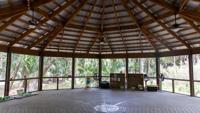
The Happehatchee campus includes bamboo and oak trees, a riverside boardwalk and a pavilion. The site was once part of a Koreshan settlement in the early 1900s, though it is separate from Koreshan State Park across the street. Girl Scouts later used the property before Peterson purchased it in the early 1970s and established an eco-spiritual retreat.
Peterson lived on the site until her death in 2011 at 87. Her obituary described her as “a fierce advocate for our wildlife and wild places.” She founded the nonprofit Happehatchee Center in the mid-1990s to protect the land from development.
While the nonprofit is no longer active, supporters remain involved. In 2024, Estero transferred management of the park and center to Estero Forever Foundation Inc.

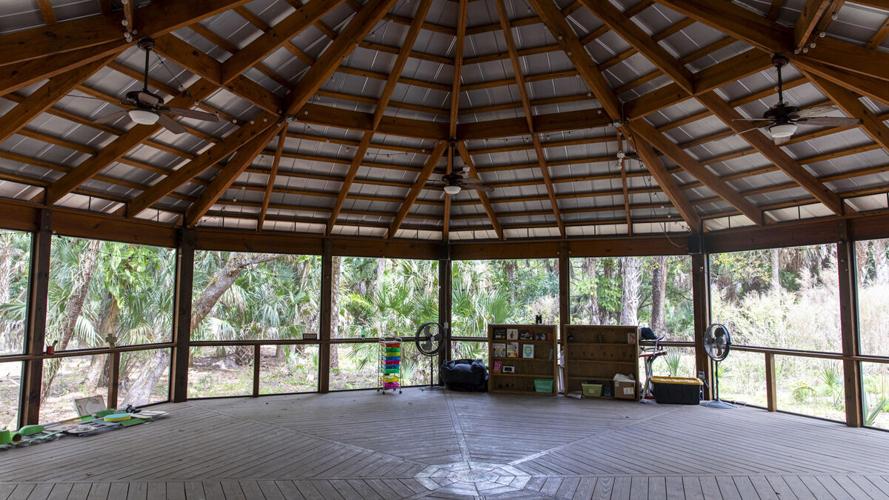
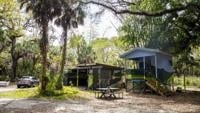
A wooden pavilion sits within the Happehatchee Community Center campus in Estero River Park, part of a 31-acre preserve along the Estero River.
Supporters, including former board president Genelle Grant, have urged the village to fulfill its agreement and open the preserve to the public.
“Seven years is a long time,” Grant said. “It’s a treasure. It should have been open to the public all this time.”
Village Manager Steven Sarkozy said the village is moving forward with its plans.
Phase I includes the parking lot, restrooms, pedestrian bridge and trail improvements, with completion expected in the second quarter of 2026. Phase II will add more trail work and a perimeter fence.
“I remain fully committed to our original vision,” Sarkozy wrote in a Feb. 5 email to Grant.

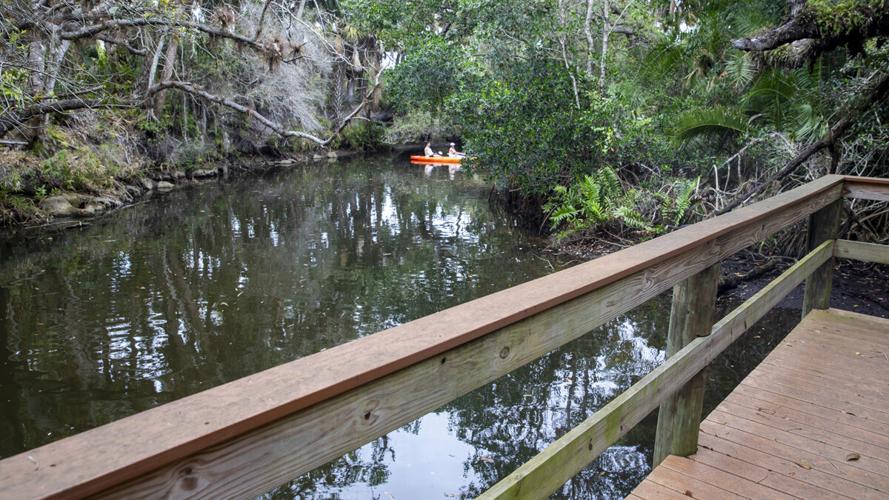
A boardwalk along the Estero River provides views of the preserve’s natural habitat as part of planned public access improvements.
He noted the village rezoned the entire 31.1-acre site as parkland and nature preserve, preventing future commercial development. The village also has developed a master plan with about $5 million in improvements, spent roughly $100,000 on maintenance and secured a $750,000 grant.
Sarkozy said Hurricane Ian delayed progress, along with environmental constraints such as a nearby eagle nest and complex permitting requirements.
“We also have been very frustrated that the project has taken so long to plan, design, permit and now construct,” Sarkozy said. “But the complications here are that we are building a bridge with the abutments over a sensitive floodway, and the permitting agencies have been very thorough in their review. We have also made sure we are maximizing grant funds available to get this done.”

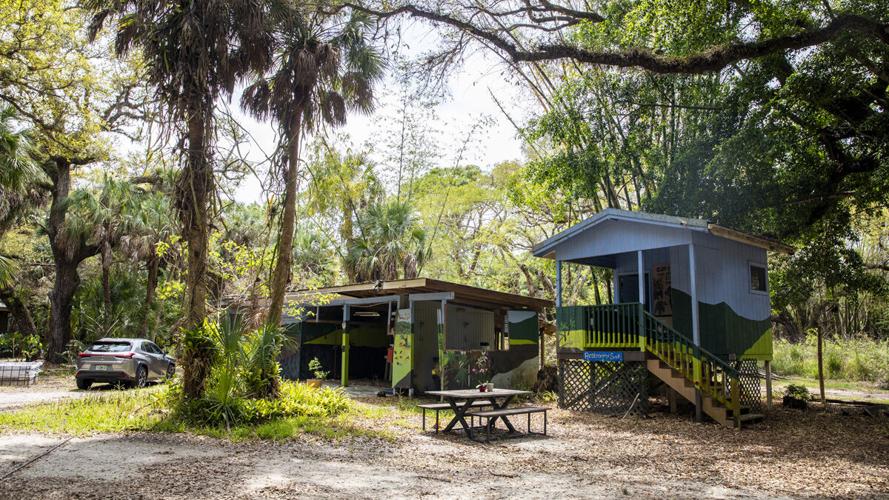
Historic buildings remain on the Happehatchee Community Center campus, reflecting the site’s legacy as an eco-spiritual retreat founded by Ellen Peterson.
Once the bridge is complete, the village plans to install a bronze plaque near the river honoring Peterson. In his update to Grant, Sarkozy wrote:
“Ellen’s work, championed by you and members of the Happehatchee board, has combined with efforts of the village of Estero to create and maintain, in perpetuity, one of the most unique natural areas in the region.”
(0) comments
Welcome to the discussion.
Log In
Keep it Clean. Please avoid obscene, vulgar, lewd, racist or sexually-oriented language.
PLEASE TURN OFF YOUR CAPS LOCK.
Don't Threaten. Threats of harming another person will not be tolerated.
Be Truthful. Don't knowingly lie about anyone or anything.
Be Nice. No racism, sexism or any sort of -ism that is degrading to another person.
Be Proactive. Use the 'Report' link on each comment to let us know of abusive posts.
Share with Us. We'd love to hear eyewitness accounts, the history behind an article.