
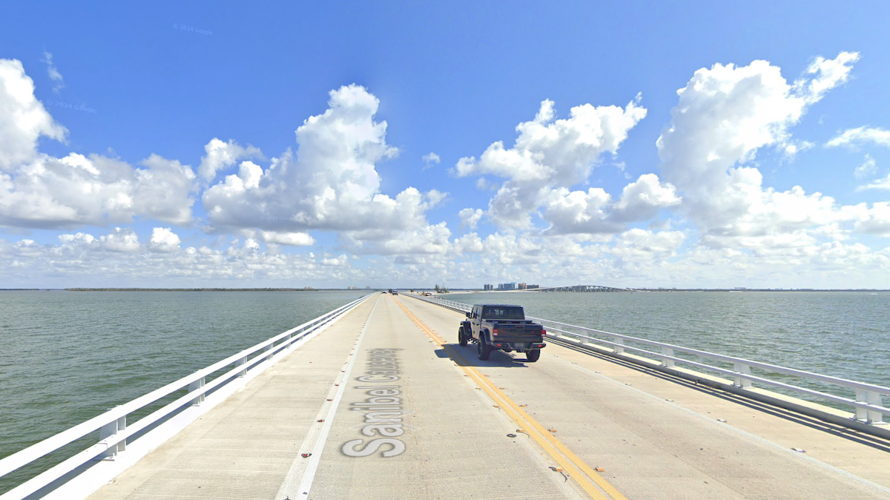



Sanibel officials hoped a stripe of paint could temporarily create a third lane on the Sanibel Causeway and ease peak-hour congestion. But a report by engineering firm Kimley-Horn found the roadway is too narrow for that approach to be viable or safe.
The only feasible option identified in the report is to build a third lane at an estimated cost of $36 million to $50 million or more, a project that would require approval from Lee County, which owns and maintains the causeway.
At a City Council meeting Dec. 16, all five council members voiced support for pursuing the second option, though no formal vote was taken. Congestion on the causeway is expected to worsen as Lee County’s population grows and visitation to Sanibel and Captiva islands increases while businesses continue recovering from Hurricane Ian in 2022.
“We know that bottleneck we have now is getting longer,” Vice Mayor Holly Smith said. “Our season is going to get longer again.”
Council members discussed potential interim measures, such as redirecting traffic or restricting bicycles during rush hour, but Kimley-Horn representatives said the 40-foot-wide road falls a foot short of the minimum width required for three lanes. Even that minimum, they added, may not meet permitting standards.
While Lee County could grant an exception to roadway standards, City Manager Dana Souza said he shared the report with Lee Transportation Manager Robert Price, who agreed with its findings. Souza said the county could face liability if an accident occurred on the bridge due to insufficient width.
“I think that’s why you don’t see a lot of exceptions on roadways with a bridge like this,” Souza said.
The city commissioned the Kimley-Horn study in June to examine ways to add a third lane to the causeway, the only vehicular access on and off the islands. During public workshops, residents suggested restriping the roadway to allow two outbound lanes and one inbound lane. Residents said outbound congestion during weekday afternoons and weekends affects emergency response times and quality of life.
Kimley-Horn compared the causeway’s dimensions with design standards in the Florida Department of Transportation Design Manual, the Florida Greenbook and guidelines from the American Association of State Highway and Transportation Officials.

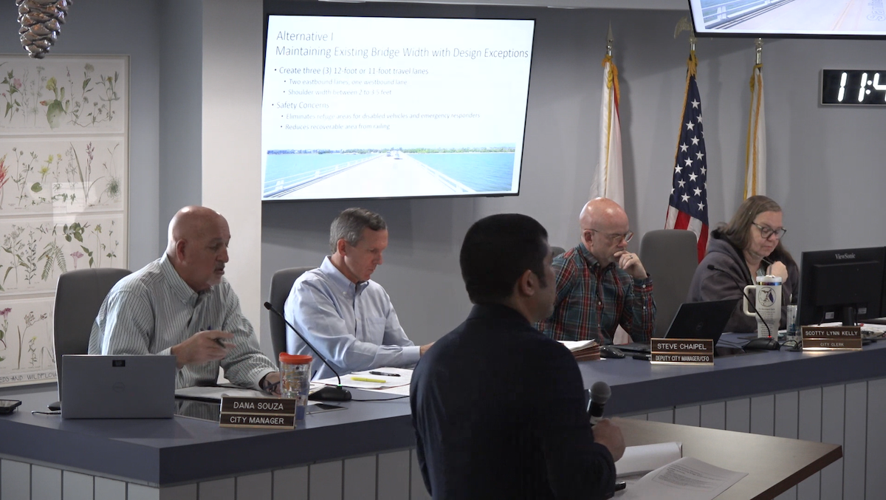
Sanibel city officials review design standards and safety constraints during a Dec. 16 City Council meeting, where an engineering report determined restriping the Sanibel Causeway to add a third lane would not meet minimum roadway width requirements.
The minimum standard among those agencies calls for 11-foot travel lanes with 4-foot shoulders, totaling 41 feet. Midrange standards require 45 to 53 feet, while optimal designs — with 12-foot lanes and 10-foot shoulders — total 56 feet. Wider roadways allow for bicycle lanes, safer emergency access and more recovery space for disabled or out-of-control vehicles.
Council members said discussions with Lee County would continue. No funding is currently allocated for the project.
“It’s an expensive, long process to even get that started, much less completed, but I think that’s what we’re faced with,” council member Richard Johnson said. “… I think we need to shift our focus to what can we do to work together with Lee County to add that additional lane if that’s what we’re going to get done.”
Mayor Mike Miller said funding would take years. “But we should start,” he said.
Council members also discussed reducing costs by adding a cantilevered or overhanging walkway to the bridges. Such a structure might support only pedestrian traffic but could add width to the roadway.
Council member John Henshaw pointed to South Seas resort on Captiva Island as a potential contributor to future traffic. In August, Lee County commissioners approved plans for 628 hotel and condominium units on 120.5 acres, overturning a 1973 zoning rule that limited development to three units per acre.
“There’s no other option but to redesign the bridge,” Henshaw said. “And that’s a county issue.”
(0) comments
Welcome to the discussion.
Log In
Keep it Clean. Please avoid obscene, vulgar, lewd, racist or sexually-oriented language.
PLEASE TURN OFF YOUR CAPS LOCK.
Don't Threaten. Threats of harming another person will not be tolerated.
Be Truthful. Don't knowingly lie about anyone or anything.
Be Nice. No racism, sexism or any sort of -ism that is degrading to another person.
Be Proactive. Use the 'Report' link on each comment to let us know of abusive posts.
Share with Us. We'd love to hear eyewitness accounts, the history behind an article.