
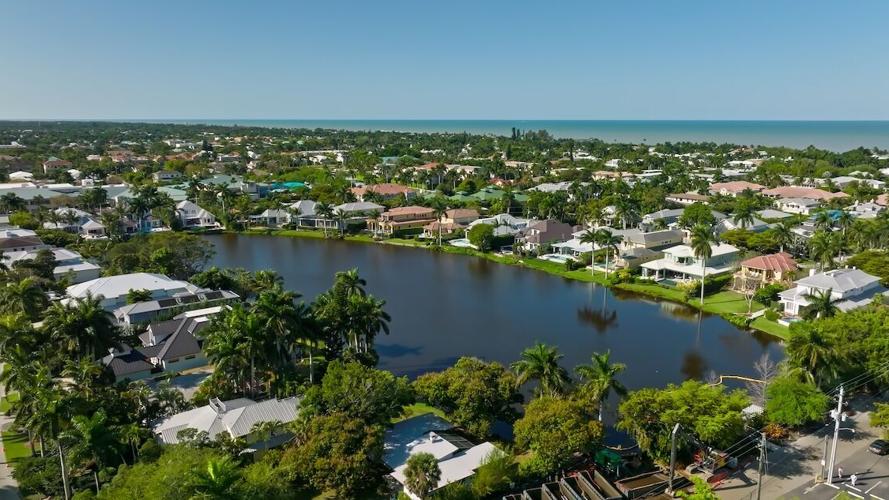




In Florida, half of all vacant homes are not waiting for renters or buyers. They’re waiting for vacationers to return to these part-time abodes.
A recent analysis by Compare the Market using U.S. Census data found that Florida has 1.48 million vacant homes, with 741,429 classified as seasonal or vacation properties — about 50% of the state’s unused housing stock, the report revealed. That share may help explain why full-time residents in Collier County are struggling to find affordable places to live.
Seasonal housing directly tightens the supply for full-time residents, said Michael Overway, CEO of the SWFL Regional Coalition to End Homelessness. “It also means that we have fewer units for people who are looking here year-round, like teachers, nurses, police officers, restaurant staff and service workers. It drives up the competition for that limited housing inventory.”
Overway pointed to the late 2022 surge in rents, which escalates — as housing prices do — as an example. “We were seeing apartments that had rented for $700 to $900 a month, now renting for $3,000 a month,” he said, adding that landlords often favor seasonal tenants willing to pay premium rates for short stays, which can push year-round residents out of the market. “It increases our housing pressure, which is already stretched.”
The ripple effects reached workers who historically would not need housing assistance. With the help of private philanthropy, “we were rehousing nurses at NCH, deputies at the sheriff’s department and government employees at a higher rate in 2023 than we had ever done in our previous 30-year history,” Overway said.
Local market data underscores the continued constraint on the housing pipeline. The Naples Area Board of Realtors reported a median closed price of $627,500 in January, with 67% of sales paid in cash, a sign of the market’s continued reliance on cash-rich buyers.

Michael Overway
Overway said snowbirds often occupy homes for less than six months, leaving units dark much of the year, which distorts both housing stability and economic balance.
Even with modest rent declines, affordability remains out of reach for many. Overway noted that households paying more than 30% of income toward housing are considered cost-burdened, yet many in Collier County exceed that threshold. “We’re still seeing folks that are paying in excess of 50% of their monthly income toward housing,” he said.
The gap in budget-friendly housing is well-documented locally. The Collier Community Foundation, on its website, estimated that nearly 54,000 households in the county are cost-burdened, and more than 16,000 households pay more than half of their income toward rent or mortgages. It also noted that Collier County is short more than 9,000 affordable rental homes for residents earning up to 60% of the area median income, leaving its lowest-earning households with few viable options.
Local government and developers have taken steps toward workforce and senior housing, but disparities endure for low-income residents. Overway said the community must expand affordable options or risk long-term consequences. He warned that if seasonal housing continues to dominate without deliberate investment in long-term affordable options, Collier County could face escalating rents, rising homelessness, workforce shortages and an economy overly dependent on tourism.
“When we create an imbalance like that,” Overway said, “ultimately tourism dollars may spike at the front end, but they’re going to fall sharply because those support mechanisms aren’t going to be there before community stability long term.”
U.S. Census data shows seasonal housing is not unique to Florida. In many resort counties nationwide, homes designated for seasonal, recreational or occasional use make up the largest share of vacant units.
In Collier County, Overway said the consequences are often misunderstood. “Most of the people that are experiencing homelessness are seniors who have been displaced, working families who have been displaced, single parents,” he said. “They’re just affected by economic imbalance.”
(3) comments
I lived and worked in Marco Island, i was priced out of there, i lived and worked in Naples in the retail and hospitality field, I moved 4 times to find a place I could afford and ended up working 3 jobs just to afford to live, I realized it wasn’t a life,and after over 20 years I decided enough was enough, I couldn’t do it anymore, I moved to fort myers, after a year there I was diagnosed with leukemia and could no longer work, I lost my job,home and car, I lost everything including my furniture I couldn’t pay storage costs! So I moved to Georgia, I could get decent health care which i could not afford in Florida, for people who have vacation homes and I witnessed this first hand, to them it’s just a play ground, to me it was my home and place of work, and this is not hate it’s a fact! Many people I knew moved out and commuted but they too got fed up of that !! Especially the time it took , and the cost of gas! Like me they also got annoyed with the traffic, when trying to get to work, there were tourists who at 8.00am were going too play golf!! They had all the time in the world, as they were on vacation but no they had to go when we were going to work, I can tell you from experience that they’re mixed feelings towards snow birds, on the one hand they boost the economy, on the other hand I found that every thing was geared to them like the residents didn’t matter, because after they left and over the years they stayed longer and longer and then bought properties that drove the price up and rent, and that’s a fact I witnessed it and was part of it, once upon a time you could rent a 2 bed, 2 bath in a nice community for $900 over looking a lake , but then the minimum went up to $1,300 and continued to climb and that was for a one bed , one bath overlooking the car park!!!
Which was why I had had 3 jobs, I worked and I’m not kidding 19 hours a day for 6 days a week, I refused to work on Sundays as I went to church then had to shop for food, do laundry etc it was no life that’s why I left, I didn’t want to it was my home, but I had no choice!!! And we found when the snow birds left most of the restaurants had limited hours, they didn’t want to pay staff, but more annoying was that even if you wanted to go out to dinner your choices were limited as the hours were not conducive to our work hours, a lot of people left, they like me looked for jobs elsewhere they got fed up and in turn businesses were short staffed because they was not enough people around to work and they had to rely on seasonal workers which they had to pay for and it wasn’t cheap!!
I remember even when I was there they tried to build affordable housing, only this time it was near a large community towards town, the HOA there ( who I feel has way too much power anyway in my opinion!) consisted of snow birds and along with others on other boards who were snow birds or had a vested interest stated that they were not going to allow them to build there as it would bring the price of their properties down!! I was angry at that comment, as if people who served them were lesser mortals , we are not just talking about restaurant workers , but fireman, police, nurses people who look after them! And believe me the hospitals run over during season we hear more ambulances and fire engines than any other time, my friend who’s a nurse says it’s because they go out in the boiling sun and don’t drink enough water and end up having a heart attack!
There is an Island off of England called Guernsey it’s next to Jersey and sark and is protected by England, I worked there many many years ago, it’s a lovely place to live and work, the locals there were having similar issues about the cost of housing and people who had been born and bred there were being out priced in the housing market and they were angry because they didn’t want to go anywhere else, so their solution was that if you were there you paid a certain price for rent and houses to keep the prices down for the locals, but if you were a mainlander ( like a snow bird but you came from the mainland, England for example even though that’s an island!) you paid double the price , that way it meant more affordable housing for the locals and kept the prices down, but also stopped other people buying a house for a vacation home and it laying empty when people needed a real home,unless of course you wanted to pay double ! It sounds unfair but it worked!!!
Anyway as someone who lived and worked there this is just my personal opinion and a few colleagues. It in no way perhaps other people’s experience, but it was mine, and I feel people should know about it!
Have a blessed day!
The argument, seasonal residents cause housing shortages, doesn’t make much sense. They obviously stimulate the construction business, so the ability of the area to create housing is increased.
Seasonal or vacation areas all around the world have special problems and opportunities. But, almost by definition this can’t be the root source cause of the problem you want to fix.
Look directly at at what can be done to increase the housing stock for less cost or what can be done to make folks economically more successful and you will be looking at real solution areas. (As hard as that might be.)
You are absolutely correct. Another point not cited impacting affordability the HOAs and real estate taxes. Many Collier County HOAs monthly payments are higher than the financed property (PITI) making unaffordable for the average buyers.
Welcome to the discussion.
Log In
Keep it Clean. Please avoid obscene, vulgar, lewd, racist or sexually-oriented language.
PLEASE TURN OFF YOUR CAPS LOCK.
Don't Threaten. Threats of harming another person will not be tolerated.
Be Truthful. Don't knowingly lie about anyone or anything.
Be Nice. No racism, sexism or any sort of -ism that is degrading to another person.
Be Proactive. Use the 'Report' link on each comment to let us know of abusive posts.
Share with Us. We'd love to hear eyewitness accounts, the history behind an article.