
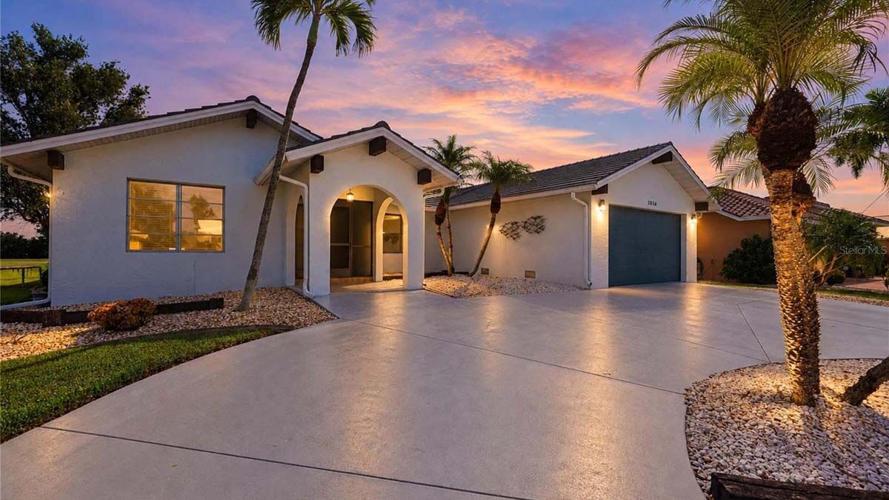


A home in the Burnt Store Isles community of Punta Gorda is shown Sept. 17. A proposed constitutional amendment on Florida’s November ballot would expand the homestead property tax exemption if approved by at least 60% of voters.
A local Realtor is advising would-be buyers who want to make a Florida home their primary residence to close on their purchase by Dec. 31 to potentially take full advantage of a proposed expansion of the state’s homestead property tax exemption.
Florida voters will decide Amendment 3, titled “Increased Homestead Exemption; Lower Cap on Increases in Non-Homestead Property Assessments,” in the Nov. 3 election. The proposed constitutional amendment requires approval from at least 60% of voters.
If approved, the amendment would provide qualifying homesteaded property owners an exemption on the first $150,000 of assessed value from nonschool property taxes beginning Jan. 1, 2027. The exemption would increase to $250,000 Jan. 1, 2028, with annual inflation adjustments beginning in 2029.
Carla Nix, owner of The Nix Team at Coldwell Banker Sunstar Realty in Punta Gorda, said those who establish Florida residency after Dec. 31 would have to wait five years to receive the increased homestead exemption. During that period, qualifying homeowners would remain eligible for the existing $50,000 homestead exemption.
“This has been the busiest summer I’ve ever had,” she said.
While Nix did not attribute the buying interest solely to anticipation of the amendment’s approval, she said, “people are seeing that prices are going back up.”
Many residents who plan to sell their homes travel during the summer and wait to list until more seasonal visitors return, contributing to fewer homes being available for sale in August.
More competition among buyers can help boost prices through supply and demand, Nix said.
Data from Realtors of Punta Gorda-Port Charlotte-North Port-DeSoto Inc. reflect tightening inventory in the local market.
Although September statistics won’t be available until October, August saw fewer active listings and a decline in inventory for single-family homes.

Carla Nix
There were 448 closed sales in August, compared with 528 in July. The median sale price was $350,000, mostly unchanged from July.
Sellers received 94.4% of their original list price, while transactions moved faster. The median time to close was 100 days, down from the previous two months.
Inventory fell to 2,277 homes in August from 2,422 in July, while the months’ supply of inventory declined to 4.7 months from 5 months.
Townhome and condo sales in Charlotte County followed a similar pattern, with fewer closed sales, a shorter time to sale and lower inventory.
The months’ supply of inventory for townhomes and condos stood at 5.9 months in August, compared with 6.4 months in July. Median and average sale prices also increased from July.
A balanced, or neutral, real estate market is generally characterized by enough inventory to meet buyer demand without giving either buyers or sellers a significant advantage. Lower inventory tends to favor sellers, while higher inventory generally gives buyers more choices and negotiating power.
Southwest Florida experienced an unusually strong seller’s market during the COVID-19 pandemic as demand surged and available inventory tightened.
The market slowed after the pandemic-era surge, but Charlotte County’s population has continued to grow.
Charlotte County Administrator Hector Flores recently cited findings from consulting firm Metro Forecasting Models showing the county’s population increased 5.5%, from 212,424 residents in April 2024 to 224,147 in February 2025.
Since June 2023, the county’s population has grown 11%. Metro Forecasting Models projects the population will reach 256,891 over the next five years, an increase of 31.1%, or 61,002 residents, from a baseline of 195,889.
The county’s historical annual growth rate since 1990 has ranged from 1.3% to 2.8%. Since June 2023, Charlotte County has added 10,994 housing units. From 2025 through 2030, approximately 17,000 additional housing units are forecast.
(0) comments
Welcome to the discussion.
Log In
Keep it Clean. Please avoid obscene, vulgar, lewd, racist or sexually-oriented language.
PLEASE TURN OFF YOUR CAPS LOCK.
Don't Threaten. Threats of harming another person will not be tolerated.
Be Truthful. Don't knowingly lie about anyone or anything.
Be Nice. No racism, sexism or any sort of -ism that is degrading to another person.
Be Proactive. Use the 'Report' link on each comment to let us know of abusive posts.
Share with Us. We'd love to hear eyewitness accounts, the history behind an article.