
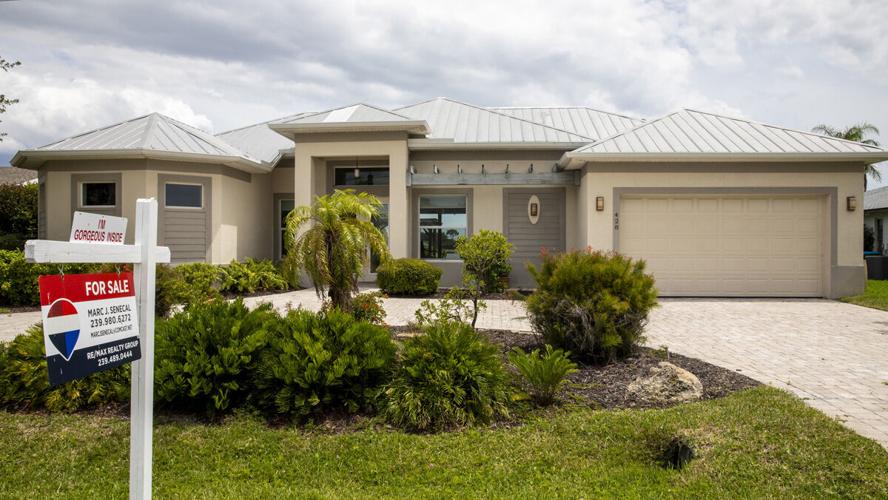









A home listed for sale in Southwest Florida. Supporters of Florida's proposed property tax referendum say expanded homestead exemptions could reduce tax burdens for owner-occupied residences.
Florida officials and real estate industry professionals expect a massive redistribution of public funding if voters approve a sweeping property tax cut for homesteaders in November.
Local governments have for years enjoyed increasingly valuable ad valorem tax revenue to fund basic public services and amenities. Now they’re reconsidering where else that money could come from.
“I think it’s just a shifting of money,” said Nelson Taylor, vice president of market research for LSI Companies in Fort Myers. “It’s robbing Peter to pay Paul.”
At a Southwest Florida Real Estate Investors Society luncheon in Fort Myers on June 9, a panel of regional delegates offered more questions than answers about where those shifts might occur.
State Sen. Jonathan Martin, whose district includes most of Lee County — including Fort Myers, Cape Coral, Estero, Sanibel, Captiva and Fort Myers Beach — summarized what lawmakers in Tallahassee see as the referendum’s two primary goals: making housing more affordable and encouraging local governments to spend more efficiently.
The referendum would reduce property taxes for homesteaded residences, but it also would force governments to either cut spending or find new sources of revenue. Legislators and industry professionals say the broader effects on renters, tourists, shoppers — and even homeowners — remain unclear.

State lawmakers participate in a panel discussion during a Southwest Florida Real Estate Investors Society luncheon in Fort Myers on June 9. The group discussed the potential effects of Florida's proposed property tax referendum on homeowners, investors and local governments.
Florida Gulf Coast University economics, finance and real estate professor Shelton Weeks attended the luncheon. Afterward, he questioned lawmakers' claims that the referendum could improve housing affordability or create greater fiscal efficiency, as well as the logic behind what he and others expect to be a widely popular amendment.
In the same way rising insurance costs played a role in softening real estate prices in recent years, he argued a housing tax cut could push prices higher.
“We’re told that it is to help with housing affordability, and it will help affordability for those folks who are already in place,” he said. “However, if you look at where this is likely to go, we should expect that the majority of the tax savings will be capitalized into real estate prices moving forward.”
He added: “So, I would not expect this — nor would I classify this as a ‘lever,’ to use the term that we just heard used in there — to improve affordability. We’re just talking about shifting the cost to somebody else.”
Gov. Ron DeSantis’ signature ballot measure, Save Our Homes from Excessive Property Taxes, was approved by the Legislature on June 2. Its core provision increases the cap on nonschool homestead taxes from $50,000 to $150,000 next year and $250,000 in 2028 and in perpetuity.
It also directs state lawmakers to develop a schedule to eliminate property taxes in coming years through general legislation.

State rep. Tiffany Esposito
“It’s not up to us,” State Rep. Tiffany Esposito, who represents parts of Lee County, including Lehigh Acres and portions of Fort Myers, said of the referendum. “We simply said you get to vote in November whether you want to get rid of property taxes or not.
“And now the conversation this summer, to (Sen. Martin’s) point, is, what does that mean? What does it mean for Lee County? What does it mean for Charlotte County? What does that mean for Collier County? What does that mean for the state? And does that affect the services we provide? If so, how?”
They were rhetorical questions.
“I personally love that we have mosquito control and sidewalks and streetlights,” she continued. “I like that we have those things. I would like to keep those things. Great. How do we pay for that? If it’s not property taxes, then what does that look like in the delivery of those imperative services for our community?”
Weeks outlined some potentially unintended consequences of what that could look like.
The referendum includes a measure that could help protect out-of-state property owners and nonhomesteaders, such as renters, by capping annual assessments on rentals, second homes and commercial properties at 5% instead of 10% per year.
Nevertheless, Weeks added: “We’re still likely to be shifting more and more burden to people who are essentially the visitors that drive the tourism segment of our economy. And that has long-term implications for us as a state.”
The referendum also affects governments unequally, not according to which ones are relatively more affordable or fiscally well managed. Cities such as Cape Coral rely more heavily on homesteaded property taxes than Fort Myers, which has a more diverse tax base.

The Fort Myers skyline is seen across the Caloosahatchee River. Analysts say Florida's proposed property tax referendum could have varying effects on local governments depending on their tax base and reliance on property tax revenue.
Wealthier coastal counties are in a better position than some inland counties where revenue comes almost entirely from property taxes.
Weeks is concerned that as state and local governments search for ways to make up shortfalls through measures, such as budget cuts, increasing sales taxes or raising flat fees or special assessments for services, it could create a more complex and inefficient system instead of improving fiscal management.
“The idea of being able to enforce some fiscal discipline on any element of government sounds promising and worthy of investigation,” he said. “But I don’t think we’ve given this quite enough thought with respect to those second- and third-order outcomes. Those are the ones that are likely to bite us.”
Real estate industry professionals also had mixed reactions to the referendum.
“I’m going to like it,” said commercial real estate broker Randy Krise of the tax cut. “But I’m afraid of what happens on the backside.”
He added, “There’s no free ride.”
Cape Coral residential Realtor James Sommers, who spoke to Gulfshore Business the day before the luncheon, called the referendum a double-edged sword.
“I think for owner-occupants, for homesteaded properties, it would make Florida more desirable,” he said. “Meanwhile, if it only increases the tax on investment properties, second homes and commercial properties, it may make Florida less desirable to those investors.”
Sommers added: “Yes, I believe anytime you offer the public free anything, it’s going to pass. Is it a political thing, where it’s the illusion of being tax-free?”

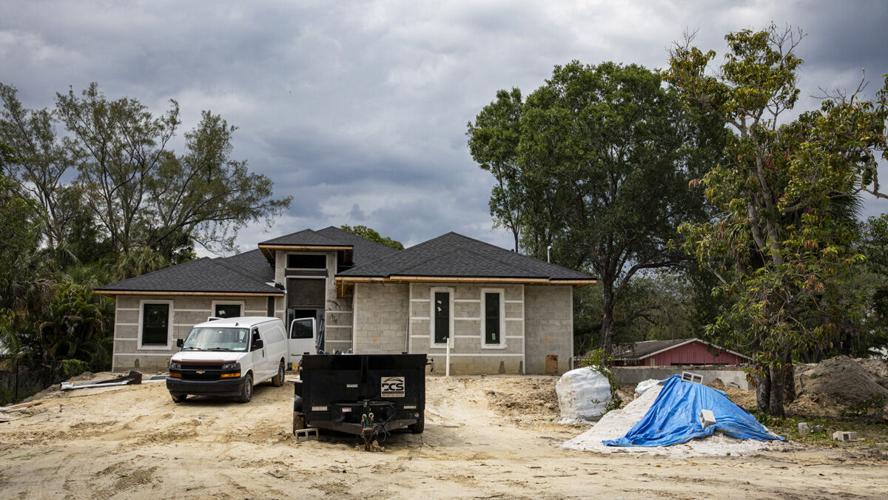
A home under construction highlights ongoing residential growth in Southwest Florida. Some economists argue Florida's proposed property tax referendum could increase housing demand and place additional pressure on home prices.
Real estate attorney and property tax consultant Mike Hagen spoke with Gulfshore Business on June 2 shortly after the Legislature approved the referendum.
“I think it’s going to be a boon for local real estate,” he said. “It’s going to be a big draw. My take on it is that DeSantis wanted something going out that people will remember him for and if it passes, I think they will remember him. He was the guy who was really spearheading it. Overall, I see it as a positive. It will require governments to tighten their belts a little bit, which in my opinion is a good thing.”
The Royal Palm Coast Realtor Association, Naples Area Board of Realtors, Punta Gorda Association of Realtors and the statewide group Florida Realtors either did not respond to a request for their position on the referendum or declined to take one.
“We are currently reviewing the legislation and evaluating its potential impacts before determining whether the organization will take a position,” wrote NABOR’s Danielle Hudson, vice president of public policy.
Florida Realtors President Chuck Bonfiglio replied by email that its members are reviewing the proposed ballot measure and its impacts.
“We remain focused on advancing policies that expand housing opportunities, support the growth of Florida’s communities, strengthen the state’s economy, and promote the long-term success of Florida’s real estate industry,” he wrote.
(3) comments
Whenever the floriduh legislature puts up an item for a voter approved amendment it is always detrimental for the citizens of floriduh if passed.
In June of 2025, Governor DeSantis vetoed a bill that would authorize a study of government property taxation, homestead taxation, and the spending of property tax revenues. The debate over eliminating Florida's homestead property tax centers on balancing direct homeowner relief against the long-term funding stability of critical local public services.
While Governor Ron DeSantis and proponents of the measure argue that eliminating ad valorem taxes on homestead properties provides immediate financial relief and protects residents from rising living costs, opponents and local officials emphasize that property taxes are the primary funding mechanism for local infrastructure. Because Florida has no state personal income tax, local governments rely heavily on these revenues to fund essential public safety and educational services.
Core Arguments for Elimination
• Homeowner Relief: Eliminating the tax provides a permanent financial cushion for Florida residents against inflation and rising housing costs.
• Bureaucratic Efficiency: Proponents argue that the state already understands the economic landscape and does not need to spend taxpayer funds on lengthy government studies to take action.
• Economic Freedom: Removing the tax burden allows residents to keep more of their hard-earned money, potentially stimulating local economic spending.
Core Arguments for a Comprehensive Study
• Funding Local Services: Property taxes directly fund county and city operations, including police departments, fire and rescue teams, public schools, and road maintenance. A formal study would clarify how these vital services would be sustained.
• Alternative Revenue Scenarios: Eliminating one revenue stream typically requires raising others. An analytical review by agencies like the Florida Office of Economic and Demographic Research (EDR) would project whether the state would need to increase sales taxes, implement new consumer fees, or cut local budgets to balance the deficit.
• Impact on Non-Homestead Properties: Without homestead property taxes, local governments might face pressure to raise tax rates on commercial real estate, rental properties, and second homes, potentially driving up business costs and rent for non-homeowners.
Key Considerations for the Evolving Policy
• Local Government Autonomy: Property taxes are collected and spent locally. Shifting to a state-controlled revenue replacement model could diminish the ability of individual municipalities to address unique community needs.
• Long-Term Financial Planning: A non-partisan government analysis is designed to identify unintended economic consequences before structural changes are permanently locked into the state constitution via a ballot measure.
Lindsay M. Harrington
Punta Gorda
Well stated Lindsay!
Welcome to the discussion.
Log In
Keep it Clean. Please avoid obscene, vulgar, lewd, racist or sexually-oriented language.
PLEASE TURN OFF YOUR CAPS LOCK.
Don't Threaten. Threats of harming another person will not be tolerated.
Be Truthful. Don't knowingly lie about anyone or anything.
Be Nice. No racism, sexism or any sort of -ism that is degrading to another person.
Be Proactive. Use the 'Report' link on each comment to let us know of abusive posts.
Share with Us. We'd love to hear eyewitness accounts, the history behind an article.