

NBA Commissioner Adam Silver marveled at the growth of Southwest Florida over the past 20 years and said the region could someday reconnect with the league he leads.
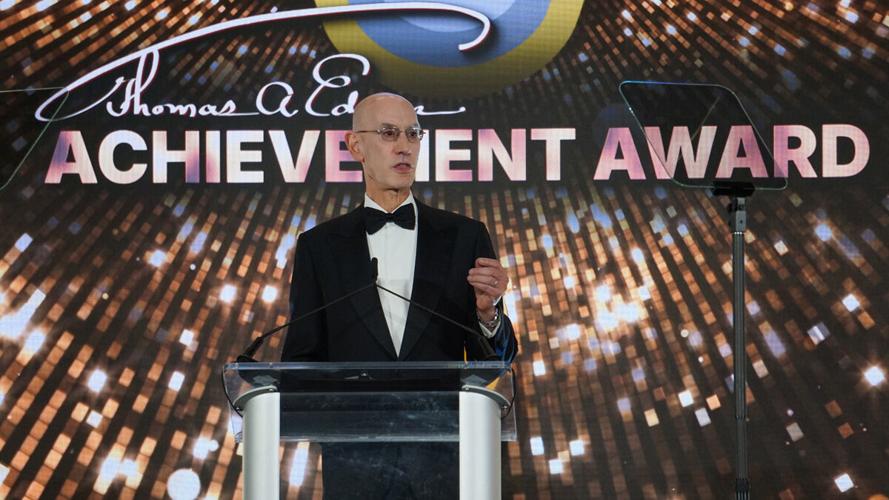
Silver accepted the Edison Achievement Award during the Edison Awards on April 16 before about 1,000 innovators and business leaders at the Caloosa Sound Convention Center in downtown Fort Myers.
Before tying a thread between light bulb inventor Thomas Edison and basketball creator James Naismith during his evening remarks, and after discussing the game’s global reach earlier in the day, Silver spoke with Gulfshore Business.
He ranked Southwest Florida high on the list of potential expansion sites for the NBA’s developmental league, now known as the NBA G League. The “G” stands for Gatorade, the title sponsor.
In 2004-05, the Florida Flame — part of what was then called the NBA Developmental League — played at Hertz Arena in Estero, then known as Germain Arena. Future Basketball Hall of Fame guard Dennis Johnson coached the first season, and NBA veteran guard Jeff Malone led the team in its second. Attendance and financial struggles eventually ended the franchise.
Silver’s predecessor and mentor, David Stern, visited Fort Myers and Estero during that time. Silver succeeded Stern as commissioner in 2014.

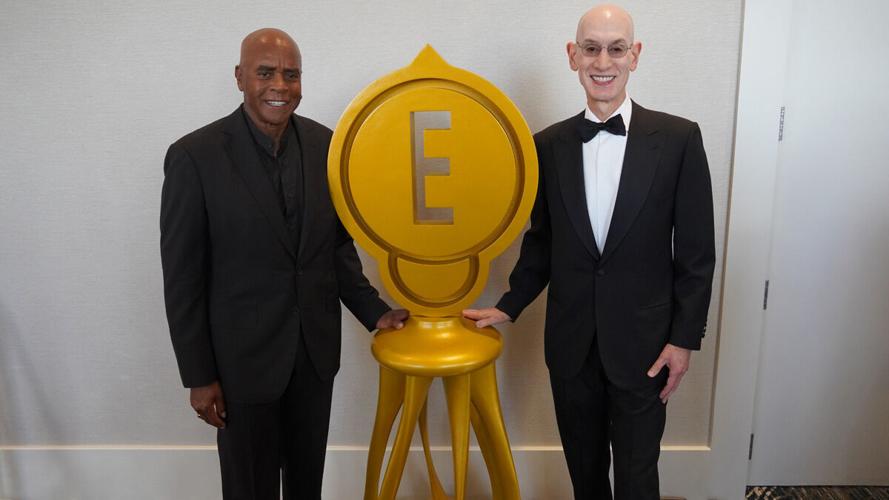
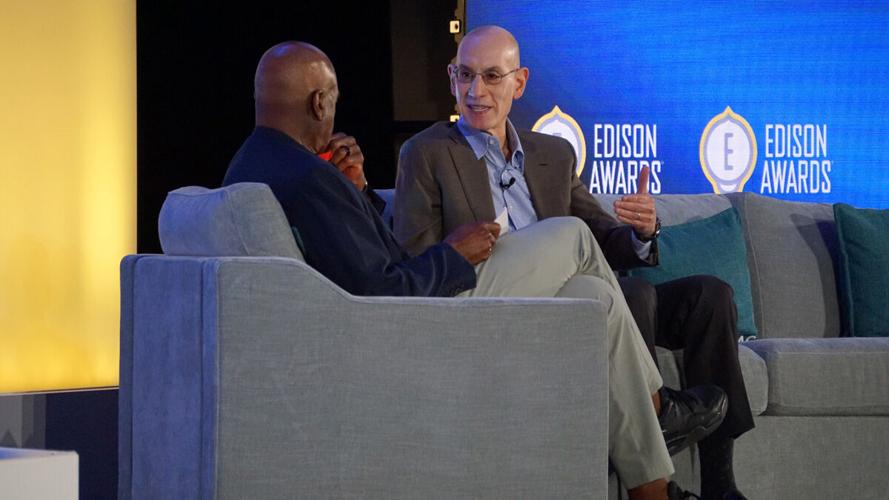
NBA Commissioner Adam Silver, right, and NBA Ambassador Ahmad Rashad attend the Edison Awards on April 16 in Fort Myers. Silver later said Southwest Florida could be a candidate for future G League expansion.
“It’s remarkable to see the amount of growth here over the last 20 years,” Silver said. “It’s almost like it’s a completely different place.”
Silver said the league’s development model has evolved alongside that growth. While today’s G League teams have one-to-one affiliations with NBA franchises, the Flame had ties to four teams.
Silver said the NBA spent years evaluating the idea of a development league, but the landscape has shifted significantly with advances in technology and the game’s global growth. He noted that when the league previously operated a D-League team two decades ago, it did not yet have a presence in Africa, and it is now working to establish a league in Europe while taking a more comprehensive, global approach to player development.
“But there’s no doubt, this region in particular would be at the top of places on our list if we were looking to expand our development opportunity,” he said. “It’s a remarkable place to be. I can understand being down here a couple of days why so many of my friends have relocated down here.”
Today, most NBA teams own their G League affiliates, with many choosing to locate them close to the parent club. For example, the Orlando Magic’s affiliate, the Osceola Magic, plays in nearby Kissimmee.
Miami Heat is an exception, with their affiliate, the Sioux Falls Skyforce, based in South Dakota.
Silver said the transition from the former development league to the G League reflects a shift in priorities, with teams placing greater emphasis on player development over business operations. He said the closer alignment allows coaches and trainers to move easily between G League and NBA facilities, a model that differs significantly from the past.
Silver, who said he co-wrote the business plan for what became the WNBA 31 years ago, said sports continue to grow across all levels.
“There seems to be an insatiable appetite for sports content in this country,” Silver said. “Every day it seems like I’m reading about new sports ventures. Every conceivable, different sport. From pickleball to every version of lacrosse to women’s sports. It’s remarkable.”
He said his role requires balancing player development with business realities, noting the timing must be right for a G League team to return to the Fort Myers-Naples area.
“I have a responsibility on the development side but also on the business side,” Silver said. “We’re doing business around the world. There are all these things swirling about my head, so there’s nothing to announce now. But we’re always looking for new ways to connect with our fans over this big continent. Because there can only be so many NBA franchises.
“Even at a summit like this, where it’s all about innovation, what are the new ways we can connect with our fans, understanding that 90% of our fans will never set foot in an arena? What is it we can do through technology, through their television screens, through their phones, through whatever AI platform that they’re using, to make them feel closer to it?”

Ahmad Rashad, left, moderates a discussion with NBA Commissioner Adam Silver during the Edison Awards in Fort Myers. Silver addressed innovation, fan engagement and potential future expansion opportunities.
Silver had just finished doing a Q&A session with Ahmad Rashad, the former host of the “NBA Inside Stuff” television show, which coincided with the playing era of Michael Jordan. Rashad asked him about his big break, going from attorney to the NBA.
Silver’s first role in the NBA was serving as late Commissioner David Stern’s special assistant, a hands-on position in the days before cellphones and the internet.
“He was a visionary, there’s no question about it,” Silver said of Stern. “He took this into a modern sports league. Nobody thought of a sports league as a brand. He had this vision. It wasn’t just a league. It was a brand in which consumers related to as a brand. There was a fashion side to it.”
Silver added that Stern’s leadership style stood out, noting he was always prepared, deeply curious and unafraid to ask questions, and that he did not rely on titles or hierarchy.
Silver also pointed to increased parity in the league.
“The first 65 years of the league, three teams, the Lakers, Celtics and Bulls, won 60% of the championships,” Silver said. “Now, 11 different teams in 15 years have won championships. It seems wide open this year.”
He closed by connecting the legacies of Edison and Naismith, whose breakthroughs came just 12 years apart — Edison’s light bulb demonstration in 1879 and Naismith’s original 13 rules of basketball in 1891.
“I don’t like the word legacy,” Silver said. “We’ve been doing this a long time together. I’m passing through this league, and it’s 80 years old. Ultimately, I’d like the legacy of this period of the NBA to be a measure of the impact it has made on the lives of people around the world.”
(0) comments
Welcome to the discussion.
Log In
Keep it Clean. Please avoid obscene, vulgar, lewd, racist or sexually-oriented language.
PLEASE TURN OFF YOUR CAPS LOCK.
Don't Threaten. Threats of harming another person will not be tolerated.
Be Truthful. Don't knowingly lie about anyone or anything.
Be Nice. No racism, sexism or any sort of -ism that is degrading to another person.
Be Proactive. Use the 'Report' link on each comment to let us know of abusive posts.
Share with Us. We'd love to hear eyewitness accounts, the history behind an article.