
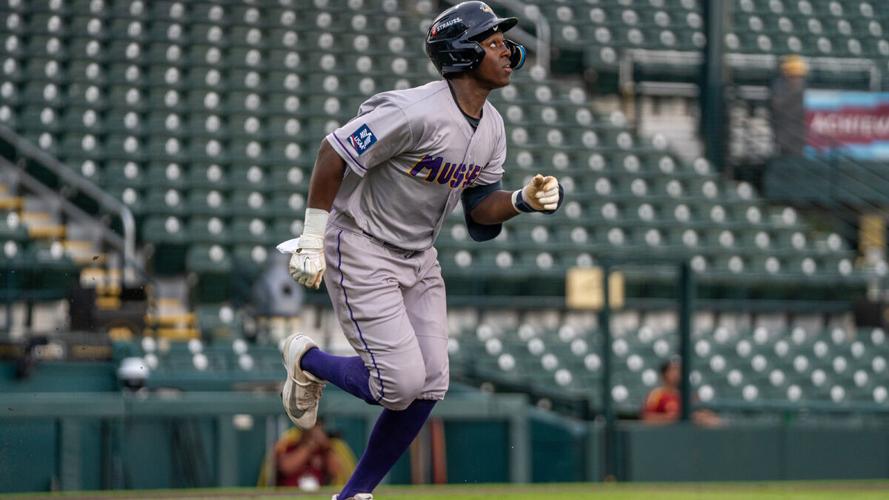





Minnesota Twins prospect Vahn Lackey watches the flight of a ball while playing for the Fort Myers Mighty Mussels. The No. 3 overall pick received a record $9.49 million signing bonus after the MLB draft.
Editor’s note: The Minnesota Twins announced around 3 p.m. Aug. 24 that Vahn Lackey had been promoted from the Low-A Fort Myers Mighty Mussels to the High-A Cedar Rapids Kernels.
The young man, 6-foot-3, broad-shouldered and lean, walked into Hammond Stadium, spring training home of the Minnesota Twins and regular-season home of the Fort Myers Mighty Mussels.
Vahn Lackey, who turned 21 on July 7, sat at a table at the back of the Mighty Mussels box office and discussed how, so far, he has spent his record-setting $9.49 million signing bonus.
He hasn’t.
Lackey did buy a car, a Mercedes GLE SUV, which starts at about $62,000. But he said he purchased it before being drafted, with money from his family. Asked if he has made any big splurges with the bonus, Lackey shrugged and shook his head — no, he has not. He’s renting a condo in Fort Myers owned by a neighbor.
“I’m a Florida resident,” Lackey said, which was one of the first pieces of advice he received from his financial adviser because there’s no state income tax.
“He’s not the one to do any kind of frivolous spending,” said Bobby Lackey, Vahn’s father, who works in IT as a mainframe programmer and was a computer science major at Fort Valley State in Georgia. “He’s kind of low-key like myself.”
As the No. 3 pick in this year’s Major League Baseball draft, Vahn Lackey knew he would be financially set for life. But a year ago, Lackey had no idea if he even would be a first-round selection.
As baseball signing bonuses continue to climb, the prospects have become something of mini-corporations that fuel a baseball economy in different ways.
From Aug. 25 through Aug. 30, Lackey will be playing in the last Mighty Mussels homestand of the season, all six games against the Bradenton Marauders, the Low-A minor league affiliate of the Pittsburgh Pirates. The catcher will try to showcase his prowess behind the plate, handling pitching prospects, throwing out would-be base stealers and hitting balls thrown in excess of 95 mph over the fence at Lee Health Sports Complex.
Tickets cost $5, which is about five-thousandths of 1% of Lackey’s signing bonus. He could buy about 1.9 million Mighty Mussels tickets if he so chose, which would fill the ballpark, capacity 9,300, about 204 times over — more than two full seasons of sellouts.

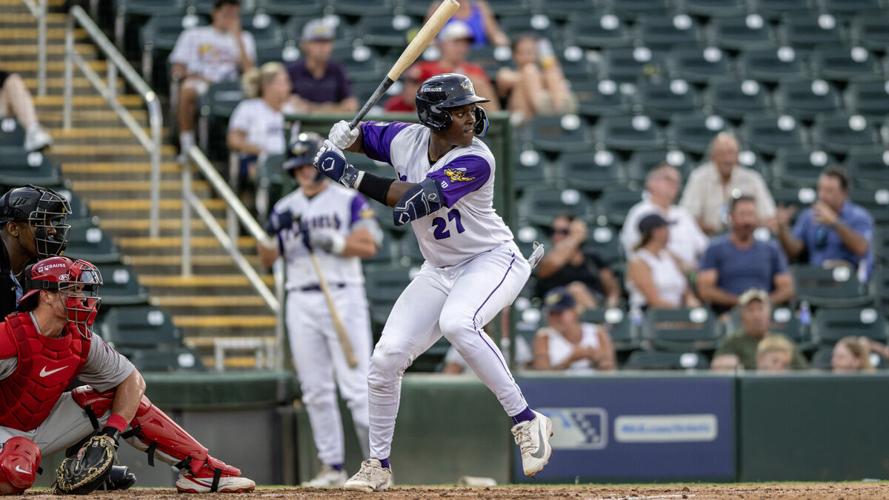
Vahn Lackey prepares to swing for the Fort Myers Mighty Mussels. The 21-year-old catcher is beginning his professional career after receiving a $9.49 million signing bonus from the Minnesota Twins.
But behind the scenes, and before his first professional baseball offseason, Lackey is just a cog in his own machine, the human ignition of his own economic engine. He has hired three different companies to help him in different ways, and he has relied on three advisers to help him navigate it all: his father, his lead agent and his financial adviser.
Chase Murray, a former minor league outfielder with the Pittsburgh Pirates who played at Georgia Tech, now works for Atlanta-based BIP Wealth as a wealth consultant. The wealth management firm has six offices across Georgia, Tennessee and Arizona. It has $6.4 billion in assets under management and serves 3,200 households, according to its marketing department. But it also has a Baseball Division dedicated to helping professional baseball players manage their money.
“Our investment philosophy when working with players like Vahn is simple: We want to treat this money as though it could be the last money he earns from the game of baseball,” Murray said in an email. “There are no guarantees in baseball. It is an incredibly difficult and unpredictable game, and even the most talented players can see their careers change in ways they never anticipated.
“While we have tremendous confidence in Vahn and fully believe he can play this game for a very, very long time, we also believe it is our responsibility to plan for every possibility. Our goal is to make sure the money Vahn is earning today doesn’t simply sit on the sidelines and be ultra-conservative. Instead, we want to put that money to work for him, to invest it thoughtfully, protect it and give it the opportunity to grow over time.”
Murray said Lackey has the best of both worlds — having a say in how that signing bonus will be preserved for the long run but also how he can access it when he needs it for the short term. Murray said he balances transparency with financial education. BIP Wealth will help Lackey develop strategies in the public and private markets with the goal of balancing liquidity, risk management and long-term growth, Murray said.
Murray said Lackey’s financial plan accounts for known and anticipated expenses, including agent fees, federal taxes and other obligations, with enough cash set aside to cover them without exposing money needed in the near term to market risk.
Before hiring a financial management firm, Lackey needed to negotiate the life-changing contract. Before entering his junior season at Georgia Tech, Lackey hired his team of agents at Excel Sports Management, including lead agent Carter Hall.
Hall said he knew Lackey had top-pick potential — but he needed to harness it.
Agents and their agencies typically make 4% to 5% of a player’s contract and 10% to 20% of endorsement contracts. Other than apparel and baseball equipment deals, the big endorsements typically don’t arrive until the player reaches the big leagues.
The symbiotic financial arrangement between agent and player means the former will help the latter succeed. Excel Sports flew Lackey to its own conditioning facility in California, getting him acclimated to life as a top prospect.
“The biggest thing here is we want to be able to support him in all aspects of his game,” said Hall, who played center field at Georgia Tech from 2015-19 before becoming a sports agent. Hall also helped represent Marek Houston, a former Wake Forest shortstop who received a $4.49 million signing bonus from the Minnesota Twins as the No. 16 pick in the 2025 draft. Houston played for the Mighty Mussels last season.

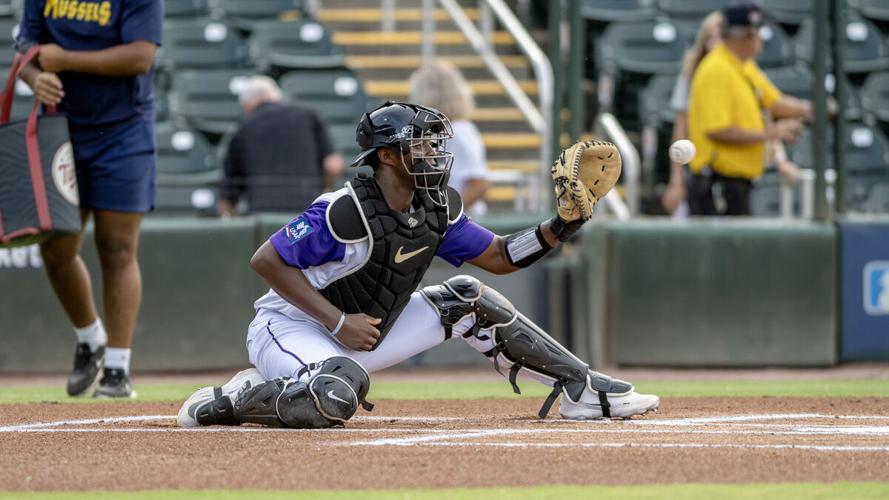
Fort Myers Mighty Mussels catcher Vahn Lackey receives a throw while warming up. Lackey was the No. 3 overall pick by the Minnesota Twins and received a $9.49 million signing bonus.
“Performance dictates economics,” Hall said. “Vahn’s the player. He has to go out and do it every day. We want to make sure we have as many resources as possible to be the best player he can be.”
Hall connected Lackey with Maven Baseball Lab in Atlanta. Maven works with baseball players of all levels to improve their hitting. This goes beyond coaching; Maven uses motion-capture technology and does a deep dive into hitting mechanics combined with data analysis. Maven can compare Lackey’s swing and hitting mechanics to the game’s best players. Analysis fees start between $2,000 and $5,000.
“I did some things with my swing,” Lackey said. “I did some things to where I would be able to hit more homers. The start of my junior year, that was the beginning of a big transformation for me.”
Lackey hit four home runs as a freshman at Georgia Tech and six as a sophomore. Last season as a junior, he hit 20. He approached the game like a business, he said.
“You kind of have to think about it,” Lackey said of the financial incentives. “It’s in the back of your mind. But at the end of the day, I’m just trying to get better every day. I try to tune out the outside noise.”
Lackey credited Maven co-founder and owner Tyler Krieger and coach Chris Antariksa with helping him find his power, a critical aspect of hitting that leads to financial empowerment within the game.
“Right out of the gate, you see the frame, and you see the ability to adjust,” said Antariksa, who worked as a hitting coordinator for the Los Angeles Dodgers and later the Atlanta Braves before joining what he called “the private sector” at Maven.
“He’s a really good strike-zone controller,” Antariksa said of Lackey, meaning he can force opposing pitchers into making mistakes. “That’s really fun to see. He’s a great and humble person, too. There’s a natural curiosity Vahn has inside of him. He was able to leverage that and put himself into a great position.”
In Lackey’s first 15 games with the Mighty Mussels, he hit for a .204 average (11 hits in 54 at-bats) with a home run, nine runs batted in and five stolen bases. Lackey also has drawn 14 walks with 16 strikeouts, showing signs of discipline at the plate.
“It’s been a bit of an adjustment,” Lackey said.
On Aug. 21, he hit his first professional home run, driving a changeup over the left-center-field wall against the Palm Beach Cardinals. The ball left his bat at 106.2 mph, according to Statcast. Lackey was able to retrieve the ball and knew exactly who would get it: his father.
Lackey and his family were out to eat July 11 at Fogo de Chão, a Brazilian steakhouse in Atlanta, when they learned the Twins had drafted him No. 3 overall.
Lackey’s $9,497,500 signing bonus surpassed the previous record for a catcher, the $8.1 million Adley Rutschman received from Baltimore in 2019.

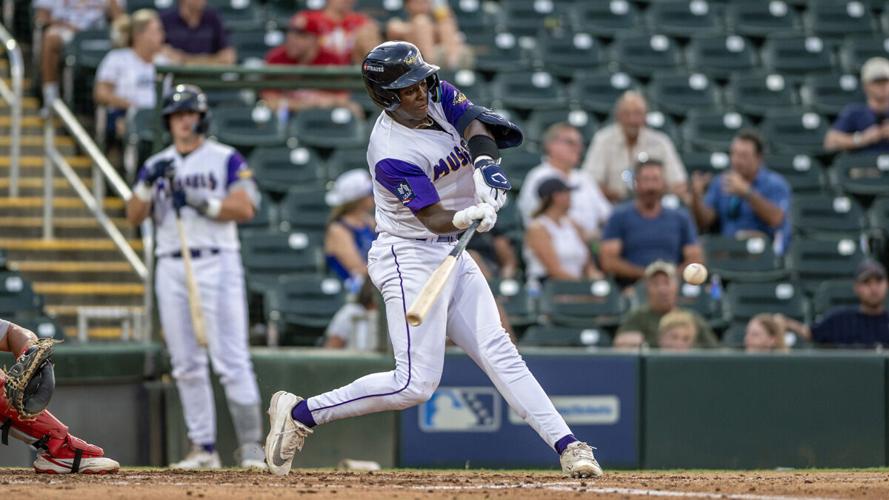
Fort Myers Mighty Mussels catcher Vahn Lackey makes contact at the plate. Lackey hit 20 home runs during his junior season at Georgia Tech before the Minnesota Twins selected him No. 3 overall in the MLB draft.
As for the Minnesota Twins, Lackey’s signing bonus eclipsed the franchise records held by outfielder Walker Jenkins ($7.14 million, 2023), infielder Royce Lewis ($6.725 million, 2017), outfielder Byron Buxton ($6 million, 2012) and catcher Joe Mauer ($5.1 million, 2001).
“It means a lot to me,” Lackey said of the distinction. “I just think it’s going to be a great opportunity for me.”
Hall, Murray and Bobby Lackey have been his “big three” advisers, Vahn Lackey said.
Bobby Lackey watched his son play catcher at Collins Hill High School in Suwanee, about 33 miles northeast of Atlanta.
“He was a late bloomer,” Bobby Lackey said.
During a game against Buford High, the father of an opposing player knew Georgia Tech coach James Ramsey.
“Hey, you need to come and check out this kid,” the dad told Ramsey.
That led to Lackey landing on the Yellow Jackets’ radar, followed by a choice of scholarship offers among Georgia, Georgia Tech and Kennesaw State.
“Kennesaw State was the first one that had an eye on him,” Bobby Lackey said. “He researched and decided that Georgia Tech would be the best one to develop a catcher.”
(0) comments
Welcome to the discussion.
Log In
Keep it Clean. Please avoid obscene, vulgar, lewd, racist or sexually-oriented language.
PLEASE TURN OFF YOUR CAPS LOCK.
Don't Threaten. Threats of harming another person will not be tolerated.
Be Truthful. Don't knowingly lie about anyone or anything.
Be Nice. No racism, sexism or any sort of -ism that is degrading to another person.
Be Proactive. Use the 'Report' link on each comment to let us know of abusive posts.
Share with Us. We'd love to hear eyewitness accounts, the history behind an article.