

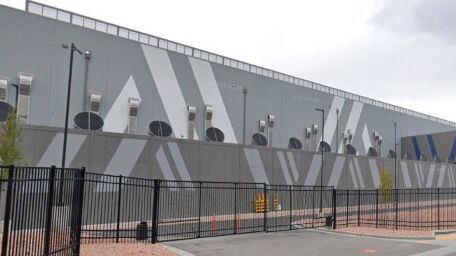
A data center facility is shown in a presentation to Charlotte County commissioners on June 16. Officials opted to take no immediate action on regulations while maintaining the county's existing prohibition on data centers.
Charlotte County commissioners are holding off on developing regulations for data centers, saying existing county policies already prohibit the facilities from locating in the county.
Planning and Zoning Official Shaun Cullinan on June 16 outlined Senate Bill 484, which Gov. Ron DeSantis signed May 7 and gives local governments the authority to develop their own regulations for data centers.
Because data centers are not listed as a permitted use in either the county code or comprehensive plan, they are effectively prohibited, Cullinan said. However, he added that the new law appears to require local governments to address the issue and establish regulations for data centers.
Several commissioners expressed concern about allowing data centers in the county, particularly because of their water consumption.
“The big issue is water,” Commissioner Stephen R. Deutsch said after Cullinan presented examples of the significant water consumption associated with existing data centers. “We haven’t come up with a way to replace water.”
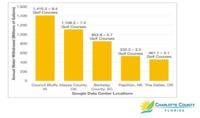
According to county data, a data center in Council Bluffs, Iowa, uses 1.4 million gallons of water per day, the equivalent of watering 9.4 golf courses, while a facility in Berkeley County, South Carolina, uses 858,800 gallons per day, or the equivalent of watering 5.7 golf courses.
One possible location for a data center, if one were ever proposed in Charlotte County, could be a decommissioned mine with its own water source.
Deutsch said the county should consider treating data centers the same way it has phosphate mining, which is prohibited in the county.
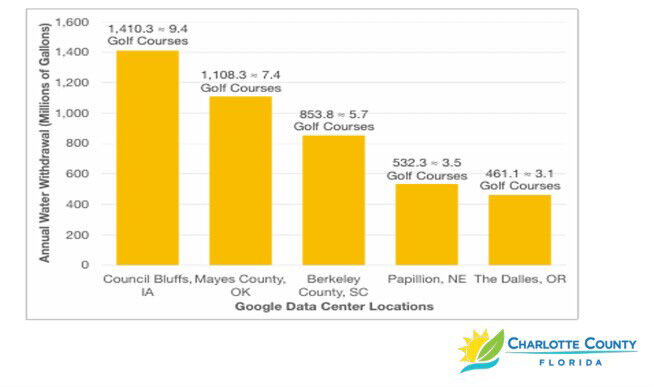
A Charlotte County presentation compares water consumption at existing data centers around the country, showing usage equivalent to irrigating multiple golf courses. Water demand emerged as one of commissioners' primary concerns during a June 16 discussion on potential data center regulations.
Other commissioners agreed that maintaining the current prohibition is the appropriate course for now, although they said the county’s legal department would need to review the issue.
The board also agreed to wait six months to see how other local governments respond to the new law and expressed interest in touring a data center before making any decisions.
Cullinan said there are currently no applications for a data center in Charlotte County. Under existing regulations, any application would be denied
In addition to discussing water consumption, Cullinan outlined potential drawbacks and benefits associated with data centers.
Potential concerns include high energy consumption, wastewater management issues, heat generation, strain on electrical grids, rising utility costs and land-use conflicts.
Potential benefits include high-paying technology jobs, an expanded tax base, improved connectivity, stronger digital infrastructure and additional fiber-optic investments.
The city of Punta Gorda asked the county to update planning for Enterprise Charlotte Air Park before considering data center approvals and suggested evaluating data center scenarios through the City/County Joint Water Supply Plan.
Commissioner Ken Doherty said data centers should be considered only through the Planned Development process and should not be permitted by right.
Doherty also said data centers should not be allowed to use potable water for cooling, and that wastewater should meet Environmental Protection Agency standards. He added that facilities should not be permitted to connect directly to public power supplies.
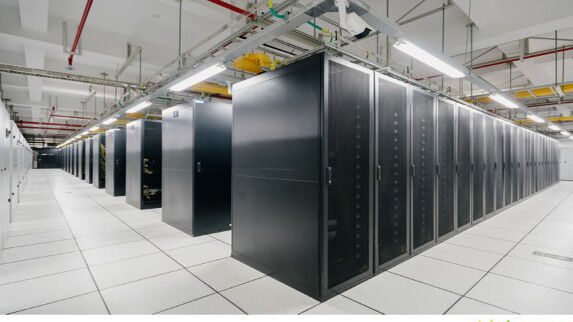
Rows of servers operate inside a data center facility. Charlotte County commissioners discussed the potential impacts of data centers, including water consumption, energy use and infrastructure demands, while considering whether future regulations are needed.
He noted that Florida Power & Light is considering dedicated substations for some projects, including facilities that could potentially be supported by nuclear-generated power.
Commissioner Dr. Chris Constance said public reaction to a nearby small nuclear facility would likely be negative.
Noise also emerged as a concern.
Commissioner Bill Truex said the constant humming generated by data centers could affect nearby residents and potentially impact livestock and wildlife.
Doherty added that any future regulations should include a half-mile setback requirement.
Commissioners also questioned where a data center could realistically be located in Charlotte County after Cullinan explained that such facilities require reliable water supplies, low flood risk, stable geology and separation from storm surge zones.
Cullinan said dozens of data centers are planned across Florida because of the state’s population growth, proximity to Latin America and the Caribbean, Miami’s telecommunications infrastructure, growing demand for artificial intelligence computing and expanding fiber connectivity.
Commission Chair Joe Tiseo said the board will revisit the issue in the future and plans to engage stakeholders through community outreach before considering any regulatory changes.
(0) comments
Welcome to the discussion.
Log In
Keep it Clean. Please avoid obscene, vulgar, lewd, racist or sexually-oriented language.
PLEASE TURN OFF YOUR CAPS LOCK.
Don't Threaten. Threats of harming another person will not be tolerated.
Be Truthful. Don't knowingly lie about anyone or anything.
Be Nice. No racism, sexism or any sort of -ism that is degrading to another person.
Be Proactive. Use the 'Report' link on each comment to let us know of abusive posts.
Share with Us. We'd love to hear eyewitness accounts, the history behind an article.