
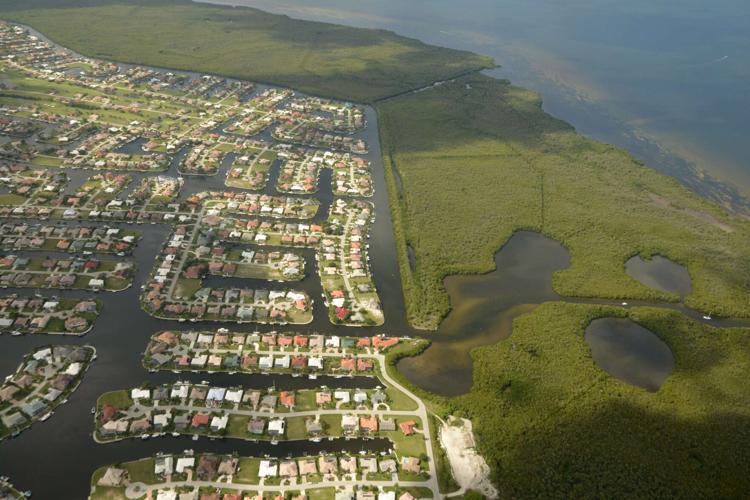





An aerial view shows waterfront homes and canals in Punta Gorda.
A proposed constitutional amendment that would significantly expand Florida's homestead exemption could lower property tax bills for many homeowners, while creating financial challenges for local governments and some property owners, according to a Florida Gulf Coast University real estate professor.
On June 2, the Florida Legislature approved House Joint Resolution 1, placing the measure before voters in the November general election. If approved, the amendment would increase the homestead exemption to $150,000 in 2027 and $250,000 in 2028, with the exemption adjusted annually for inflation beginning in 2029.
Supporters say the proposal would provide meaningful tax relief for homeowners. Critics, however, warn it could shift more of the property tax burden to nonhomesteaded properties and reduce revenue available for local government services.

Shelton Weeks is a Lucas Professor of Real Estate and director of the Lucas Institute for Real Estate Development & Finance at Florida Gulf Coast University’s Lutgert College of Business.
Shelton Weeks, a professor in the Department of Economics and Finance at FGCU, said he is concerned about the potential consequences for the state’s real estate market.
Southwest Florida is a patchwork of communities with different needs, he said, and there is no clear plan to replace the revenue local governments could lose.
Weeks said seasonal residents contribute significantly to the local economy, but owners of second homes who do not qualify for a homestead exemption may reconsider maintaining their Florida properties if they end up shouldering a larger share of the tax burden.
One possible result of the legislation is that more residents could decide to move to Florida, Weeks and a local broker agreed.
People planning to retire or relocate may view Florida more favorably because of the larger homestead exemption available in future years.

Brian Helgemo
Brian Helgemo of Compass Realty in Punta Gorda said Southwest Florida's housing market is heavily driven by nonhomesteaded residents and second-home owners, making a dramatic surge in local homebuyers unlikely. However, because HJR 1 also reduces the annual assessment increase cap on nonhomesteaded properties from 10% to 5%, he said there could be a modest increase in activity from investors and vacation-home buyers.
The legislation also could create a new housing trend, Helgemo said.
With a larger homestead exemption available, some seasonal residents may choose to establish permanent residency in Florida before the Dec. 31 deadline to maximize their tax savings.
That possibility highlights another concern, Weeks said. A growing population will require additional services, not fewer, and state restrictions on how local governments spend revenue could force cuts to programs, such as mosquito control.
Charlotte County commissioners and Punta Gorda officials have already discussed the potential impact on future budgets. Without new revenue sources, local officials have warned that reserve funds could be depleted by 2032.
Charlotte County's population has already been growing, and if growth exceeds current forecasts, additional services will be needed to support residents.
Weeks said a one-size-fits-all approach isn’t appropriate because municipalities have different needs and tax bases. Local officials, he said, should be able to determine how best to serve their communities.
The legislation also could affect housing affordability. An influx of new buyers could increase demand and put additional upward pressure on home prices, Weeks said.
Socioeconomic differences also play a role. Weeks compared affluent Naples with Immokalee, noting that residents in different parts of the same county often have very different service needs.
Charlotte County has an older population than Lee and Collier counties, with many residents living on fixed incomes and owning their homes. While those homeowners could benefit from a larger homestead exemption, they also could face reductions in services they depend on.
Without local control over spending decisions, some residents may benefit from the legislation, others may see little change, and some could be negatively affected by reductions in public services.
Homesteaded residents who pay less in property taxes beginning in 2027 will have more discretionary income. Others, however, could face higher tax burdens and less disposable income while also experiencing potential reductions in local services if state-imposed spending restrictions lead to budget cuts.
(2) comments
The last thing floriduh needs is more people. We used to have growth management laws that had growth pay for itself and have infrasture planned for growth. We built our 1700 sq ft. house on 5 acres in 2002 and my taxes are $2,500 a year. I'm all for newcomers paying higher property taxes than established residents. Let's not even get started how regressive an increase in sales tax would be to make up the shortfall.
The pros far out way the cons for the long term homestead citizens of FL. Seniors that own their primary residence in FL are on fixed incomes. Many young families are homesteaders and need the tax breaks. The snowbirds are wealthy enough to continue paying their property taxes otherwise they wouldn’t own their 2nd, 3rd or 4th home in Florida. This is a no brainer and must pass. Lastly, local governments have gone crazy with the I creases in their budgets over the past 10 years…bloated and created many “services” that serve very few if any citizens…time for each local government to take a very hard look at their mission statements and their bloated staffing & programs.
Welcome to the discussion.
Log In
Keep it Clean. Please avoid obscene, vulgar, lewd, racist or sexually-oriented language.
PLEASE TURN OFF YOUR CAPS LOCK.
Don't Threaten. Threats of harming another person will not be tolerated.
Be Truthful. Don't knowingly lie about anyone or anything.
Be Nice. No racism, sexism or any sort of -ism that is degrading to another person.
Be Proactive. Use the 'Report' link on each comment to let us know of abusive posts.
Share with Us. We'd love to hear eyewitness accounts, the history behind an article.