
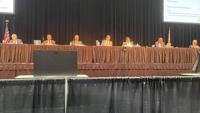
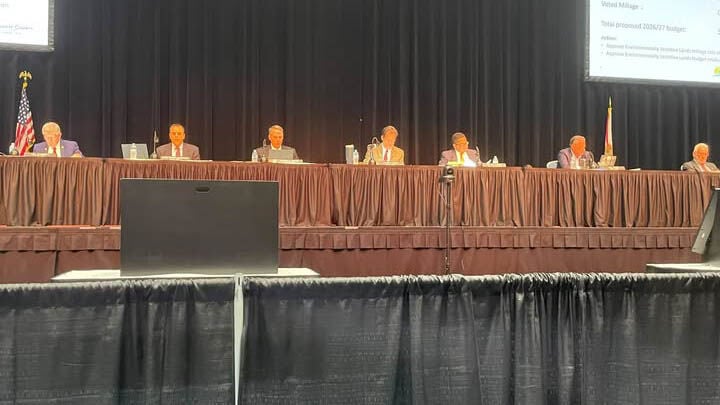
Charlotte County commissioners hold their final budget hearing Sept. 28 at the Charlotte Harbor Event & Conference Center in Punta Gorda. Commissioners unanimously adopted a $1.79 billion net budget for fiscal 2026-27.
Charlotte County commissioners unanimously adopted a $1.79 billion net budget for fiscal 2026-27 during their final budget hearing Sept. 28.
The countywide ad valorem operating budget totals $528.2 million.
Commissioners adopted a countywide millage rate of 6.1275 mills, up from 6.0394 mills in fiscal 2025-26, an increase of about 1.46%.
The final rate is lower than the tentative 6.1576 mills commissioners considered this year but remains 0.67% above the rollback rate of 6.0866 mills.
At 6.1275 mills, countywide property taxes on a property with $300,000 in taxable value would total $1,838.25. A property owner’s final tax bill also can include other taxes and assessments, including those for public schools, municipal service taxing units and water management districts.
One mill equals $1 in tax for every $1,000 of taxable property value.
Commissioners made several adjustments before adopting the final budget. The Charlotte County Sheriff’s Office budget was reduced by another $1.18 million, while beach renourishment expenses increased by $728,241.
At the Sept. 14 hearing, Sheriff Bill Prummell reduced his proposed budget by $7.5 million from the amount discussed at commissioners’ July 23 budget workshop. The reductions included funding for a replacement patrol vehicle, airframe insurance for the agency’s Black Hawk helicopter and jail medical insurance.
Unlike the first public budget hearing Sept. 14, the final hearing at the Charlotte Harbor Event & Conference Center in Punta Gorda drew a relatively small crowd. About 50 people attended, including county staff and law enforcement. The county calendar confirms the final hearing was held Sept. 28 at the event center. Charlotte County
Charlotte County resident Jim Fuccillo was the only member of the public to speak. At the first hearing, numerous residents criticized the budget and cited the rising cost of living in Charlotte County.
Fuccillo said the commission was not practicing “true fiscal conservatism” and criticized the proposed 20-year extension of the county’s 1% Local Option Sales Tax. Other residents also questioned the length of the proposed extension during the first hearing.
If voters approve the extension Nov. 3, the county would maintain its 1% local sales surtax, which is added to Florida’s 6% state sales tax. The local tax is paid on taxable purchases in the county by residents and visitors.
The 1% Local Option Sales Tax extension and Amendment 3, a proposed expansion of Florida’s homestead property tax exemption, have dominated county budget discussions because both could affect how Charlotte County and Punta Gorda fund government services and capital projects. The county is holding town halls on the sales tax and property tax reform following adoption of the budget. Charlotte County
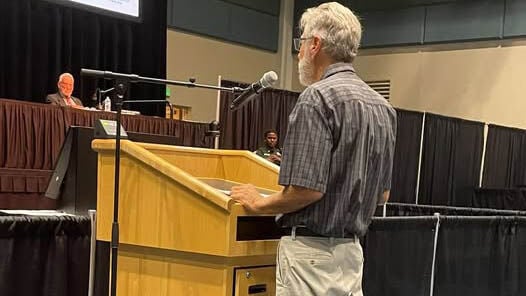
Charlotte County resident Jim Fuccillo addresses commissioners during the final budget hearing Sept. 28 at the Charlotte Harbor Event & Conference Center in Punta Gorda. Fuccillo criticized the county’s spending and the proposed 20-year extension of the 1% Local Option Sales Tax.
Amendment 3 would increase the homestead exemption for nonschool property taxes to as much as $150,000 beginning in 2027 and $250,000 beginning in 2028 for qualifying residents. Beginning in 2029, the $250,000 exemption would increase annually when inflation is positive.
Residents who established permanent Florida residency by Dec. 31, 2026, could qualify for the larger exemption. Those who establish permanent Florida residency on or after Jan. 1, 2027, generally would receive an exemption of up to $50,000 during their first four years. Beginning with the fifth year of the exemption, they could qualify for the larger exemption available to established residents.
The amendment also would reduce the annual assessment cap on nonhomestead residential and nonresidential property from 10% to 5%.
Charlotte County commissioners have voiced concerns about the potential effects of the amendment on local government finances, growth management and public services.
Charlotte County has used the 1% Local Option Sales Tax to fund capital projects since 1994. The current six-year extension, approved by voters in 2020, runs through 2026.
Sales tax revenue funds infrastructure, public facilities, parks and environmental land acquisition. The fiscal 2027 capital budget was calculated based on voters approving the proposed sales tax extension.
Ad valorem revenue is used for countywide operations and services, including infrastructure, law enforcement and fire services, parks and recreation, libraries and other programs.
(0) comments
Welcome to the discussion.
Log In
Keep it Clean. Please avoid obscene, vulgar, lewd, racist or sexually-oriented language.
PLEASE TURN OFF YOUR CAPS LOCK.
Don't Threaten. Threats of harming another person will not be tolerated.
Be Truthful. Don't knowingly lie about anyone or anything.
Be Nice. No racism, sexism or any sort of -ism that is degrading to another person.
Be Proactive. Use the 'Report' link on each comment to let us know of abusive posts.
Share with Us. We'd love to hear eyewitness accounts, the history behind an article.