
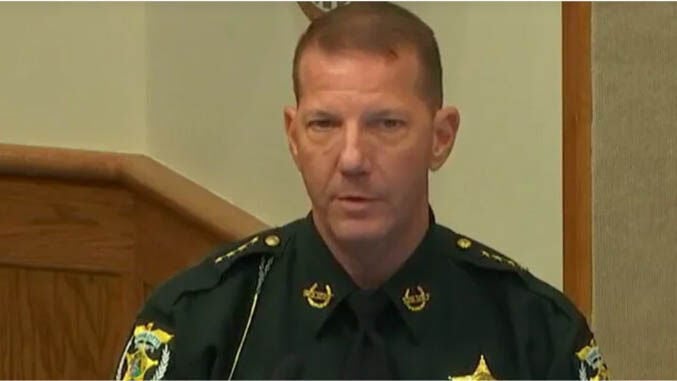
Charlotte County Sheriff Bill Prummell discusses his agency’s budget during the County Commission’s July 23 budget workshop. Prummell cited population growth, increased calls for service and rising operating costs as factors affecting the Sheriff’s Office budget.
Charlotte County officials face an uncertain budget year as they wait for voters in November to decide on two ballot items that could affect funding for both the county and city of Punta Gorda.
During the Charlotte County Commission’s first public budget hearing Sept. 14, commissioners and county officials, including Assistant Budget Director Francine Lisby, discussed the possible effects of a proposed 20-year extension of the 1% Local Option Sales Tax and Amendment 3, which would provide qualifying homesteaded property owners with tax reductions.
The proposed fiscal 2027 net county budget is about $1.79 billion.
Amendment 3, if approved by at least 60% of Florida voters, would increase the homestead exemption for nonschool property taxes to $150,000 beginning Jan. 1, 2027.
The exemption would increase to $250,000 Jan. 1, 2028, with annual inflation adjustments beginning in 2029. The amendment also would reduce the annual assessment cap on nonhomestead property from 10% to 5%.
If Charlotte County voters decide not to extend the 1% sales tax, both the county and city of Punta Gorda would have to find other funding mechanisms for capital projects.
If approved, the extension would maintain the county’s 1% local sales surtax, which is added to Florida’s 6% state sales tax. The local tax is paid on taxable purchases made within the county by residents and visitors.
Charlotte County has used the 1% Local Option Sales Tax to fund capital projects since 1994. The current six-year extension, approved by voters in 2020, runs through 2026.
Some residents have questioned whether the proposed 20-year extension is too long. Lisby said the extension would allow the county to move some projects forward earlier and take advantage of better construction prices.
The sales tax funds infrastructure needs, public facilities, parks and environmental land acquisition. The fiscal 2027 capital budget was calculated based on voters approving the sales tax extension.
Ad valorem revenue is used for countywide operations and services including infrastructure, law enforcement and fire services, parks and recreation, libraries and other programs.
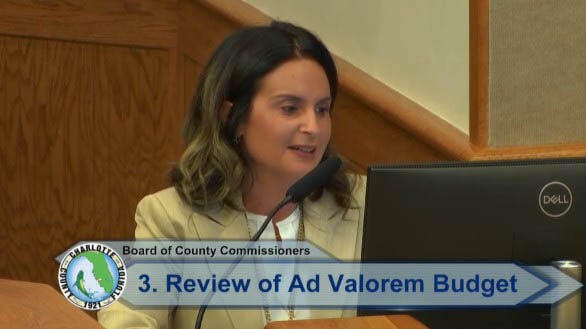
Charlotte County Assistant Budget Director Francine Lisby discusses the county’s ad valorem budget during a July budget workshop. Lisby is among county officials preparing the fiscal 2027 budget as voters prepare to decide measures that could affect future county revenue.
Residents at public meetings have cited economic hardships amid rising costs. Residents 65 and older make up roughly 41% of Charlotte County’s population.
School district property taxes would not be affected by Amendment 3’s increased homestead exemption because it applies only to nonschool property taxes.
Although the final budget won’t be decided until Sept. 28, Lisby said commissioners are moving toward adopting a lower countywide millage rate of 6.1275 mills, down from the tentative rate of 6.1576 mills.
At 6.1275 mills, countywide property taxes on a property with $300,000 in taxable value would be $1,838.25, compared with $1,847.28 at the tentative rate.
A mill equals $1 in tax for every $1,000 of taxable property value.
The $704 million operating budget represents a 4.92% increase from the previous $671 million, or $33 million more.
Charlotte County Sheriff Bill Prummell reduced his proposed budget by $7.5 million from the amount discussed at commissioners’ July 23 budget workshop. The reductions included funding for a replacement patrol vehicle, airframe insurance for the agency’s Black Hawk helicopter and jail medical insurance.
In July, Prummell appeared before commissioners and cited population growth as a major budget driver. His proposed budget initially faced a roughly $10 million shortfall before commissioners chose a neutral budget option to address the gap.
He said as Charlotte County grows, deputies respond to more calls for service, drive more miles and face higher operating costs. The inmate population also continues to rise.
The sheriff’s budget includes expenditures for law enforcement, courts, dispatch and corrections.
The final budget hearing Sept. 28 begins at 5:01 p.m. at the Charlotte Harbor Event and Conference Center, 75 Taylor St., in Punta Gorda.
(0) comments
Welcome to the discussion.
Log In
Keep it Clean. Please avoid obscene, vulgar, lewd, racist or sexually-oriented language.
PLEASE TURN OFF YOUR CAPS LOCK.
Don't Threaten. Threats of harming another person will not be tolerated.
Be Truthful. Don't knowingly lie about anyone or anything.
Be Nice. No racism, sexism or any sort of -ism that is degrading to another person.
Be Proactive. Use the 'Report' link on each comment to let us know of abusive posts.
Share with Us. We'd love to hear eyewitness accounts, the history behind an article.