
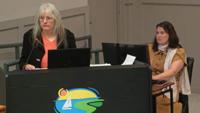
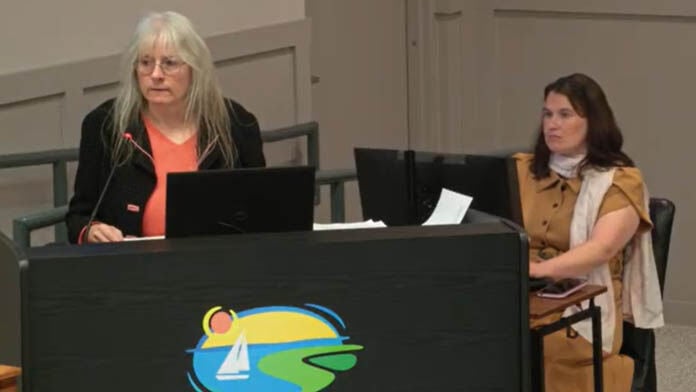
Punta Gorda Finance Director Kristin Simeone presents the city’s fiscal 2026-27 budget during the Sept. 23 City Council meeting. Council adopted the $219.3 million budget and set the property tax rate at 3.9928 mills.
Punta Gorda City Council adopted a $219 million budget for fiscal year 2026-27 while setting a property tax rate slightly below the rollback rate.
The budget includes $219.3 million in total appropriations and revenue estimates, or $198.4 million after eliminating transfers between city funds. That represents a $15.6 million increase from the 2025-26 budget.
Interfund eliminations are an accounting adjustment used to avoid counting money transferred between city funds more than once.
Council set the millage rate at 3.9928, about 0.36% below the rollback rate of 4.0074. One mill equals $1 in property tax for every $1,000 of taxable property value.
Earlier this month, when Council was considering the millage rate, Vice Mayor Jeannine Polk said last year marked the first time in 12 years that the city adopted the rollback rate. She said the 3.9928 rate would generate about $71,000 less in ad valorem revenue than the rollback rate — $19,404,045 compared with $19,474,995.
Councilmember Greg Julian voted against the lower millage rate at that meeting, saying he preferred to maintain the rollback rate. He also voted against the final budget Sept. 23, when it passed 4-1.
Finance Director Kristin Simeone, who presented the city’s $219,266,032 fiscal 2027 budget, said tax revenue accounts for about 12% of the city’s total budget.
The budget will fund service changes, including two new public safety employees, as well as technology improvements, higher annual subscription costs and the city’s paving program. It also continues funding drainage improvements that city employees have handled in-house since fiscal 2026.
Other spending includes emergency vehicles, fleet equipment replacements, infrastructure maintenance and other city needs.
Council chambers were relatively empty during the final budget hearing, and no members of the public spoke — a sharp contrast with last year’s budget adoption meeting, when some residents criticized rising utility rates amid inflation.
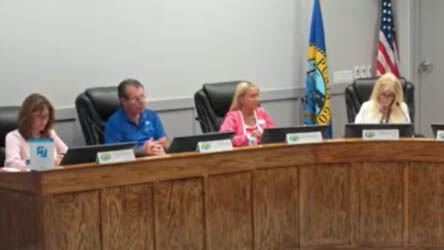
Punta Gorda City Council considers the fiscal 2026-27 budget during its Sept. 23 meeting. Council approved the $219.3 million spending plan 4-1 and adopted a property tax rate slightly below the rollback rate.
The city has been expanding its utility infrastructure to accommodate population growth outside Punta Gorda’s city limits in areas served by the city’s utility system rather than Charlotte County.
Utilities Director Tom Spencer told Council last September that growth in southern Punta Gorda approved by the county had strained the city’s system. Punta Gorda has responded by expanding its reverse osmosis plant, adding wells and treatment capacity and rehabilitating the Shell Creek Water Treatment Plant.
Spencer also said the department has struggled to keep up with maintenance of water meters installed in 2017, in part because replacement parts for the aging meters have become difficult to obtain.
The city is replacing the meters with a new system estimated to cost $10.8 million over 10 years.
While lower property values were a concern for Council last year, attention this year has turned to Amendment 3, titled Increased Homestead Exemption; Lower Cap on Increases in Non-Homesteaded Property Assessment.
If approved by at least 60% of Florida voters, the amendment would increase the homestead exemption for nonschool property taxes to $150,000 in 2027 and $250,000 in 2028, with inflation adjustments thereafter. It also would reduce the annual cap on assessment increases for nonhomestead properties from 10% to 5%.
The measure, if approved, would reduce ad valorem revenue collected by local governments.
Also on the Nov. 3 ballot is a proposed 20-year extension of Charlotte County’s 1% local option sales tax. If approved, the tax would keep the county’s overall sales tax rate at 7%. Charlotte County voters have approved six local option sales tax programs since 1994.
City and county officials have said during public meetings that if voters approve Amendment 3 but reject the sales tax extension, local governments would need to find other ways to offset the resulting revenue losses.
(0) comments
Welcome to the discussion.
Log In
Keep it Clean. Please avoid obscene, vulgar, lewd, racist or sexually-oriented language.
PLEASE TURN OFF YOUR CAPS LOCK.
Don't Threaten. Threats of harming another person will not be tolerated.
Be Truthful. Don't knowingly lie about anyone or anything.
Be Nice. No racism, sexism or any sort of -ism that is degrading to another person.
Be Proactive. Use the 'Report' link on each comment to let us know of abusive posts.
Share with Us. We'd love to hear eyewitness accounts, the history behind an article.