
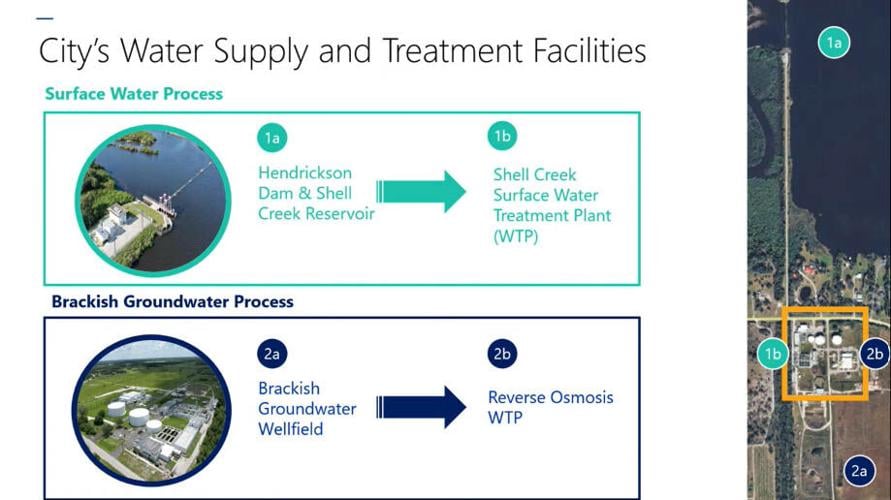



A city diagram illustrates Punta Gorda’s two water treatment systems, including surface water drawn from the Shell Creek Reservoir and brackish groundwater treated through reverse osmosis. City Council approved a $95.9 million expansion plan Oct. 28 that would add 4 million gallons of daily treatment capacity to the reverse osmosis system.
Punta Gorda City Council voted unanimously Oct. 28 to approve a $95.9 million water expansion plan that will add two treatment units to the city’s existing reverse osmosis facilities, increasing capacity by 4 million gallons per day.
Part of the project funding is expected to come from the Florida Department of Environmental Protection’s Supplemental Appropriation for Hurricanes Helene and Milton and Hawai’i Wildfires program, established through the American Relief Act.
The program funds projects designed to improve resilience to rapid hydrologic changes and natural disasters.
Punta Gorda applied for funding in 2025 and qualified for SAHM assistance for its Shell Creek Water Treatment Plant following storm surges from hurricanes Helene and Milton in 2024.
The surges and elevated downstream water levels overtopped Hendrickson Dam, affecting source water quality at the treatment plant. Increased chloride concentrations in the Shell Creek Reservoir created treatment challenges and reduced the reliability of the city’s water supply.
In response, the city completed a facility plan evaluating alternatives to expand capacity and identify the most cost-effective, resilient option with minimal community and environmental impacts.
Utilities Director Tom Spencer and his staff worked with Carollo Engineers’ Nicole Cohen, an environmental engineer who presented three options to City Council.
Cohen said additional water capacity is needed to accommodate Punta Gorda’s growing population. Growth accelerated during the COVID-19 pandemic, while restrictions imposed by the Southwest Florida Water Management District on surface water withdrawals have further limited the city’s options.
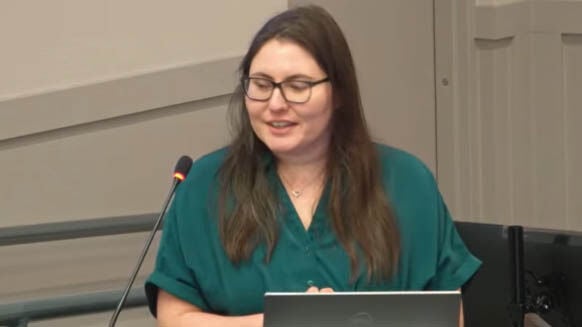
Nicole Cohen, an environmental engineer with Carollo Engineers, presents water supply expansion alternatives to Punta Gorda City Council on Oct. 28. Cohen recommended expanding the city’s reverse osmosis facilities, citing reliability, resilience and lower projected costs over 25 years.
Cohen said the recommended plan would provide a reliable local water supply, improve system resilience and limit community impacts. It also has the lowest life-cycle cost over 25 years, she said.
The other two alternatives were more expensive.
Purchasing up to 3.3 million gallons per day from the Peace River Manasota Regional Water Supply Authority would cost $144.2 million. A combined option involving water purchases from the authority and a reverse osmosis expansion adding 4 million gallons per day would cost $118.8 million.
Cohen said purchasing water from the authority would provide an additional source of treated water when conditions at Shell Creek limit surface water use. Existing pipelines would help reduce the need for new construction.
The combined option of authority water purchases and a reverse osmosis expansion would diversify the city’s water supply but involve moderate construction impacts, she said.
Punta Gorda currently relies on two water treatment processes.
The surface water system draws water from Hendrickson Dam and the Shell Creek Reservoir and conveys it to the Shell Creek Water Treatment Plant.
The brackish groundwater system draws water from the city’s brackish groundwater wellfield and sends it to the reverse osmosis plant for treatment.
Before the vote, Council opened the meeting to public comment on the water expansion plan.

Punta Gorda City Council members meet Oct. 28 at City Hall, 326 W. Marion Ave. The council unanimously approved a $95.9 million plan to expand the city’s reverse osmosis water treatment capacity and strengthen its water supply against future disruptions.
Resident Tim Ritchie warned Council about phosphate mining upstream along the Peace River in DeSoto County. He said major phosphate waste spills decades ago killed most of the fish in the river, which turned bone-white.
Resident Samuel Terpening urged Council to be guardians of the city’s water.
Later at the Oct. 28 meeting, Council adopted a resolution opposing phosphate mining within the city limits and raised concerns about its impact on the environment.
Following the vote to approve the water expansion plan, council member Janis Denton thanked Spencer and his staff for coordinating the study and evaluating the alternatives.
“I’m really happy the city is being proactive in this,” she said.
(0) comments
Welcome to the discussion.
Log In
Keep it Clean. Please avoid obscene, vulgar, lewd, racist or sexually-oriented language.
PLEASE TURN OFF YOUR CAPS LOCK.
Don't Threaten. Threats of harming another person will not be tolerated.
Be Truthful. Don't knowingly lie about anyone or anything.
Be Nice. No racism, sexism or any sort of -ism that is degrading to another person.
Be Proactive. Use the 'Report' link on each comment to let us know of abusive posts.
Share with Us. We'd love to hear eyewitness accounts, the history behind an article.