
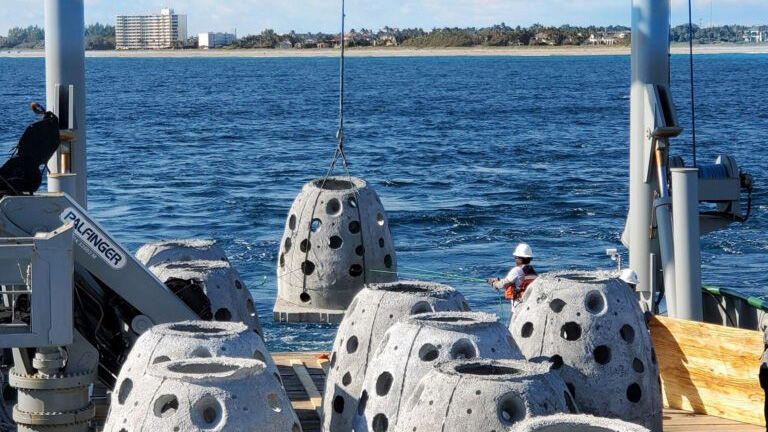
A prefabricated concrete reef module is lowered from a vessel into the Gulf. Collier County’s new artificial reef will use similar structures to provide habitat for fish and other marine life.
Collier County has accepted $100,000 to build an artificial reef to address the decline of marine ecosystems caused by climate change, overfishing, development and pollution — and increase tourism through fishing and diving opportunities.
The Board of County Commissioners, in absentia on Aug. 11, accepted a $50,000 grant from the nonprofit Collier Community Foundation, which will be matched by $50,000 from Coastal Conservation Association Florida, an Orlando-based nonprofit. Because the Aug. 11 board meeting was canceled, the funding was approved by County Manager Amy Patterson and will be ratified by the board at its Aug. 25 meeting.
The county’s Paradise Coast Reef program was established in the early 1980s to promote tourism, provide fishing and diving opportunities and enhance marine habitat. At least 37 reefs were created using 18,000 tons of recycled concrete through regional projects managed since the late 1970s, including by the cities of Naples and Marco Island.

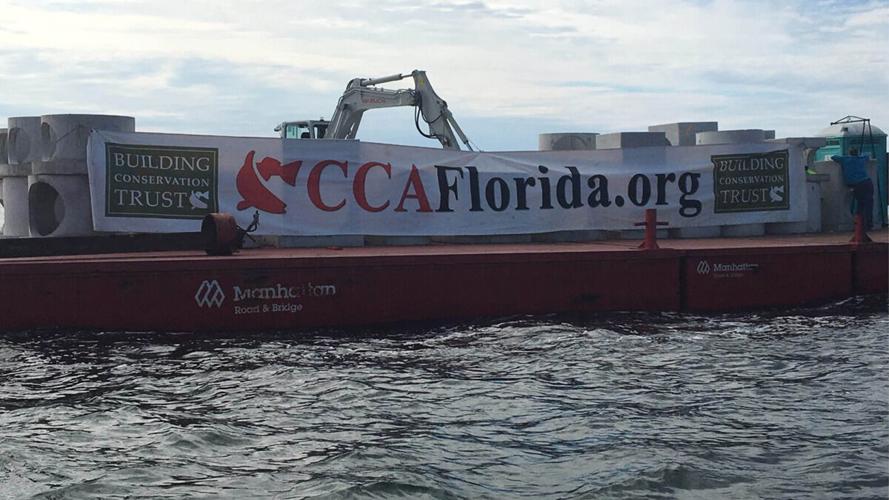
Reef materials are transported by barge as part of an artificial reef project supported by Coastal Conservation Association Florida. CCA Florida is providing $50,000 toward Collier County’s planned reef off Naples.
Artificial reefs help the ecosystem by creating complex habitats that provide refuge for juvenile sportfish, marine invertebrates and various fish species, including groupers, snappers and amberjacks, according to CCA Florida. They also dissipate wave energy, which helps protect shorelines from hurricanes and erosion.
The reef will be built with prefabricated concrete reef modules that comply with requirements of the Florida Fish and Wildlife Conservation Commission and the U.S. Army Corps of Engineers, County Coastal Management Program Manager Andrew Miller wrote in a memo to commissioners. Modules will be transported by dump truck, loaded onto a barge and taken to the site, about 10 miles off the coast of Naples. County staff will complete the required administrative, permit compliance and field verification efforts.
The reef is expected to be completed later this year and will be monitored for three years to determine its impact, with researchers measuring the presence of corals and sponges and the variety of fish species. Within days of deployment, fish begin gathering at artificial reefs.
(0) comments
Welcome to the discussion.
Log In
Keep it Clean. Please avoid obscene, vulgar, lewd, racist or sexually-oriented language.
PLEASE TURN OFF YOUR CAPS LOCK.
Don't Threaten. Threats of harming another person will not be tolerated.
Be Truthful. Don't knowingly lie about anyone or anything.
Be Nice. No racism, sexism or any sort of -ism that is degrading to another person.
Be Proactive. Use the 'Report' link on each comment to let us know of abusive posts.
Share with Us. We'd love to hear eyewitness accounts, the history behind an article.