
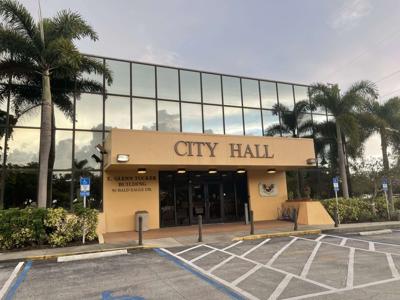

Marco Island City Hall is the seat of municipal government on Marco Island.
Like other municipalities, Marco Island is setting its property tax rate as Floridians consider Amendment 3, which could reduce the city’s operating revenue by $3 million to $4 million in the next five years. That vote comes on Nov. 3, during the midterm elections.
Not only that, but voters in Marco Island will decide Aug. 18 whether to approve a $23 million bond to replace the Caxambas Bridge and the Goldenrod Bridge. They also will consider repairing three bridges: Blackmore, Sandhill and South Seas.
With the fate of Amendment 3 and the city’s infrastructure bond still uncertain, Marco Island Vice Chairman Rene Champagne urged his fellow councilors to consider how the city could find itself on unsteady financial ground.
“Should the bond not be approved, if the people in the community and sitting in the audience think we’ve been discussing cost cuts too frequently, you haven’t seen anything if the bond doesn’t pass,” Champagne said at the Aug. 3 City Council meeting. “We are going to go into every budget, every department and start looking for more cuts. It’s the only way to keep this city fully funded and keep the services flowing.”
Should voters statewide agree to slash property tax revenue in 2027-28, the Florida Policy Institute says, Marco Island will lose about $3.4 million on a recurring basis by FY 2031-32. If the city set its proposed millage rate too low, people who rely on city services could find themselves without some of them, Champagne said.
“Should Amendment 3, the governor’s referendum pass, we are really looking at serious problems,” Champagne said. “That would be anywhere from $3 million to $5 million in loss of revenue on top of not having the bond fund pass; this city would be up the creek.”
City Manager Casey Lucius agreed that the bond would require a change in strategy.
“If the bond does not pass, the projects we have outlined for the next 10 years will not be funded and I will come back to City Council and we’ll have a discussion about alternative funding strategies,” she said.
The Council voted 5-2 to set a millage neutral rate for the city, which means residents will continue to pay the same property tax rate as last year, at 1.267 mills. That translates into $1.267 in property tax for every $1,000 of a property’s assessed value. Hideaway Beach’s millage rate will also stay the same as last year, at 1.600 mills.
Again citing the city’s uncertain financial future, Champagne proposed setting the millage rate at 1.3551 mills, which matches the city’s spending cap.
“As we sit here today, the budget we put together quite frankly, doesn’t meet the obligations that the city has,” the former CEO and U.S. Navy officer said. “Keeping it at millage rate-neutral is asking for continued financial difficulty for finding money to pay for various services and/or more importantly, infrastructure improvement.”
Under Florida’s Truth in Millage Act, once a municipality adopts a proposed tax rate at its first public hearing, it cannot adopt a higher rate at the final hearing without restarting the entire notification process. That’s why Champagne urged his fellow councilors to adopt a higher millage up front and reduce it where possible during budget discussions in August and September.
To settle on that number would require a unanimous vote by the Council, budget manager Melissa Hinton told Champagne.
Councilor Deb Henry said she is relying on good will and the faith of the voters.
“We have the bond referendum on the ballot starting (Aug. 18), and I think it’s in good faith that we need to move forward knowing that we would be good stewards,” she said. “And if the referendum in November passes? Well then, it’s going to be time to pay the piper. Staying at neutral shows we are being good stewards to the community.”
Councilor Kevin Dohm joined Champagne’s argument.
“Let’s get realistic here,” he said. “We need some kind of a safety net. If we’re all going to be reasonable about this, and we want to keep our island the way it is, I think we’re going to have to do what’s necessary even if it’s not popular. I didn’t sign anything that said I won’t raise taxes, but we need to evolve.”
Chairman Darrin Palumbo, noting that the Council lacked the votes to set the preliminary millage rate at 1.3551 mills, said he and other Council members had pledged never to raise property taxes. Even in this case — when the difference between 1.267 mills and 1.3551 mills represents only an $88 hike in annual property taxes for a $1 million home — Palumbo called it a no-go.
“It’s not the amount, it’s the philosophical debate on Marco,” Palumbo said. “Some of us were elected [because we] campaigned on and made promises to the citizens who put us here. They didn’t put councilors here who had said, ‘I’m raising your taxes.’”
Champagne, who was appointed to the Council on St. Patrick’s Day, 2025, said the city is now a slave to that promise.
“Since 2016, the city has gone only one direction with the millage rate, and that’s down,” he said. “We know what kind of difficulty those City Council decisions have led to. We’ve been facing them on the Council for 17 to 18 months now. It’s been nonstop trying to find ways to develop new revenue streams so that we can spend it for necessary items that need fixing.”
The next Marco Island City Council meeting is at 5:30 p.m. Aug. 17.
Council has rescheduled its standard September 2026 meeting and budget hearing dates to Thursday, Sept. 10, and Tuesday, Sept. 22.
(0) comments
Welcome to the discussion.
Log In
Keep it Clean. Please avoid obscene, vulgar, lewd, racist or sexually-oriented language.
PLEASE TURN OFF YOUR CAPS LOCK.
Don't Threaten. Threats of harming another person will not be tolerated.
Be Truthful. Don't knowingly lie about anyone or anything.
Be Nice. No racism, sexism or any sort of -ism that is degrading to another person.
Be Proactive. Use the 'Report' link on each comment to let us know of abusive posts.
Share with Us. We'd love to hear eyewitness accounts, the history behind an article.