
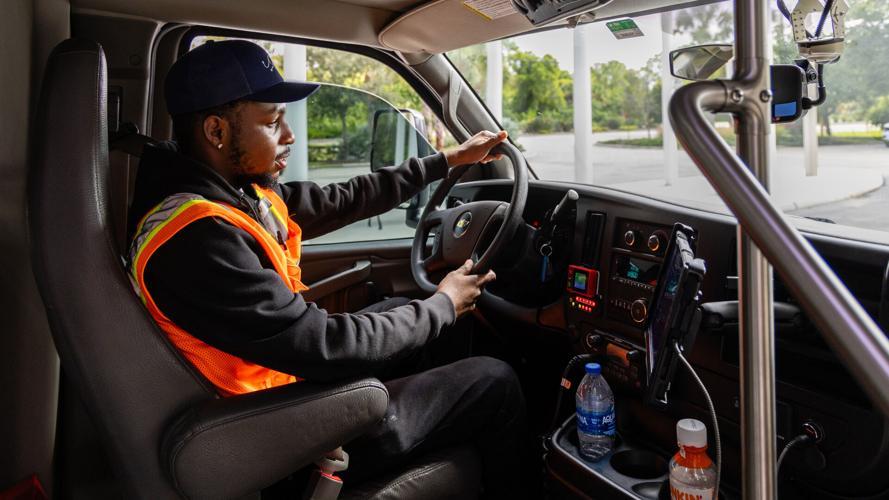


Driver Lormil Saint Fleur works aboard a CATConnect paratransit vehicle in East Naples.
After a heated bidding process, a San Francisco transit company was awarded a $12.55 million Collier Area Transit contract, with $297,268 in additional startup costs, to manage CAT’s fixed-route buses and paratransit routes.
It was the fourth-ranked bidder after negotiations stalled with the current transit management company, Dallas-based MV Transportation, the top-ranked operator, and two other bidders. The contract, which involves a fleet of 28 buses, reflects a 3% increase and funding for an increase in paratransit trips; the county also plans to purchase its first electric bus.
The Board of County Commissioners, in absentia Aug. 11, unanimously awarded a $12,553,640 contract to WeDriveU, whose proposal was $365,679.26 more than MV Transportation’s last amended contract. Because the Aug. 11 board meeting was canceled, the contract and other consent agenda items were approved by County Manager Amy Patterson and will be ratified by the full board at its Aug. 25 meeting.
MV Transportation, which has had the contract since 2019, filed a Worker Adjustment and Retraining Notification Act letter with the state on July 30, saying it plans to lay off 151 workers, including 112 drivers, on Sept. 30 or within 14 days after that at CAT’s East Naples facility at 8300 Radio Road. Most of the employees, 128, are represented by the Transport Workers Union of America. WeDriveU hasn’t responded to inquiries from Gulfshore Business about whether it plans to hire the employees, and the union said the company hasn’t responded to its calls.

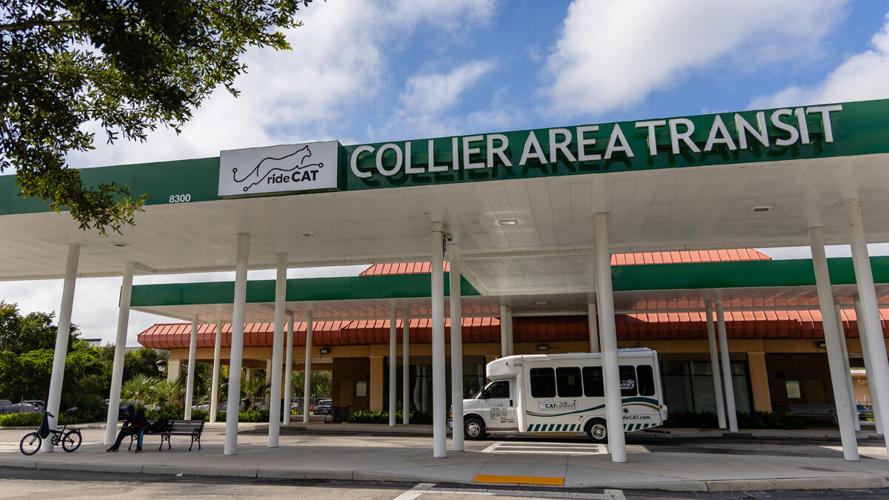
The Collier Area Transit Operations Center at 8300 Radio Road in East Naples.
Employees also include managers, dispatchers, reservationists, customer service representatives, accounting clerks, a utility worker and others.
On Aug. 15, WeDriveU will begin a 45-day startup period to mobilize and transition services from MV Transportation, according to a memo to commissioners by Ellen Sheffey, CAT director for the Fiscal & Public Transit Services Division.
The three-year contract, with two possible one-year renewals, came after months of negotiations. A request for proposals was advertised in October 2024, prompting six responsive and responsible bidders, the memo said. A selection committee met in March 2025 and scored the proposals, resulting in a tie for third place, which was resolved through tie-breaking procedures and led to four oral presentations a month later.
“The proposers were final ranked, resulting in a three-way tie for first place,” Sheffey wrote, adding that the tie was resolved.
Illinois-based Transdev Services was top-ranked, followed by WeDriveU, MV Transportation and Massachusetts-based Keolis Transit Services. However, MV Transportation and WeDriveU filed formal protests, and the county Procurement Services director evaluated their merits and opted to select a new ranking committee to reevaluate all proposals.
Last August, the committee scored and ranked the six bidders and agreed oral presentations were not needed. The committee recommended the award go to MV Transportation, which was ranked first, followed by Keolis Transit Services, Transdev Services, WeDriveU, Brooklyn-based Corporate Transportation Group and Atlanta Transit.
But after negotiations began in December, county officials realized MV Transportation would not meet CAT’s budget requirements, and the Purchasing Department notified MV Transportation it was ceasing negotiations. The memo shows the same occurred with Keolis and Transdev. On May 22, CAT began negotiations with WeDriveU, culminating in a “proposed successful agreement.”

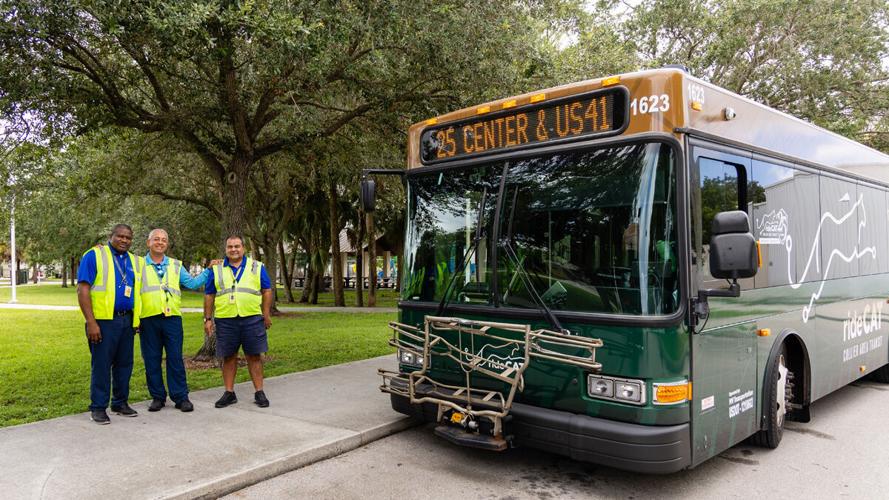
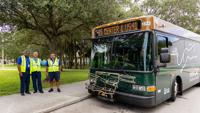
From left, drivers Jeremy Pelissier, Jorge Salinas and Héctor Hernández.
County officials anticipate contract amendments as the new company responds to level-of-service adjustments. Due to expected adjustments during the contract term, the memo said, the contract separates administrative functions from operations to manage costs. To ensure high service levels without negatively affecting service quality, the memo said, performance standards have been established, including incentives and disincentives.
The contract includes assessments for incidents such as missed trips — $50 for paratransit and $100 for fixed-route stops; $50 for driver-related infractions, such as smoking, unprofessionalism and getting lost; and $500 for failing to inspect a bus before leaving the facility.
Records show CAT provided 108,836 trips in 2023, up from 83,940 in 2022; more recent data wasn’t provided. The contracts show the revenue-per-hour rate for fixed routes will total $64.93, compared with the current $62.64, while paratransit costs per trip will rise to $44.81 from $38.17 and will continue to rise over the contract.
Current paratransit CATConnect costs of $4.56 million will increase to $5.62 million, partly due to an increase in riders, while the fixed-route bus contract will rise to $4.733 million from $4.57 million.
(0) comments
Welcome to the discussion.
Log In
Keep it Clean. Please avoid obscene, vulgar, lewd, racist or sexually-oriented language.
PLEASE TURN OFF YOUR CAPS LOCK.
Don't Threaten. Threats of harming another person will not be tolerated.
Be Truthful. Don't knowingly lie about anyone or anything.
Be Nice. No racism, sexism or any sort of -ism that is degrading to another person.
Be Proactive. Use the 'Report' link on each comment to let us know of abusive posts.
Share with Us. We'd love to hear eyewitness accounts, the history behind an article.