




The U.S. and Southwest Florida economies remain infused with uncertainty in the fourth quarter, driven by artificial intelligence investment without clear returns, rapidly shifting trade policies and an ongoing federal government shutdown that leaves economists with limited data to assess the situation.
The stock market remains in a bull run dating to October 2022, Southwest Florida-based Florida Trust Wealth Management reported. But despite the continued rise, market uncertainty paints a more complicated economic picture.
“This uncertainty is also the driver of recent Federal Reserve action,” wrote Florida Trust Wealth Management Chief Investment Officer Kristian R. Jhamb and Portfolio Manager Logan S. Webb in an October market outlook report. “Cuts to short-term interest rates at the Fed’s Sept. 17 meeting were predicated on a growing concern over a labor market that has softened significantly, driven to some degree by the uneven trade and economic climate.”
The Federal Reserve on Oct. 29 again voted to lower interest rates by a quarter point, though two members dissented.
The cuts could help spur a residential housing market that has softened since its 2022 peak, said Realtor Karen Borrelli, president of the Royal Palm Coast Realtor Association. However, uncertainty over global tariff negotiations could restrain sales.
“When people are worried about what’s happening in the economy and what the future looks like, they’re less likely to spend money on housing,” Borrelli said.

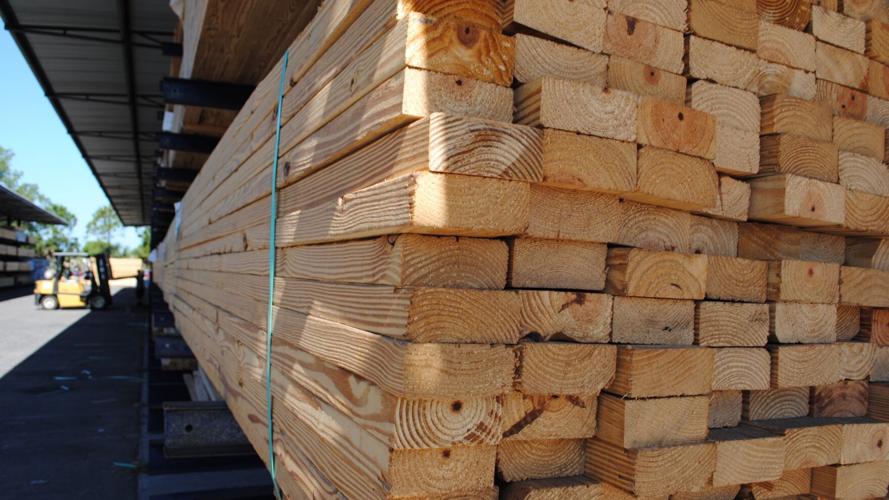
Lumber supplies at a Southwest Florida distributor. Builders say new federal tariffs are driving up costs on imported materials.
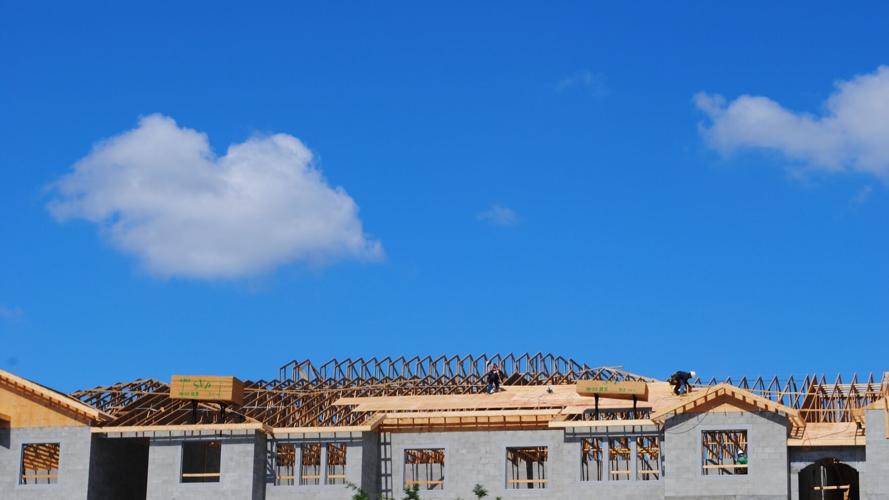
Southwest Florida construction professionals reported mixed effects from tariffs on goods including Canadian lumber. Rising costs are expected to impact homebuyers, but builders and suppliers are trying to absorb some of the expense.
“We are doing everything in our power to not increase the cost to the end user,” said Justin Einstein, vice president of custom homebuilder Aubuchon Homes.
For some companies, the impact of tariffs has been less severe than expected. “When the tariffs were first announced, we did receive letters from our subcontractors and suppliers stating they expected prices to increase and encouraged us to lock in pending contracts with them at the time,” said Dan Adams, executive vice president and partner of Stevens Construction, a health care and commercial construction company. “However, we have had negligible impact — some materials have increased in price and others decreased but not due to tariffs, just the ebbs and flows of the industry in general.”
Stock markets that fell sharply when President Donald Trump first announced tariffs in April were up 7% for the third quarter, Florida Trust Wealth Management reported. But the unpredictable negotiation process has left some business owners uncertain.
“Overall, it makes it more costly to run a business if you have that much uncertainty,” said Eric Glocer, owner of Cape Coral-based tile and stone importer PCC Tile, which sometimes places orders a year in advance.
The uncertainty also is affecting buyer behavior. Florida Gulf Coast University economists reported that the Florida Consumer Sentiment Index fell 1.5 points in September, with consumers planning to limit spending due to concerns about the national economy.

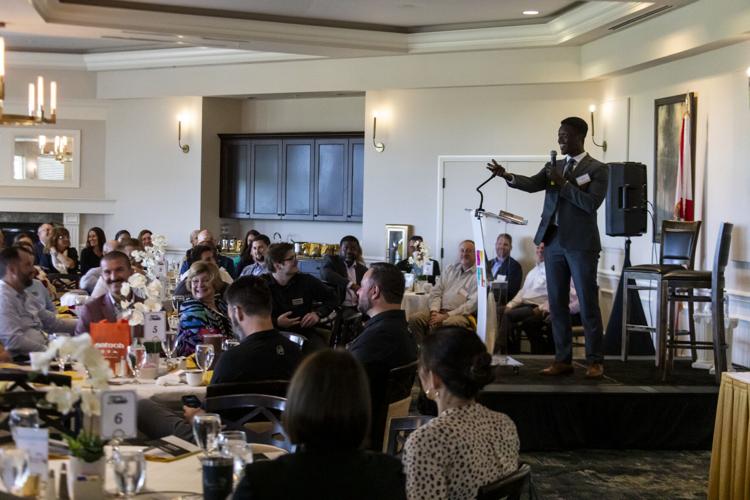
Jeremy Mathurin of Microsoft speaks during SWFL Inc.’s AI Summit at Plantation Golf & Country Club in Fort Myers.
“If consumers have less confidence, they’re probably going to be less likely to take that vacation,” said Ian Breusch, chief operating officer and senior portfolio manager for Florida Trust Wealth Management.
Technology companies continue to drive market gains through major investments in generative AI, and Southwest Florida professionals report widespread adoption. However, the return on those investments remains unclear.
A guest speaker from Microsoft at the Chamber of Commerce SWFL Inc. meeting in September asked attendees how many use generative AI in their professional lives. Nearly everyone raised their hand. Public employers also are joining in, with the city of Fort Myers investing in a $72,000-per-year digital assistant.
“The amount of money that’s percolating in that industry, the growth or anticipation of growth that’s coming out of that place has really driven stock markets,” Breusch said. “AI is expected to change business in ways we can’t quite understand or imagine just yet.”
(1) comment
I finally understand how these seemingly disparate elements — tariffs, AI, out of country supplies such as Canadian lumber — all become eggs in the same basket. The story is vivid and clear without being simplistic, the sourcing is varied and articulate, and the photos, by the way, are both artfully appealing and precisely relevant. Sparkling journalism at a time we need it, to understand what's happening in our regional economy and lives.
Welcome to the discussion.
Log In
Keep it Clean. Please avoid obscene, vulgar, lewd, racist or sexually-oriented language.
PLEASE TURN OFF YOUR CAPS LOCK.
Don't Threaten. Threats of harming another person will not be tolerated.
Be Truthful. Don't knowingly lie about anyone or anything.
Be Nice. No racism, sexism or any sort of -ism that is degrading to another person.
Be Proactive. Use the 'Report' link on each comment to let us know of abusive posts.
Share with Us. We'd love to hear eyewitness accounts, the history behind an article.