
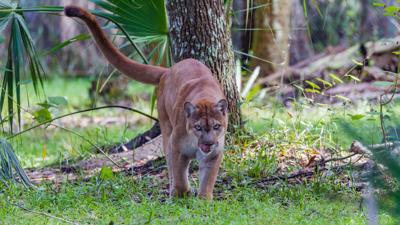
Three conservation groups have sued federal agencies over approval of a 10,264-acre residential and commercial project in eastern Collier County, arguing it will destroy key Florida panther habitat.
The Center for Biological Diversity, Sierra Club and South Florida Wildlands Association filed the lawsuit April 8 in U.S. District Court in Fort Myers against employees of the U.S. Fish and Wildlife Service, Department of the Interior and Army Corps of Engineers. The Department of Justice, which represents the agencies, said it does not comment on pending litigation.
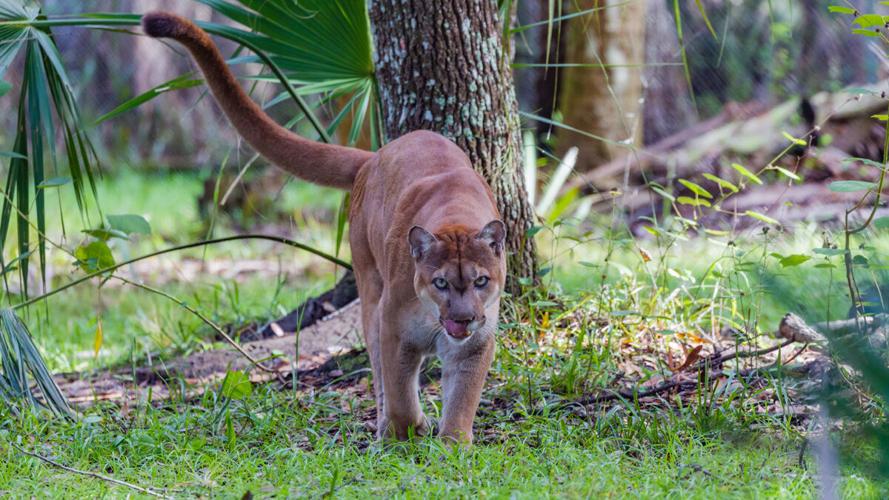
“The Fish and Wildlife Service violated the Endangered Species Act by approving this massive project smack dab in prime panther habitat and just a few miles from the Florida Panther National Wildlife Refuge,” said Jason Totoiu, Center for Biological Diversity’s senior attorney and Florida policy director. “Our state’s struggling panthers depend on a thriving Southwest Florida population and the ability to expand northward, which are both threatened by this development. We’re suing to stop these cats from sliding closer to extinction.”

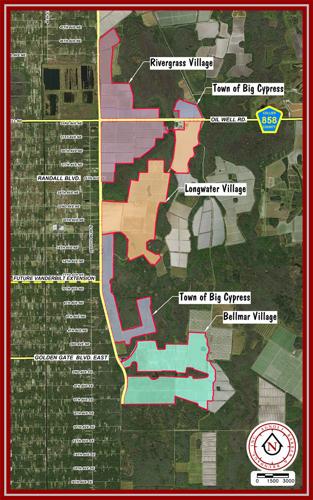
A site map outlines the proposed town of Big Cypress and the villages of Rivergrass, Longwater and Bellmar in eastern Collier County. Environmental groups are seeking to halt the project over impacts to Florida panther habitat.
The groups seek a permanent injunction to halt development of an approved town and three planned villages in the county’s Rural Lands West area. The project, developed by Collier Enterprises, part of the Tarpon Blue Family of Companies, includes the town of Big Cypress and the villages of Rivergrass, Longwater and Bellmar east of Golden Gate Estates. The buildout is expected over 15 to 20 years.
Rivergrass broke ground in January, with 1,000 homes planned in the initial phase and potential expansion to 2,500 homes. Another approved development, the 3,205-home Horse Trials Village, is undergoing environmental review.
The lawsuit follows earlier legal challenges. Six years ago, Conservancy of Southwest Florida sued in state court over county approval of Rivergrass. Although the groups lost, an appeal led to a settlement preserving 655 acres of panther habitat and other environmental concessions.
In 2024, Sierra Club, Conservancy and Center for Biological Diversity, represented by Earthjustice, won a federal case in which a judge ruled the Environmental Protection Agency and U.S. Fish and Wildlife Service violated the Endangered Species Act by transferring Florida’s wetland permitting authority under Section 404 of the Clean Water Act to the state.
The latest lawsuit seeks additional limits on development, alleging federal agencies acted in a manner that is “arbitrary and capricious, an abuse of discretion” and not supported by the Administrative Procedure Act.
The lawsuit alleges that the Fish and Wildlife Service’s Biological Opinion overlooks the likelihood that the panther is already at risk even without the project and does not adequately assess how the project’s additional impacts could affect the species’ survival and recovery, as required under the Endangered Species Act.
Federal officials developed a recovery plan for Florida panthers nearly 20 years ago, but more than 30,000 acres of habitat have been lost since. Vehicle strikes kill dozens of panthers annually, and increased competition for shrinking habitat has led to more fatal conflicts among the animals.
Environmental groups estimate fewer than 200 adult Florida panthers remain in the wild, confined to a single breeding population in the region. The federal recovery plan calls for three self-sustaining populations of at least 240 panthers each, supported by sufficient habitat, before the species can be removed from the endangered list.
The lawsuit asks a judge to find the agencies violated federal law, halt further project actions, set aside the biological opinion and wetlands permit tied to the project and require federal agencies to reinitiate review of impacts on panthers before allowing additional development.
“Our hope is that this lawsuit will finally determine how much development is too much for the Florida panther,” said Matthew Schwartz, executive director of South Florida Wildlands Association. “We are also acutely aware that many more projects in the habitat beyond Rural Lands West are on the horizon, and this lawsuit may well be the panther’s last stand.”
(0) comments
Welcome to the discussion.
Log In
Keep it Clean. Please avoid obscene, vulgar, lewd, racist or sexually-oriented language.
PLEASE TURN OFF YOUR CAPS LOCK.
Don't Threaten. Threats of harming another person will not be tolerated.
Be Truthful. Don't knowingly lie about anyone or anything.
Be Nice. No racism, sexism or any sort of -ism that is degrading to another person.
Be Proactive. Use the 'Report' link on each comment to let us know of abusive posts.
Share with Us. We'd love to hear eyewitness accounts, the history behind an article.