



What happens during a cardiac emergency on a Collier County public school campus? Are teachers and staff — and even students — prepared to take measures necessary to help save the life of a student, staff member or campus visitor suffering a cardiac event? Do they have access to lifesaving equipment and know how to use it as they wait for emergency medical services to arrive?
A new state law that went into effect this summer requires every public school and charter school in Florida to have an automated external defibrillator on site, and a Cardiac Emergency Response Plan in place with staff trained to act in a cardiac emergency, according to the American Heart Association, which advocated for the bill.
HB 1607, championed by state Sen. Corey Simon and state Reps. Taylor Yarkosky and Alex Rizo, also revised training requirements for students in grades 6, 8, 9 and 11 “to ensure they receive instruction in cardiopulmonary resuscitation and the use of AEDs,” according to a bill summary online at fastdemocracy. com.
Jessaca Rodriguez, executive director for AHA in Southwest Florida, said the most important thing that organizations and schools can do when it comes to thinking ahead and reducing deaths from cardiac arrest is having that plan in place. “This includes having an AED and having a Cardiac Emergency Response Team comprised of staff at every school,” Rodriguez said. “And at the district level, a plan should be in place for practicing drills and ensuring that all staff is properly trained in CPR and AED use and then working alongside local EMS and other organizations to build upon this plan.”
Nationwide, more than 365,000 people experience cardiac arrest outside a hospital each year, according to AHA, and currently only 10% of those people will survive.
Hands-only CPR, if performed immediately, can double or triple a person’s chance of survival, the organization said, and in schools with AEDs, approximately 70% of children survive cardiac arrest — seven times the overall survival rate.

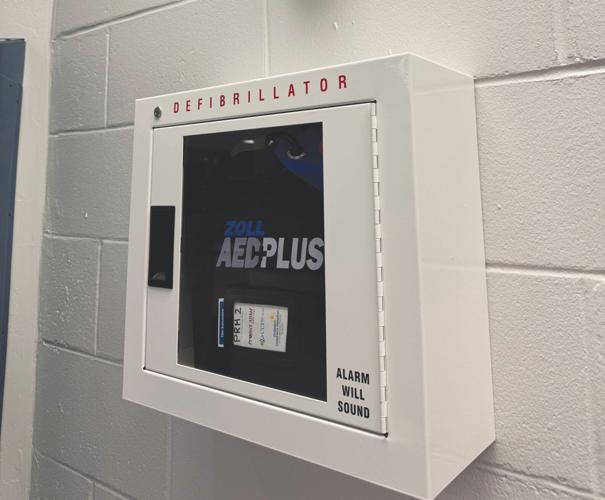
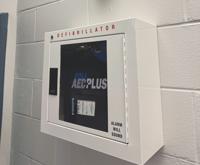
An automated external defibrillator at Pine Ridge Middle School is one of many across Collier campuses, part of the district’s emergency response plans.
Collier schools: Response plans in place
While the new state law went into effect in July, Florida schools have until July 2027 to fully meet the requirements.
But Collier County Public Schools has long had cardiac emergency plans in place, according to Chad Oliver, chief communications officer for the school district.
“For years — before this was a state mandate — CCPS has made it our practice district-wide to provide training and equipment to ensure our campuses are prepared for a variety of emergencies that might arise,” Oliver said in a written response to questions about the new bill. “Students and staff have been learning valuable life skills that may be used on or off a school campus to save lives.”
Oliver said all Collier County public schools already have at least one AED on campus, and all high schools have multiple units in the school building and available for athletics on the fields or in the gymnasium.
He said CCPS maintains a list of all AED locations on campuses and works with local EMS to ensure first responders are aware of those locations.
“CCPS already has a plan in place that requires our schools to maintain a Cardiac Emergency Response Team, trained and ready to respond to a medical emergency on campus when needed,” Oliver said. “This team consists of six to 10 staff members on a particular school campus who are trained to respond and assist with any cardiac emergencies. Many, if not all, team members are certified to perform CPR, AED and first aid.”
Additionally, Oliver said, CCPS offers CPR, AED and first aid training for district employees, with priority given to those required to have the certification for their job description and CERT members.
As for training students in lifesaving measures, Oliver said in his statement that the district had already been required to teach hands-only CPR and AED use to all students in grades 9 and 11, while also offering opportunities for high school students to voluntarily receive CPR certification.
“Extending basic training in first aid, CPR and how to use an AED to middle school students will be a new implementation,” Oliver said.
Asked whether additional funds had been required due to the new law, the district statement said: “As of now, we have not incurred any additional costs due to having a thoughtful emergency plan already in place.”

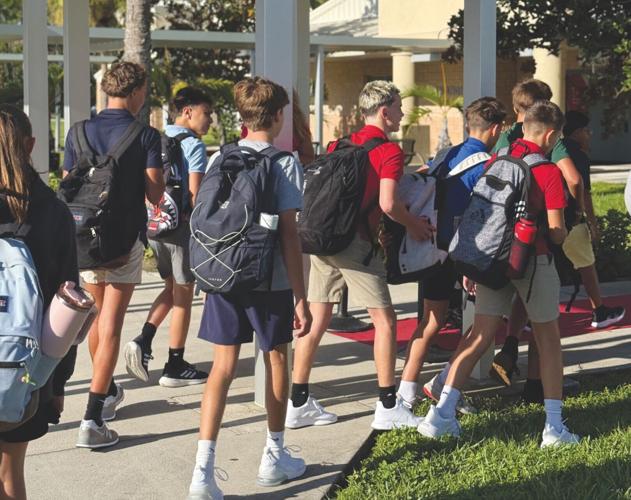
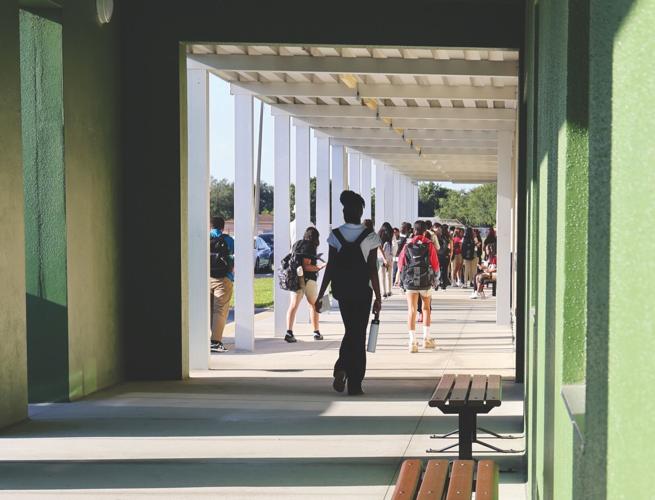
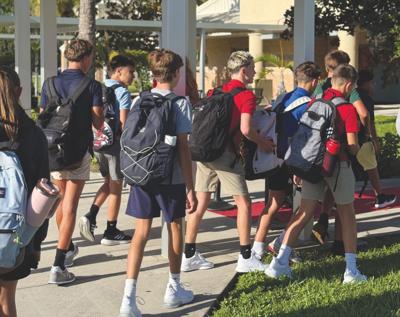
Collier County students arrive for class as the district continues to meet new state requirements for AED access and CPR training.
‘A nation of lifesavers’
For the American Heart Association, the need for more education and training around CPR and how to use an AED — and not just in schools — has been a major focus this year, according to Rodriguez.
“What we are trying to do is build the chain of survival in Southwest Florida when it comes to cardiac arrest, because currently nine out of 10 cardiac arrests occur outside of a hospital, and in 90% of those cases, the victim dies because CPR is not being performed adequately or in a timely manner,” Rodriguez said. “Quite simply, not enough people know what to do or how to do CPR, so we’re trying to remove that barrier and really bring this education to the forefront in our community.”
Rodriguez said the timeliness of CPR efforts is critical when it comes to increasing a victim’s chance of survival.
“We know that every minute that passes without a victim receiving CPR or an AED, their chance of survival decreases up to 10%,” she said. “So, the time really is critical, which is what this legislation was designed to address, and also the education so that people know what to do and how to do it effectively.”
The focus on the importance of timely CPR was illustrated at the organization’s Heart Ball gala in Naples this spring, which raised a record $850,000, through the story of 7-year-old Oscar Stuebe of Palm Beach.
Oscar was hit in the chest by a baseball during a game and suffered cardiac arrest. Thanks to the quick actions of his mom, Sarah, a nurse — who called 911 and performed CPR — his life was saved. There was hardly a dry eye in the house as Oscar and his family took the stage during the gala to thank supporters who make lifesaving efforts, training and technology possible for cardiac emergencies.
Tiffany McCaskill Henderson, government relations director for AHA Florida, said she thinks the effect of the new bill will extend beyond school campuses as more and more teachers and students are trained, becoming part of what an AHA initiative calls “a nation of lifesavers.”
“In the school environment, more personnel — faculty and staff — will know what to do; students in middle and high school will know what to do,” Henderson said. “And then, inevitably, it could reach out further into the community. I’ve heard stories where they may say, ‘A classmate of mine saved their grandmother because they learned CPR in school.’ Bystander CPR is very important.
“This [bill] is for the schools, but even if you’re out in your community and something occurs, you can act, and you can help.”
(0) comments
Welcome to the discussion.
Log In
Keep it Clean. Please avoid obscene, vulgar, lewd, racist or sexually-oriented language.
PLEASE TURN OFF YOUR CAPS LOCK.
Don't Threaten. Threats of harming another person will not be tolerated.
Be Truthful. Don't knowingly lie about anyone or anything.
Be Nice. No racism, sexism or any sort of -ism that is degrading to another person.
Be Proactive. Use the 'Report' link on each comment to let us know of abusive posts.
Share with Us. We'd love to hear eyewitness accounts, the history behind an article.