
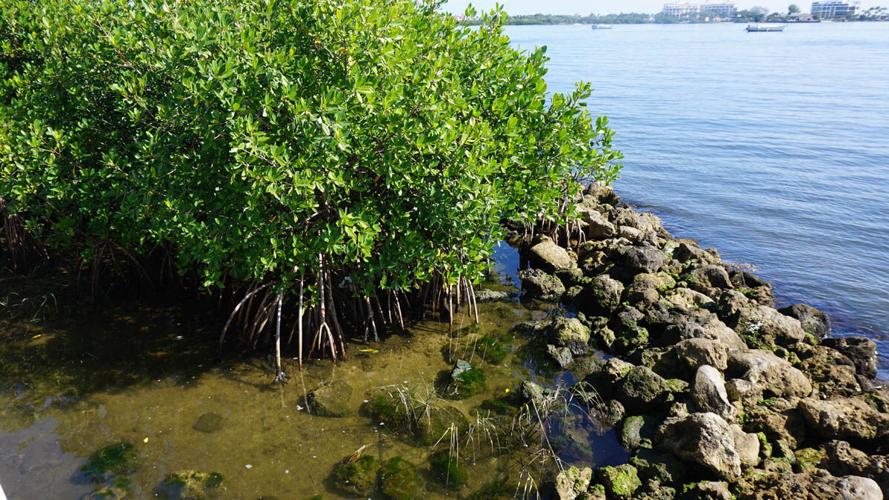



Mangroves grow alongside riprap at Lake Worth Lagoon, demonstrating how natural and traditional shoreline protection can work together. Conservancy of Southwest Florida’s new blueprint explores similar approaches for coastal communities.
Sometimes Mother Nature really does know best — including when it comes to flood protection.
That’s the premise of a new resource — Working with Nature: Flood Resilience Blueprint — released this month by Conservancy of Southwest Florida to promote nature-based approaches to reducing flood and storm impacts in coastal communities.

Carrie Schuman
Carrie Schuman, Ph.D., climate resilience advisor for Conservancy, said the blueprint is meant to demonstrate how mangroves, wetlands, oyster reefs, dunes and other natural systems can work with traditional “gray” infrastructure, including seawalls and stormwater systems.
According to Conservancy, mangroves are more than just a defining feature of Southwest Florida’s coastline: They serve as a literal frontline defense against storm surge.
For example, Schuman said a 2019 study found that mangroves reduce average annual flood losses to properties behind them in Collier County by about 25%. A separate study published in Cell Reports Sustainability in 2025 estimated that mangroves reduce annual storm-surge property losses in Collier County by $67 million.
Schuman said the blueprint, developed in collaboration with Miami-based consulting and engineering firm Cummins Cederberg and Largo-based Ecosphere Restoration Institute, provides a science- and engineering-based resource showing how nature-based strategies can be “layered in” to create multiple lines of flood defense.
“We really advocate for what we would call balanced adaptation,” Schuman said. “We’re advocating for these approaches because our region is dealing with changing conditions, such as increased flooding from multiple sources, intensifying storms and hotter days and nights.”
That balanced adaptation, she said, can also provide benefits for water quality, wildlife habitat and quality of life for residents and visitors.

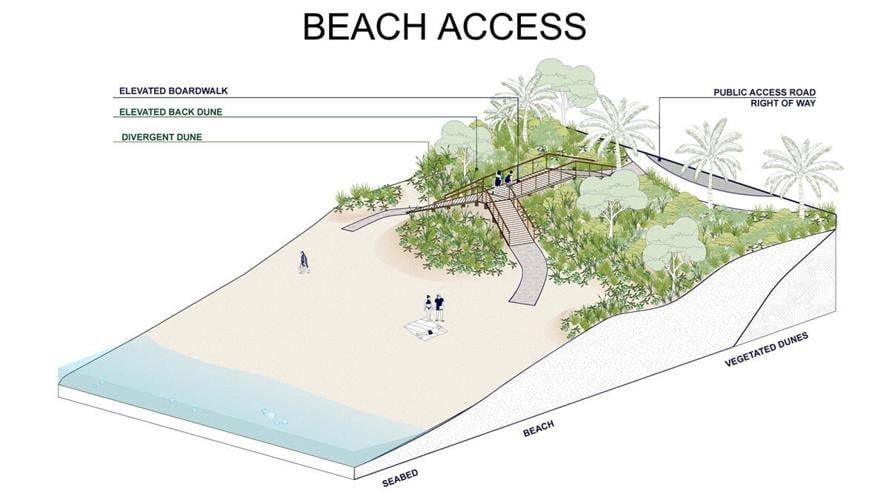
Beach access points can be vulnerable areas where storm surge channelizes and moves inland. This concept shows how resilience of beach access points can be improved, according to the Conservancy. It involves elevating the back dune system, which can help limit the inland movement of floodwaters.
Nature as infrastructure
Schuman said the blueprint, which identifies strategies that could be adapted to different types of locations in Naples or other coastal communities, is designed as an education and communication tool, not a final engineering plan.
Of the six concepts in the blueprint, five focus on characteristic shoreline types within the city of Naples, with the sixth focusing on local parks: mangrove protection; mangrove planter; living riprap; living seawall; beach access; and park-based resilience features.

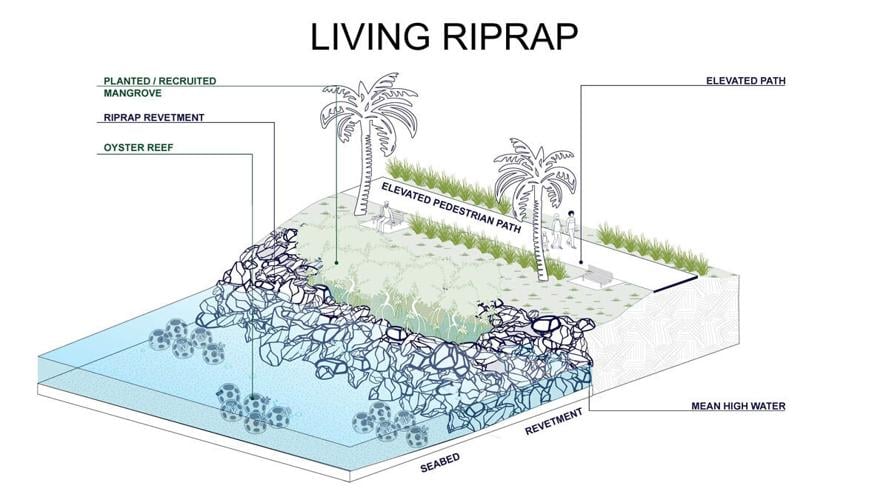
The Conservancy says this concept creates layers of protection for an existing unhardened shoreline using riprap — large, loose stones and sometimes concrete or granite — to stabilize shorelines and reduce erosion while allowing some water passage.
Schuman emphasized that nature-based solutions are not a “magic bullet” to eliminate flooding, but they can help reduce its impacts.
“The goal is never to say we can keep water out entirely,” she said. “Florida is a state really built on water, so you’re not going to keep water out, but you’re going to reduce the speed that it comes in, and you’re going to dissipate some of that wave energy.”

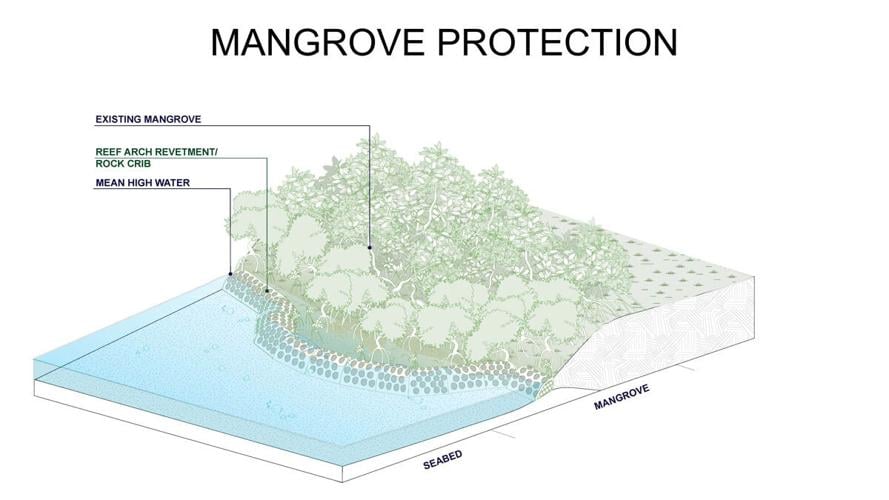
Mangroves help protect shorelines by reducing wind and wave energy. Studies suggest mangroves reduced annual flood risk in Collier County by about 25%, or $67 million. This concept places protective features around established mangroves.
From blueprint to pilot programs
Conservancy says the blueprint provides a resource for community and government leaders, property owners, homeowners and other decision-makers to explore how these strategies, in tandem with traditional infrastructure solutions, can create multiple lines of defense that help reduce damage and improve recovery.
As for what could happen next, Schuman said education is necessary to change how Southwest Florida thinks about infrastructure and to encourage the development of pilot programs.
She said there is no set number of pilot programs or firm implementation timeline, and Conservancy will work to identify potential partners and appropriate sites.
As for costs, Schuman said nature-based projects are often less expensive than totally “gray” designs such as seawalls but could still range from about $200,000 to $1 million or more.
Conservancy says those interested in implementing a pilot project should work with a Florida-registered professional engineer to develop site-specific designs and obtain necessary permits.
(0) comments
Welcome to the discussion.
Log In
Keep it Clean. Please avoid obscene, vulgar, lewd, racist or sexually-oriented language.
PLEASE TURN OFF YOUR CAPS LOCK.
Don't Threaten. Threats of harming another person will not be tolerated.
Be Truthful. Don't knowingly lie about anyone or anything.
Be Nice. No racism, sexism or any sort of -ism that is degrading to another person.
Be Proactive. Use the 'Report' link on each comment to let us know of abusive posts.
Share with Us. We'd love to hear eyewitness accounts, the history behind an article.