


Staffing and funding cuts at one of the nation’s premier science agencies could leave Southwest Florida less able to respond to hurricanes and contribute to an accelerating federal brain drain, former and current NOAA staffers and affiliated researchers are warning.
“Ever since [President Donald Trump’s inauguration on] Jan. 20, it’s been like, ’What kind of horrible thing is coming up next?’ And that’s really been the modus operandi here. It’s just been bad news after bad news.”
That is how one meteorologist with the National Weather Service, who spoke with The Naples Press on condition of anonymity to discuss sensitive issues openly, described the Trump administration’s cuts this year across the National Oceanic and Atmospheric Administration, part of the Commerce Department.
“The Weather Service lost 600 people in [Trump’s first] 90 days,” the meteorologist said. “We were about 4,200, and now we’re down to about 3,600.”
Only probationary employees — new hires with less protections — were laid off, he added, with the rest of the reduction coming from employees taking buyouts or deferred resignations.
For Floridians, the cuts at the National Weather Service, one of the most public-facing agencies inside NOAA, come at an especially difficult time: the start of the yearly hurricane season on June 1.
“I’m worried that there will be a forecast failure that otherwise didn’t need to happen,” said James Franklin, the former chief of forecast operations at the Miami-based National Hurricane Center, a division of the National Weather Service.
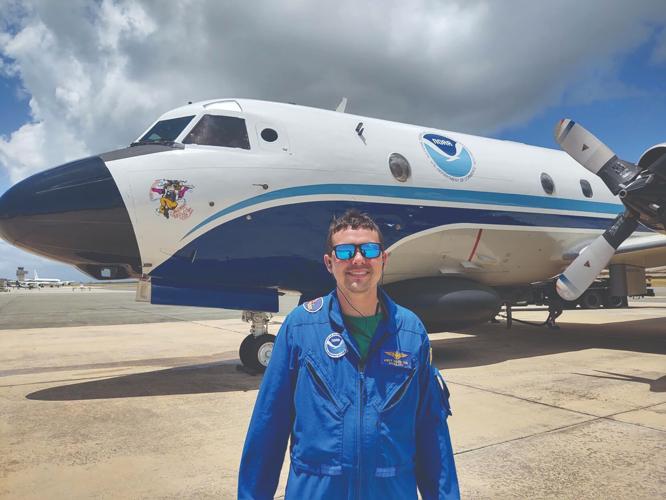
“The chance of a blown forecast … is going to go up, I believe, this summer. The ‘hurricane hunter’ planes not being able to fly [due to staffing cuts], not having the right people on board to fly the [weather] balloons, not having the meteorologists at local offices to get … warnings out properly — you just run the risk of a big error that’s going to catch people unprepared,” said Franklin, who retired nearly a decade ago but remains in touch with current staffers.
By “local offices,” Franklin was referring to the network of 122 regional offices the National Weather Service operates across the country, including five in Florida. The Florida offices, together with the National Hurricane Center, sit on the front lines of the state’s hurricane preparedness efforts.
Substantial but ‘absorbable’
And while the staffing cuts at the National Hurricane Center are, in the meteorologist’s words, substantial but “absorbable,” both he and Franklin said the reductions at the Florida regional offices are much more concerning.
“When a hurricane is approaching, these are the people who put together all the local forecasts,” Franklin explained. “So for example, the Hurricane Center will make the forecast … but somebody has to translate that forecast into what’s going to happen in Naples, in Key West, in Miami … That’s done at the local level, that’s not done at the Hurricane Center.”
As of now, the Miami office, which covers Collier County, is down five forecasters, the meteorologist said — a substantial reduction considering the office typically employs just 16 or 17 staffers.
But the National Hurricane Center and the National Weather Service’s regional offices are far from the only parts of NOAA facing cuts.
Reductions at the Environmental Modeling Center, a separate agency within the National Weather Service that plays a key role developing the models the National Hurricane Center uses, means advancements in hurricane forecasting could also stall.
“A five-day forecast now is about as accurate as a one-to-two-day forecast was 30 years ago, and those improvements really help people prepare … and [now] we stand to lose some of that,” said Andy Hazelton, a former hurricane scientist at the Environmental Modeling Center in College Park, Maryland.
“These forecast improvements that people have come to count on, they shouldn’t be taken for granted, because without investment, those things don’t happen,” he added.
Hazelton was one of nine staffers at the Environmental Modeling Center fired in late February in one of the first rounds of cuts affecting probationary employees across the federal government. He was reinstated in mid-March, only to be let go again in mid-April.
“It was just very disappointing,” Hazelton recalled. “We were hoping we’d be spared because of the importance of what we do, but unfortunately, we weren’t.”
Funding thousands of researchers
In addition to operating a variety of agencies including the National Hurricane Center and Environmental Modeling Center, NOAA also helps fund thousands of university researchers across the country through grants and cooperative agreements.
That is now under threat, too — and for Bob Weisberg, distinguished university professor emeritus of physical oceanography at the University of South Florida in Tampa, that is a big problem.
“NOAA is only part of the equation. What the academic community does is absolutely essential to the development of science and technology in our nation. And I’m even more concerned with the cuts that are being made to the academic research enterprise than I am to the federal [side],” Weisberg said.
“For example,” he continued, “most of the coastal observations in the ocean are being made by the academic community. There’s a program that we have called [the Integrated Ocean Observing System]. It’s the academic community that is doing that, [while] NOAA funds it. But I’m told that the entire program is being disbanded. That would be an absolute disaster.”
That program, a longstanding NOAA initiative, is run through 11 regional associations across the country. The Southeast Coastal Ocean Observing Regional Association, or SECOORA, covers parts of Florida, as well as the Carolinas and Georgia.
SECOORA, which is incorporated as a nonprofit in Charleston, South Carolina, applies for grants from the agency and then distributes those funds to ocean researchers at universities across its coverage area. Those researchers, in turn, make their findings available to NOAA.
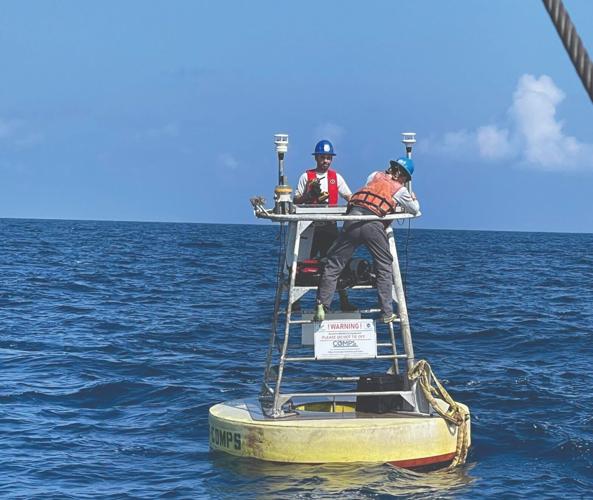
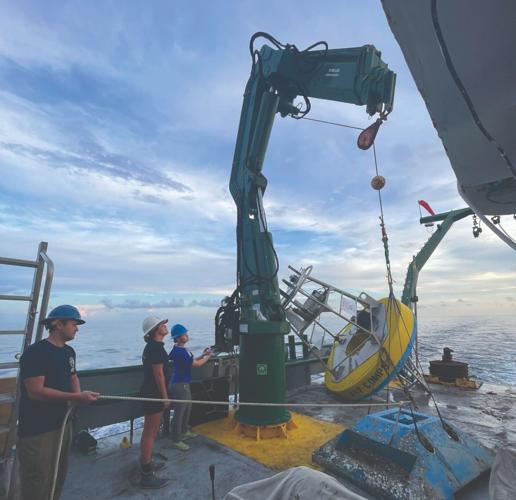
In Tampa, for example, SECOORA supports a team at USF that operates a network of data-gathering ocean buoys. The buoys collect oceanographic and atmospheric data every hour, providing NOAA with a close to real-time understanding of conditions off the Gulf coast.
“[The buoys] connect via satellite, and all the data they’ve collected for that hour gets dumped back to a satellite receiver on land at USF. That data immediately gets ingested into USF servers, where it’s quality controlled,” explained Jennifer Dorton, SECOORA’s deputy director. “Then at that point, SECOORA picks up that data and we push it out to [NOAA], so it gets into the system that allows that data to be open and available to the Weather Service, the [regional] weather forecast offices and the National Hurricane Center.”
She added: “From the time that buoy connects via satellite until the time [the data] is ingested into those server systems at [NOAA] is a matter of maybe a minute. It is that fast.”
Pull the buoys out?
But now programs that SECOORA helps coordinate are facing closure. The organization, which gets nearly all its funding from NOAA even though it is not formally part of the agency, was expecting to get its main yearly grant on July 1, but has not yet heard anything.
“At this point we don’t know if we’re going to get the money. We can’t even figure that out, [NOAA] can’t tell us anything. We don’t even know if the money’s coming … At this point, it’s very late to not know that we don’t have any money,” Dorton said. “There is just nothing, no info.”
If NOAA funding dries up, USF will have to pull its buoys out of the water by September, Dorton said.
“Without that buoy data, the Hurricane Center is still going to be able to create a model … But the problem is, they wouldn’t have anything to benchmark that model against. They wouldn’t have anything to look at and go, ‘Hang on, this isn’t quite right.’ And that’s a problem. That’s when you start putting lives and property in danger,” she said.
Most of the NOAA staffers and researchers said a sense of uncertainty had overtaken their work due to reduced staffing and funding.
A number of them said they understood NOAA had, like many other federal agencies, become bloated, but still pushed back on cuts they said were not done in a thoughtful way.
“To be blunt about it, NOAA does have a lot of room where they can make cuts,” said Weisberg, the USF professor. “Every agency is kind of fat, so to speak. And if they do it strategically, maybe the nation might be better off. But to just make these drastic cuts without really thinking what the ramifications may be is frightening.”
Improvements have saved billions
Nonetheless, all the NOAA staffers and researchers said they continued to believe the agency was delivering important results on a highly efficient, cost-effective basis.
Many of them pointed to a study last year by the nonprofit National Bureau of Economic Research that found that improvements to hurricane forecasting since 2007 have saved the country an average of $5 billion per landfalling hurricane.
“If I’m not mistaken, we had five landfalling hurricanes last year. So if that study is right, then the progress that we’ve made over the last almost two decades saved U.S. society $25 billion [last year],” said Franklin, the former National Hurricane Center chief.
By comparison, NOAA’s entire budget last fiscal year was just over $6.3 billion.
“If you look to the next 18, 20 years, and think about all the improvements that are not going to happen [due to the cuts] … it’s tremendously costly,” he continued. “And in terms of really modest expenditures of money, the savings to society just dwarf those expenditures.”
Still, many of the NOAA staffers and researchers said they understood that the current staffing and funding cuts will not be easy to reverse.
The meteorologist described the cuts to the National Weather Service as “thousands of years of lost experience,” adding, “That does not come back in a month. It’s something that the agency will be recovering from for quite a while.”
For his part, Weisberg said the cuts in academia “are crippling our ability as a nation to drive future technology forward, which to me, is economic suicide. Really, I find that to be most disturbing.”
Franklin echoed those thoughts: “This is a generational loss that would take years or decades to reestablish … You’ll handicap a field, possibly for a generation. And that, to me, is the really sad part about this … It’s going to handicap progress for decades.”
This story was published in The Naples Press on June 13.
(0) comments
Welcome to the discussion.
Log In
Keep it Clean. Please avoid obscene, vulgar, lewd, racist or sexually-oriented language.
PLEASE TURN OFF YOUR CAPS LOCK.
Don't Threaten. Threats of harming another person will not be tolerated.
Be Truthful. Don't knowingly lie about anyone or anything.
Be Nice. No racism, sexism or any sort of -ism that is degrading to another person.
Be Proactive. Use the 'Report' link on each comment to let us know of abusive posts.
Share with Us. We'd love to hear eyewitness accounts, the history behind an article.