




While it wasn’t a record year for the number of sea turtle nests on Collier County beaches, with no significant tropical storm activity, it came close.
On the beaches the county’s Sea Turtle Monitoring Program oversees — Barefoot, Vanderbilt, Park Shore, City of Naples and Marco Island — 1,179 nests were recorded, compared to 996 in 2024.
Mary Toro, environmental supervisor for the program, said in an email response to questions that the highest recorded number for sea turtle nests for Collier County was 1,273 in 2023.
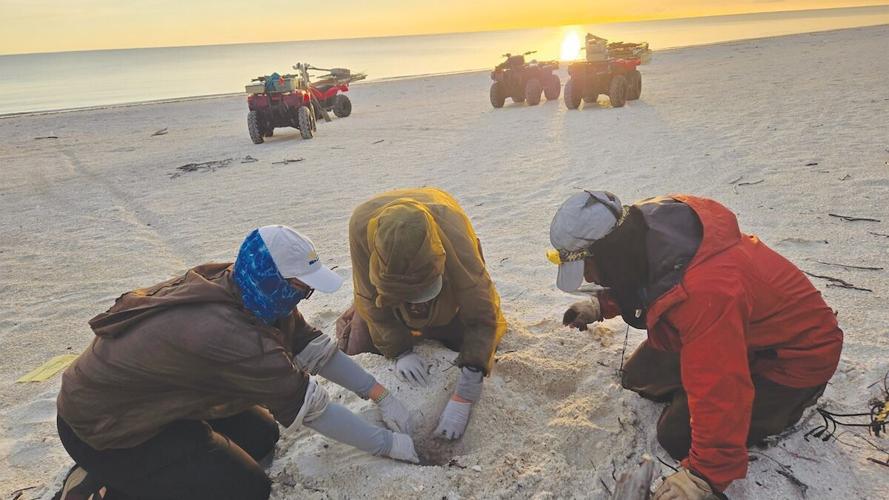
On Keewaydin Island, where the Conservancy of Southwest Florida monitors sea turtle nests, 558 were recorded — predominantly loggerhead turtles — compared to 421 last year.

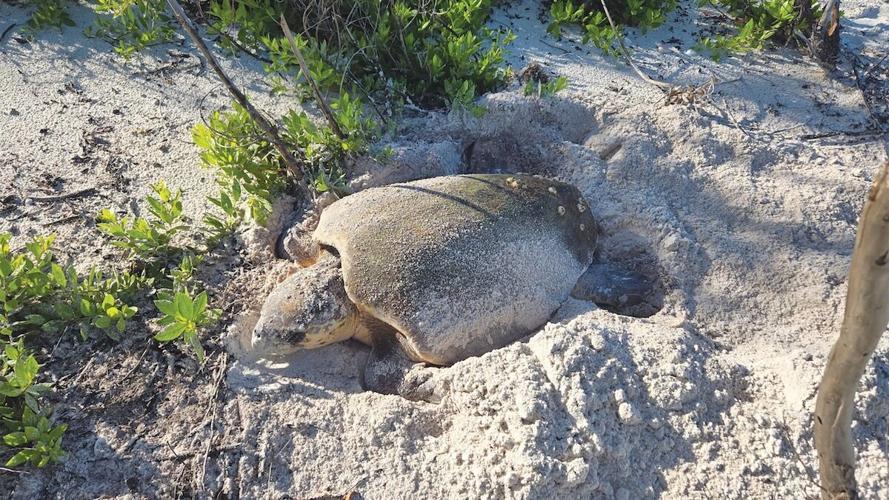
Rare daytime nesting by female loggerhead on Keewaydin Island.
Jeffrey Schmid, senior biologist for the Conservancy, said this is the second-highest number of turtle nests on Keewaydin for a season, slightly higher than the 526 nests documented in 2023 but lower than the record of 628 nests on the island in 2022.
In a phone interview, Schmid said he was excited about not just the high number of nests, but the estimated number of hatchlings from those nests.
“Success for sea turtle nesting can be judged in two ways, and one is better than the other,” Schmid said. “First is nest numbers, which was the second highest we’re recorded since we started monitoring out on the island.
“But perhaps a better metric is the number of hatchlings that make their way to the Gulf from those nests, because some years when we have storms we might have a high number of nests, but you get very low hatching because of inundation from those storms.”
Schmid said this year the Conservancy estimated just over 38,000 hatchlings.
“We don’t actually count each one,” Schmid explained. “We count hatched eggshells, and we estimated that around 38,200 or so hatchlings came off of Keewaydin this year, which again, was our second highest for hatchling production.”
He said the first highest number of hatchlings was 42,900 in 2022, when there were 628 nests.
In 2024, with 425 nests recorded on Keewaydin and tropical storm [later Hurricane] Debbie hitting in early August, he said only about 15,000 hatchlings came off the beach.
“That total number of nests is a good metric for females depositing their eggs, but hatchling production is probably a better metric to use because it takes into account the effects of the tropical storms and hurricanes that we experienced during the nesting season,” Schmid said.
For the beaches overseen by the Collier County team, Toro said via email that county staff “are continuing to work on the hatchling numbers” and they anticipate those numbers will be published in a report that is usually completed in February.

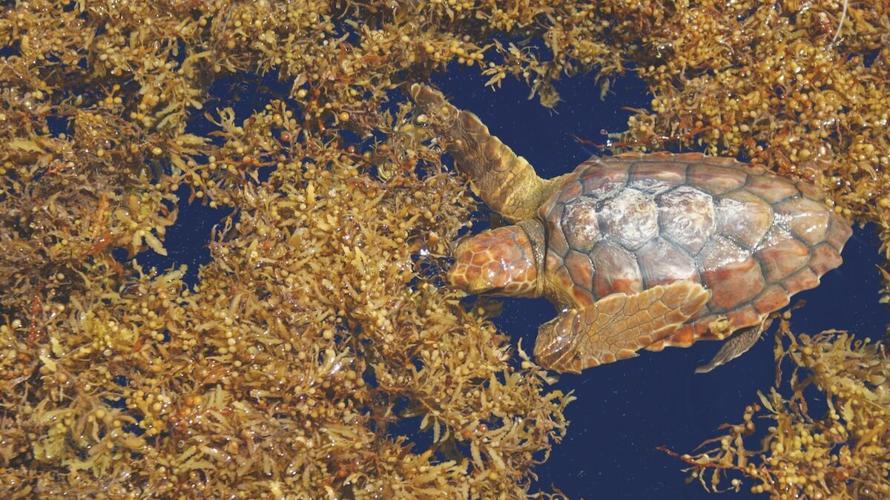
Young loggerhead in a floating mat of sargassum seaweed.
Conservation efforts paying off
Asked why 2025 was such a successful year for sea turtle nests — aside from the lack of major storms — both Toro and Schmid credit ongoing long-term conservation efforts.
“It was a successful year for nests because the population is doing well,” Toro said. “The population seems to be rebounding because of continued conservation efforts throughout the state for many years.”
Schmid concurred, saying in a Conservancy report released near the end of the nesting season that the overall trend on Keewaydin has seen an increase in numbers over the past 20 years that matches the pattern seen on other Florida beaches.
“This positive trend can be attributed to long-term conservation efforts that include both protection of turtle nests on beaches, such as the Conservancy’s program, and reducing the mortality of turtles inhabiting coastal waters, such as requiring turtle excluder devices in shrimp trawls,” Schmid’s report stated.
“This latter conservation measure was crucial to bringing the critically endangered Kemp’s ridley turtle back from the brink of extinction and undoubtedly played a role in the subsequent increase of nesting female loggerheads on Florida beaches.”
In the recent phone interview, Schmid said that in terms of the future success of the species, it’s important to look at those long-term trends and not just any one season.
“We understand that there are going to be some really good record-breaking years, but they all can’t be record-breaking years,” he said. “So, that’s kind of my philosophy, is not looking at necessarily season-to-season.
“Although this past season, with the uncharacteristic lack of tropical activity, produced a lot of hatchlings, a hatchling leaving the beach is going to go through a lot of perils before it grows up to be a female that returns in another 30 years or so. There are a lot of things that can go on between when a hatchling leaves and when it comes back.”
(0) comments
Welcome to the discussion.
Log In
Keep it Clean. Please avoid obscene, vulgar, lewd, racist or sexually-oriented language.
PLEASE TURN OFF YOUR CAPS LOCK.
Don't Threaten. Threats of harming another person will not be tolerated.
Be Truthful. Don't knowingly lie about anyone or anything.
Be Nice. No racism, sexism or any sort of -ism that is degrading to another person.
Be Proactive. Use the 'Report' link on each comment to let us know of abusive posts.
Share with Us. We'd love to hear eyewitness accounts, the history behind an article.