
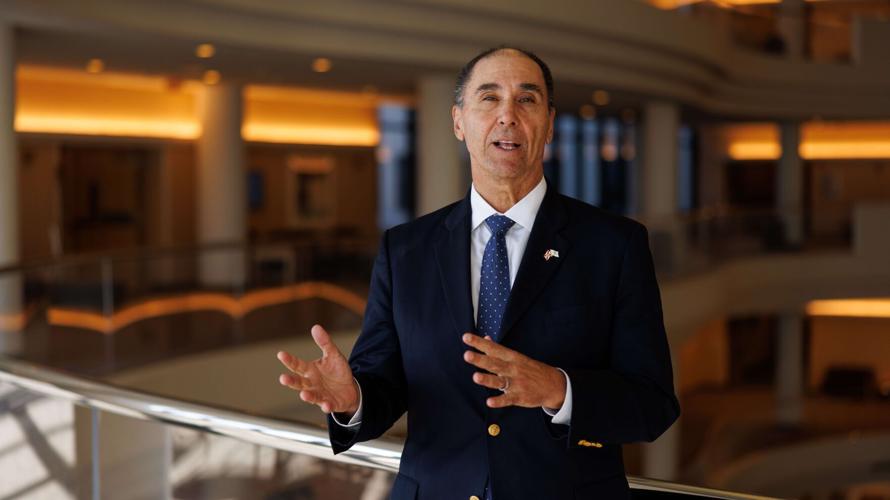



Lee Health President and CEO Dr. Larry Antonucci is retiring Sept. 30 after nearly a decade leading the Fort Myers-based healthcare system. Antonucci has served as president and CEO since 2017 and has worked for Lee Health since 2007.
As Dr. Larry Antonucci prepares to retire Sept. 30 after almost a decade as CEO of Lee Health, he is looking back at the healthcare system’s many challenges and achievements during his tenure — but is also looking ahead at the Southwest Florida healthcare landscape he has helped shape.
Under his leadership, the Fort Myers-based system has grown significantly, from an operating budget of about $1.7 billion to almost $3 billion in the latest fiscal year. The latest figures show more than 16,000 employees across the system, making it the largest employer in Southwest Florida.
Antonucci brought clinical experience to his role as CEO, having practiced obstetrics and gynecology in Lee County for 24 years before joining Lee Health in 2007 as chief administrative officer for Cape Coral Hospital. He served in several other roles with the system, including chief operating officer, before being named president and CEO in June 2017.
Antonucci will be succeeded Oct. 1 as president and CEO by current COO Ben Spence, who has served in a variety of roles at Lee Health since 1995.

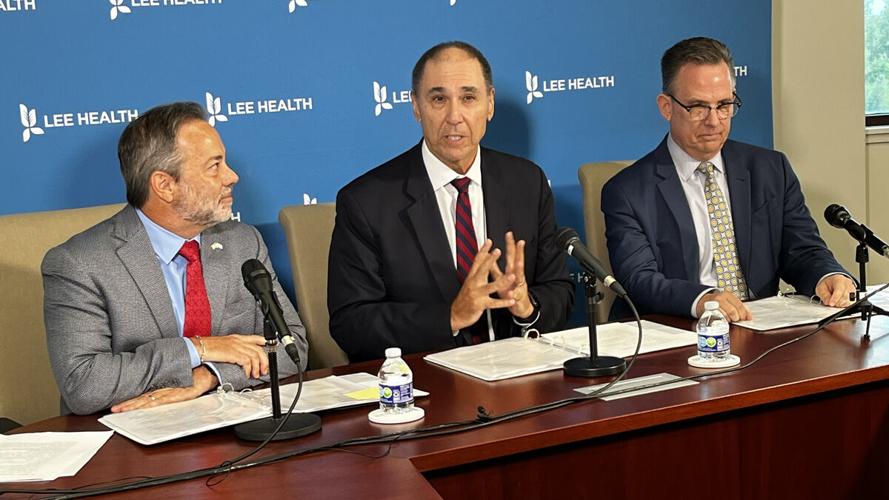
Lee Health President and CEO Dr. Larry Antonucci, center, introduces Ben Spence, left, the healthcare system's current chief operating officer, who will succeed Antonucci on Oct. 1. They were joined by Lee Health's Chief People Officer, Mike Wukitsch.
Conversion was key to the future
During his tenure, Antonucci led the Lee Health team through a global pandemic, major hurricanes and a major restructuring that he said has set the stage for the decades ahead.
That restructuring came in late 2024, when Lee Health converted from a public health system to a private nonprofit. Antonucci said the change was necessary after Florida eliminated certificate-of-need requirements for general hospitals, exposing Lee Health to greater competition from for-profit providers.
Even though it was a public system, Lee Health had no taxing authority, making commercially insured patients important to supporting its “safety net” responsibilities in the county, which require it to provide care regardless of a patient’s ability to pay.
The conversion made it possible for Lee Health to expand operations beyond Lee County and enter strategic partnerships and joint ventures designed to help make the system more competitive.
“I think it’s probably the most important thing that we’ve accomplished in these last nine years to ensure that the system will be healthy into the future,” Antonucci said.
Since the conversion, Antonucci said, the system has opened a primary care practice in Collier County, acquired Florida Heart Associates, which is now a subsidiary of the Lee Health Heart Institute, and expanded its operations at Babcock Ranch.
“We still have tremendous needs right here in Lee County, where we’re building a $900 million new facility on Colonial Boulevard,” he added. “There are still needs here, but now we have the flexibility to do more, and more things (yet to be announced) will be coming down the road.”

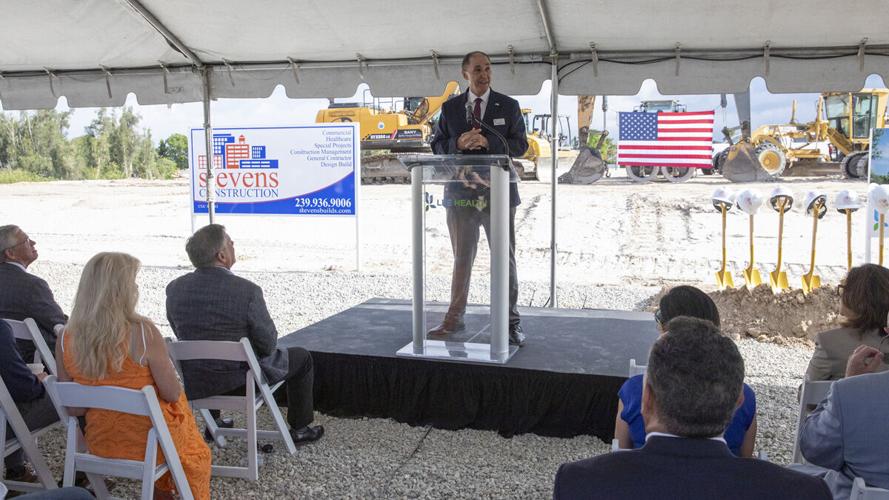
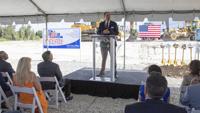
Dr. Larry Antonucci, president and CEO of Lee Health, speaks during a groundbreaking ceremony for a new pediatric outpatient center in south Fort Myers.
A look ahead
In addition to managing major crises and restructuring, Antonucci has overseen significant growth across the system, including in cardiology, oncology, orthopedics and women’s and children’s health. That growth includes expanded pediatric cancer care at Golisano Children’s Hospital.
The system also has broken ground on new facilities across Lee County, including a new 53-acre Fort Myers medical campus with a capacity for 260 beds.
But future growth — especially as the region’s population continues to expand — is not necessarily about adding hospital beds, Antonucci said.
In 2025, the system expanded its Hospital at Home program, providing hospital-level care to eligible patients in their homes, while also expanding outpatient services. Antonucci said the system invested about $12 million in equipment for the program.
“It really is about access, and it’s about the right care at the right place at the right time, and many times that’s not inpatient care,” he said. “The Hospital at Home program, our special complex care units where we can provide infusions and medications without people being in the hospital — that’s where it is.”
Antonucci also sees a transition away from “transactional care” to “relationship-based care,” with a change in mindset about what care delivery systems look like.
“We’re going to have to do things that health systems didn’t do before,” he said. “There are so many things that affect someone’s health: their ability to commute, to travel to appointments, to get appointments. We’re going to have to really embrace the patient from beginning to end and have a personal relationship that carries them through with seamless transitions.
“The future of healthcare is going to look very different. I would anticipate the next five years we’re going to see things you never imagined.”
Leading through crisis
Looking back, Antonucci said he is most proud of how everyone involved with Lee Health — from the board of directors to frontline staff — responded to crises including the global COVID-19 pandemic and Hurricane Ian.
“With the pandemic, we were dealing with a disease that we had never seen before, trying to navigate the clinical side of it, but also being a source of truth for the community,” Antonucci said. “I thought that was really important for us since there was so much misinformation out there. That’s why I really tried to be out in the community as much as possible, to let people know what we knew — and just as important, what we didn’t know.”
He recalled his pride in the Lee Health clinical team, many of whom slept in their garages because they were afraid to go into their homes for fear of spreading the disease.
“At one point, we had 600 people in the hospital with COVID who were very ill, and some people didn’t survive,” he recalled. “Watching the team deal with that was really inspiring.”
Just as the pandemic was winding down, Hurricane Ian struck in late September 2022, which Antonucci said also inspired pride in the Lee Health workforce.
“Watching our team being completely isolated from their families, not even knowing if their houses were okay, if their families were okay, while they were in the hospital working, watching their cars float out of the parking lot — it just gave you an incredible amount of pride in this organization and the people here,” he said.

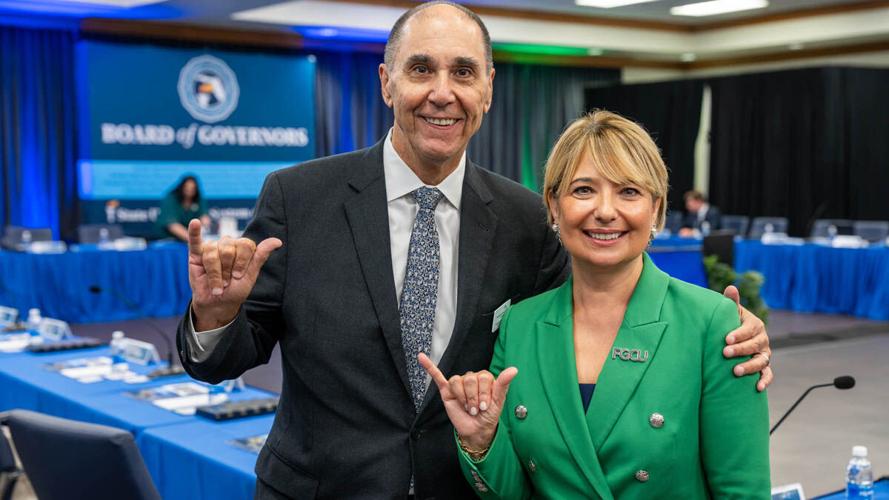
Dr. Larry Antonucci, who serves as the chair of the Florida Gulf Coast University Board of Trustees, poses for a photo with FGCU President Aysegul Timur during the September 2-3, 2026, Florida Board of Governors meeting, which was held at Florida Gulf Coast University.
Antonucci’s legacy
While Antonucci won’t be leading a major healthcare system after Sept. 30, colleagues and collaborators in the region predict that his impact will be felt for decades to come.
Aysegul Timur, president of Florida Gulf Coast University, credits Antonucci with positioning Lee Health for the future without losing sight of the community it serves.
“Dr. Antonucci spent his career caring for the people and families of Southwest Florida, and he set a tone that has helped position Lee Health and our region for what comes next,” Timur said in a statement.
She sees Antonucci — who serves on the FGCU board — as a bridge between the university and the healthcare system.
“He sees our healthcare education partnership from every angle,” she said. “That’s what makes our connection so powerful. FGCU educates the workforce, Lee Health and other healthcare organizations provide opportunities for that workforce to grow and serve, and the entire community benefits.
“Dr. Antonucci has been a central part of that full circle of impact.”
Paul Hiltz, president and CEO of Naples Comprehensive Health, said in a statement that Antonucci’s impact has extended well beyond Lee Health.
“During his tenure he guided his organization through periods of significant change, always with a clear commitment to patients and the communities of Southwest Florida,” Hiltz’s statement said. “On behalf of Naples Comprehensive Health, I thank Larry for his many years of service and for his friendship. I wish him all the best in his retirement.”
(0) comments
Welcome to the discussion.
Log In
Keep it Clean. Please avoid obscene, vulgar, lewd, racist or sexually-oriented language.
PLEASE TURN OFF YOUR CAPS LOCK.
Don't Threaten. Threats of harming another person will not be tolerated.
Be Truthful. Don't knowingly lie about anyone or anything.
Be Nice. No racism, sexism or any sort of -ism that is degrading to another person.
Be Proactive. Use the 'Report' link on each comment to let us know of abusive posts.
Share with Us. We'd love to hear eyewitness accounts, the history behind an article.