
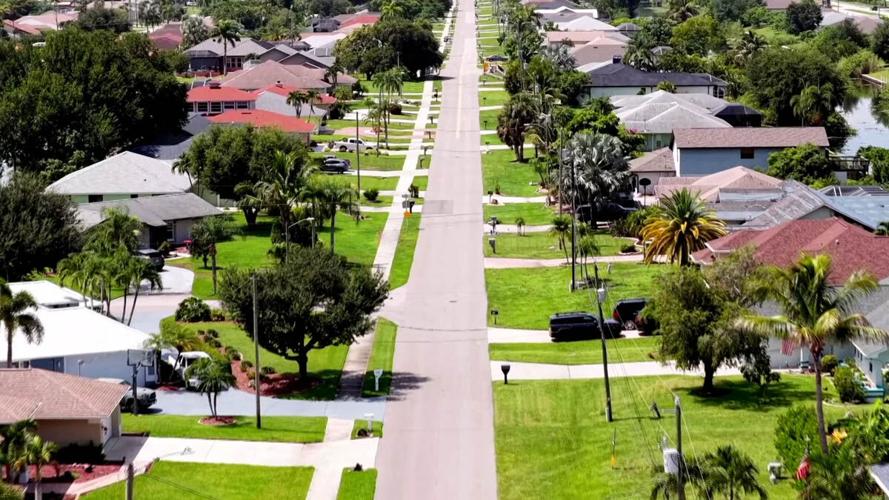



An aerial view of a residential neighborhood in Collier County. Florida voters will decide Nov. 3 whether to approve Amendment 3, which would expand homestead property tax exemptions. Supporters say the measure would ease homeowners’ financial burdens, while opponents warn that reduced tax revenue could strain local government services.
Florida Realtors and the Naples Area Board of Realtors support Amendment 3. The Florida Sheriffs Association and public safety and environmental organizations oppose it. At its core, the proposed constitutional amendment pits direct household relief against the budgets of local governments.
Florida voters heading to the polls on Nov. 3 will decide whether to increase the homestead exemption for non-school property taxes from about $50,000 to $150,000 in 2027 and $250,000 in 2028, with annual adjustments for inflation thereafter. Under the proposal, people who were not Florida residents by Dec. 31, 2026, would receive the existing exemption when eligible, with the expanded exemption beginning in their fifth year of qualifying for homestead status.
The amendment also would cap annual increases in assessed value for non-homestead properties, such as rentals, second homes and businesses, at 5%, down from 10%. It also requires Florida lawmakers to establish a process allowing counties and municipalities to increase the homestead exemption up to a home’s full assessed value.
Requiring at least 60% voter approval to pass, the amendment would generally limit counties’ and municipalities’ use of property tax revenue to public safety, education and schools, infrastructure, natural resources, bond debt service, employee retirement benefits, and government operations and administration. Other expenditures could be approved by local officials unless prohibited by state law.
Opponents, including municipal government leaders, law enforcement, firefighters and emergency services associations and the Florida Democratic Party, warn that Amendment 3 threatens the services that keep communities safe and functional. They argue the loss in property tax revenue could devastate local government budgets, potentially forcing cuts to police and fire departments, libraries, parks and road maintenance.
Unlike public schools, public safety agencies received no comparable revenue protection in the amendment’s legislative drafting. Law enforcement leaders warn that reduced city and county property tax revenue could lead to longer response times. Opponents also caution that reduced revenue could slow local building and planning departments, potentially stalling permit reviews, infrastructure expansions and inspections.
Supporters frame the measure as a vital economic lifeline against inflation and soaring living costs, dramatically expanding property tax relief for primary homeowners, some of whom could save thousands on their annual bills. Backing Amendment 3 is a coalition of Republican legislative leaders and the real estate industry.
Florida Realtors endorsed Amendment 3 in August, arguing that property tax reductions are essential to addressing affordability and market stability. As of Oct. 9, the association had contributed approximately $19.5 million to the committee behind the “Vote Yes on 3” campaign, while the National Association of Realtors had contributed about $2 million, bringing the committee’s fundraising to $21.5 million. The Naples Area Board of Realtors’ board of directors also voted to endorse the amendment.

Danielle Hudson
“The amendment would provide meaningful property tax relief for Florida homeowners while improving predictability for rental, commercial and other property owners,” said Danielle Hudson, NABOR’s vice president of public policy. “NABOR recognizes the importance of maintaining essential local services and believes those needs must be balanced with the growing financial pressures facing residents and businesses. Amendment 3 will help strengthen housing affordability and allow more Floridians to remain in the communities they call home.”
Amendment 3 advocates point out that school district property tax levies — which typically represent the largest share of a homeowner’s ad valorem bill — would not be directly affected by the amendment. Supporters say the measure could deliver annual savings for qualifying homeowners, helping prevent longtime residents from being taxed out of their neighborhoods.
Between enthusiastic endorsements and warnings of strained services lies a cautious business community. The Greater Naples Chamber, representing regional commerce across Collier County, has withheld an official endorsement.
“The Greater Naples Chamber has not taken a formal position on Amendment 3 at this time,” said Kristina Park, president and CEO. “We are continuing to monitor the potential impact the amendment could have on local government, property owners and the business community.”

Kristina Park
Officials from the Florida Home Builders Association and Collier Building Industry Association did not reply to repeated inquiries. Local community developers and builders declined to comment.
Collier County has 230,662 residential properties, of which roughly 110,000 have homestead exemptions. The Board of County Commissioners recently lowered a Conservation Collier millage rate, reducing projected property tax collections by nearly $5.5 million.
As an advocate for property rights, NABOR also opposes a county ballot referendum that would increase the tourist development tax from 5% to 6%. The proposed bed tax applies to guests staying in hotel rooms and vacation rentals for six months or less, rather than directly to homeowners’ property tax bills. Supporters say the tax is needed to complete Paradise Coast Sports Complex and fund other tourism-related projects, including tourism promotion, beach renourishment and tourist-related infrastructure.
NABOR warns the increase would hurt the pocketbooks of tourists and rental property owners.
“Our concern with the proposed bed tax increase is the absence of a sunset provision,” Hudson said. “Completing the Paradise Coast Sports Complex is one of the reasons the county has given for seeking the additional revenue, and tourist tax dollars are already committed to the complex. We believe voters should have a clear accounting of those commitments, what remains to be funded and how the additional revenue would be used. If a project is part of the reason for increasing a tax, there should also be a point when that increase ends or returns to voters for review.
“We value tourism and recognize the importance of maintaining our beaches and visitor facilities,” she added. “The board was not comfortable supporting the increase as currently proposed.”
Taken together, Amendment 3 and the tourist development tax highlight a broader battle over the economics of homeownership and property rights in Southwest Florida. For advocacy groups such as NABOR and everyday residents, the two ballot items underscore a common priority: demanding predictable, transparent governance while shielding wallets from rising costs.
(0) comments
Welcome to the discussion.
Log In
Keep it Clean. Please avoid obscene, vulgar, lewd, racist or sexually-oriented language.
PLEASE TURN OFF YOUR CAPS LOCK.
Don't Threaten. Threats of harming another person will not be tolerated.
Be Truthful. Don't knowingly lie about anyone or anything.
Be Nice. No racism, sexism or any sort of -ism that is degrading to another person.
Be Proactive. Use the 'Report' link on each comment to let us know of abusive posts.
Share with Us. We'd love to hear eyewitness accounts, the history behind an article.