
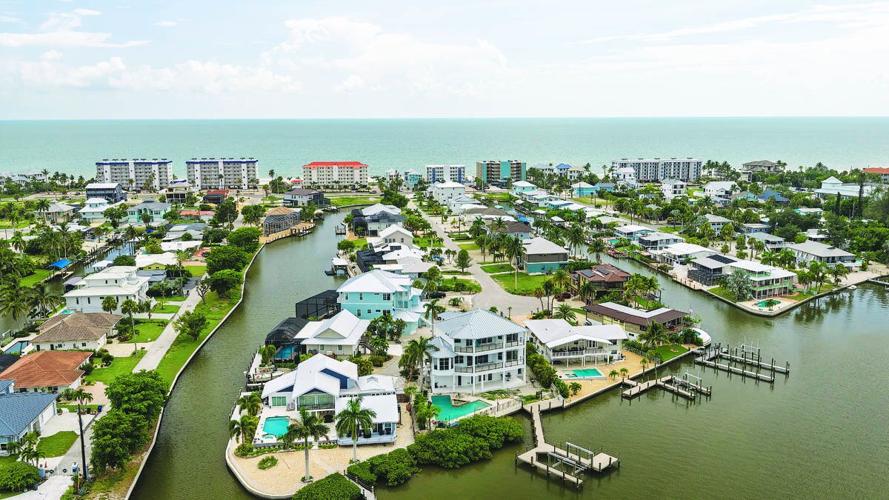


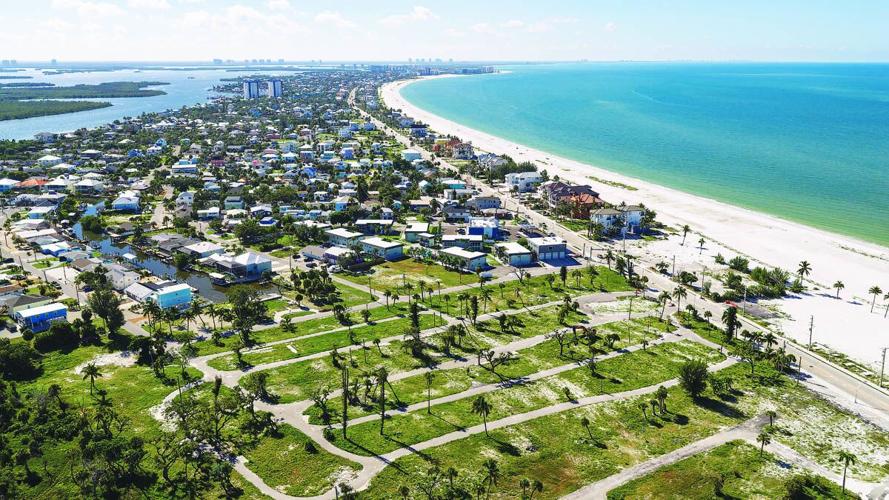
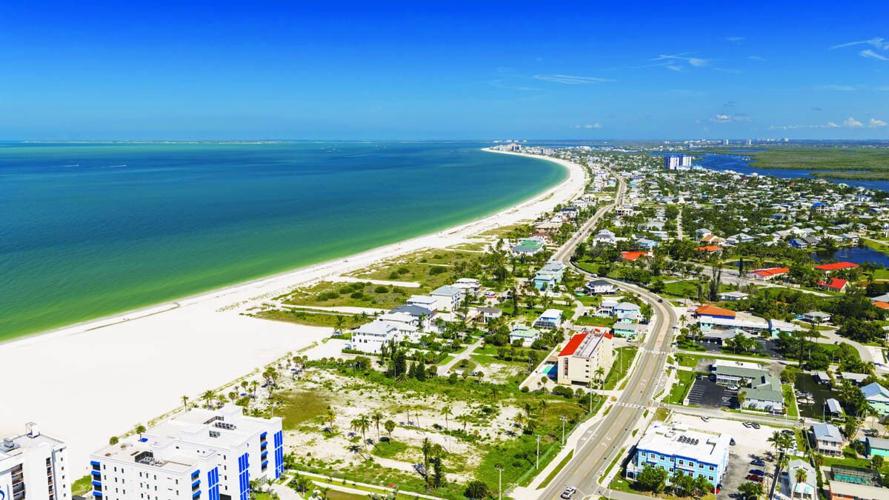

An aerial view shows homes, condominiums and waterways on Fort Myers Beach nearly four years after Hurricane Ian. New construction across the barrier island is being shaped by stricter flood requirements, higher building costs and an emphasis on resilience.
Driving down Estero Boulevard on Fort Myers Beach or cruising across Periwinkle Way on Sanibel Island show barrier island communities that are simultaneously sprinting toward recovery and running in place.
Four years have passed since Hurricane Ian devastated the barrier islands. On Sept. 28, 2022, storm surge exceeded 15 feet in some places and destroyed about 900 of the 2,100 structures on Fort Myers Beach. Ian slashed the year-round living population in half, from about 7,000 to 3,500 residents. On Sanibel, hundreds more buildings flooded and were destroyed. The two islands, which have separate municipal governments, suffered in different ways, and they are rebuilding in different ways.
Each island has had landmark ribbon cuttings in the years since. The 254-room Margaritaville Resort, about midway through construction when the storm hit, opened December 2023 on Fort Myers Beach. On Sanibel, two boutique resorts totaling 55 rooms were rebuilt, rebranded and have reopened for business in the years since.
While further reconstruction continues, it seems to be taking place at the pace of a gopher tortoise.
Times Square, the social and business hub of the northern end of the 7-mile-long Fort Myers Beach, faced the full fury of the storm’s wrath, with all of the beach-facing businesses destroyed. Not until July 6 of this year did a groundbreaking ceremony take place there — and on that day, the $13 million, 40,000-square-foot Sunset Beach Resort project still didn’t have its construction permits in hand.

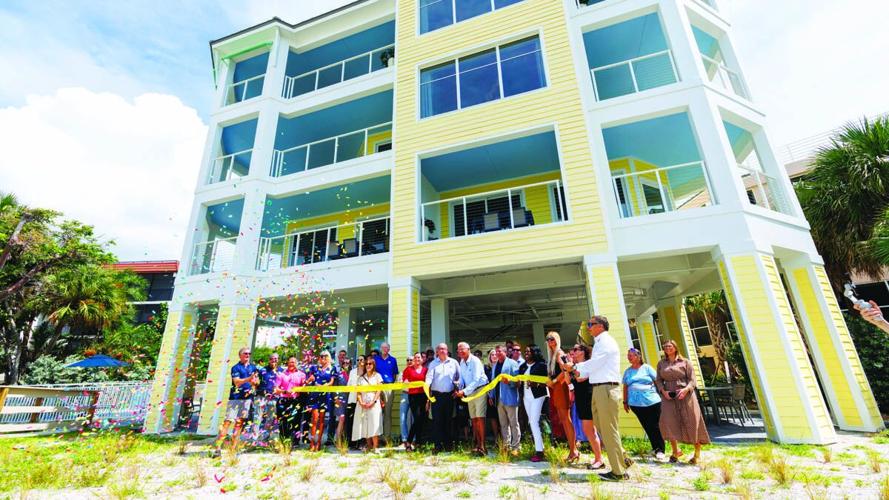
Community and business leaders celebrate the reopening of Beachview Villas on Sanibel. The 22-unit resort replaced Beachview Cottages, which were destroyed by Hurricane Ian, and represents a milestone in the island’s hospitality recovery.
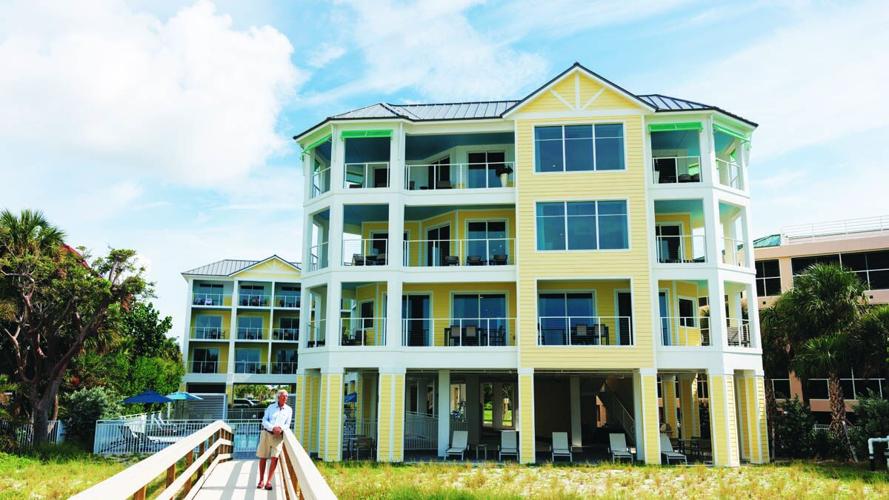
Periwinkle Way, the east-west thoroughfare and business district of Sanibel, fared better than the beachfront condominiums, homes and resorts around the island’s coast. Over the past four years, many of Sanibel’s restaurants have reopened. But only two of the destroyed beachfront Sanibel resorts have completed reconstruction: The 33-room Shalimar Beach Resort reopened Sept. 28, 2025, the third anniversary of the storm; and the 22-room Beachview Villas reopened in June 2026 following about 17 months of construction.
Visits to both islands show the new structures replacing those destroyed will be built with a focus on resiliency.

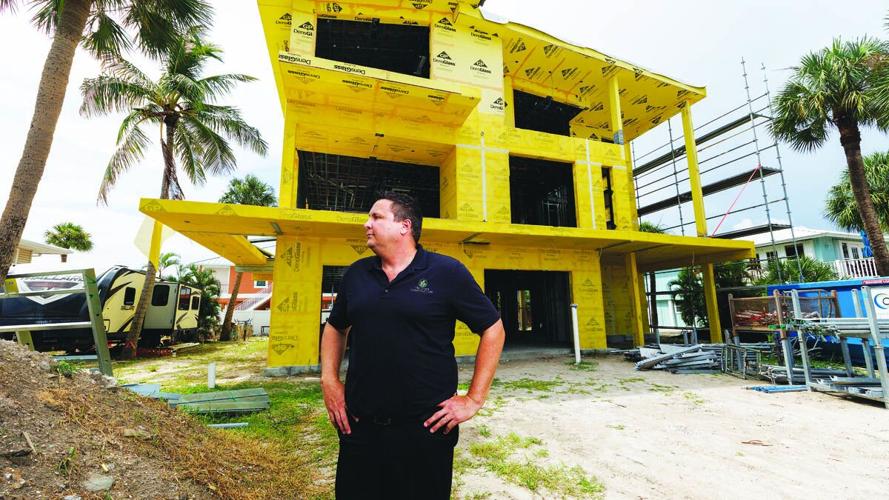
Tri-Town Construction President Marc Devisse stands outside a home under construction on Fort Myers Beach. Devisse is building Scott Houston’s steel-frame home, designed to exceed hurricane codes after Hurricane Ian destroyed Houston’s previous house.
Building to Survive
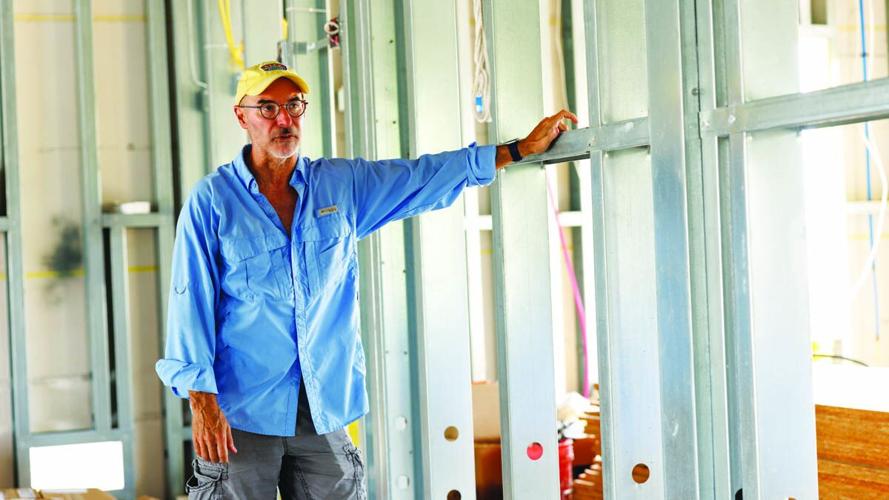
Scott Houston figuratively stands at a crossroads, but he literally stands on the floor of the second story of his under-construction Fort Myers Beach home. He’s positioned right where he plans to put a grand piano, and he’s flanked by steel beams, both vertical and horizontal, above, below and all around him.
They’re exposed still, just prior to having drywall assembled on top of them. The shiny beams are numbered with different shades of magic markers, like pieces of a giant, three-story, 6,500-square-foot LEGO set.
Houston, who spent 14 years starring on the PBS show “The Piano Guy,” faced the same decision as many Fort Myers Beach residents after Hurricane Ian. Would he sell his property? Would he stay and renovate? Or would he rebuild completely?
Houston chose the latter.
He had bought the Anchorage Street house for $525,000 in 2007, only to have it damaged beyond repair by Ian in 2022.
“Once the water got above the pilings, the whole house lifted off the pilings,” Houston says. “Then it came back down, but not where it was supposed to. I just went on a real deep dive [afterward]. I spent a lot of time in the Virgin Islands, chartering a sailboat. The building codes are very strict down there. I wanted to design a house that was purposely built to withstand hurricanes.”
During the deep dive, Houston learned steel-frame homes, not the concrete block and wood-frame ones prevalent pre-Ian on Fort Myers Beach, were trending in the hurricane-prone setting of the Virgin Islands. He learned of a British company called Bauhu Modular, which pre-designs homes, then ships the materials to the home builder.
Houston enlisted a Fort Myers Beach-based home builder, Tri-Town Construction, to assemble what arrived as 85,000 pounds of steel packed in six shipping containers. The Trump administration’s steel tariffs changed what would have been a cheaper, more resilient product into one more expensive — by about 25%, Houston said. But he decided to stick with it.

Scott Houston stands inside his new Fort Myers Beach home, which is being built with a steel frame designed for greater storm resilience. Houston chose to rebuild after Hurricane Ian damaged his previous home beyond repair.
“He was the innovator,” Marc Devisse, president of Tri-Town Construction, says of Houston. “He was at the forefront of bringing it here. He wasn’t going to rebuild something that was going to get washed away again. That’s what he went with. The way it’s built, it’s very, very strong; it exceeds the hurricane codes that we have. It’s built to be the last house standing.”
Steel framing is only part of the resiliency equation. Houston hired Lee County-based Florida Solar Design Group to install 66 rooftop solar panels and three energy-storing batteries in the garage that will allow his home to keep running the air conditioner if — or when — the power grid goes down.
“We’re going to have the storm-hardened house that can withstand Ian,” Houston says. “We didn’t put in solar to put in solar; we put in solar so we could have power if the grid goes down for three weeks like it did last time.”
Houston spends part of his time on Fort Myers Beach and also has a home near Indianapolis. The elevated expenses of the new home mean he also plans to rent it as a vacation property.
The trend of building rental properties instead of full-time residences was rising before Hurricane Ian. It can be seen in the numerous vacation rental signs posted outside homes across the island, which has priced out some of the original homeowners who couldn’t afford to stay and rebuild.
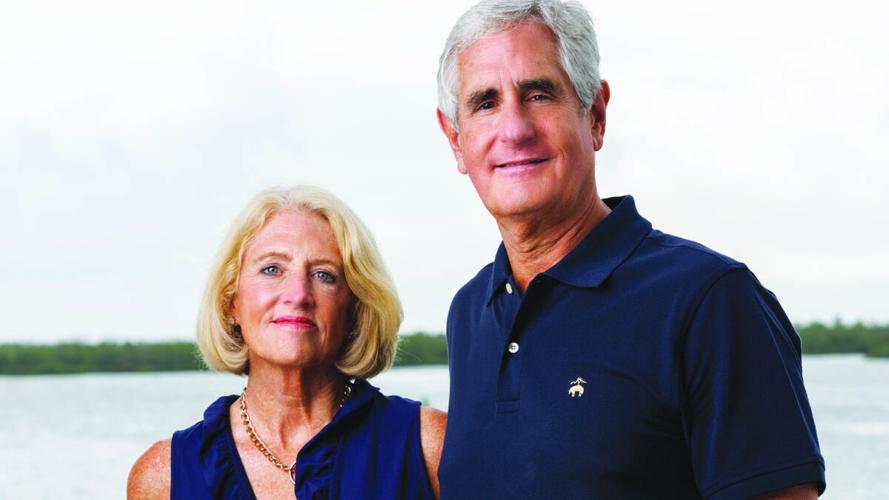
Fourteen streets and one Publix grocery store to the south of where Houston lives, John and Leslie Munger aren’t just rebuilding with resiliency. They are advocating for the rest of the town to do so, as well.

John and Leslie Munger faced the daunting task of rebuilding their Fort Myers Beach home after Hurricane Ian flooded it with 4 feet of water, calling the recovery their greatest challenge.
The Cost of Resilience
John Munger is an intellectual property attorney based in Chicago. Leslie Munger has been an executive with multimillion-dollar companies and the deputy governor of the state of Illinois. The married couple faced plenty of challenges in those jobs, but nothing, Leslie Munger said, challenged her more than recovering from Hurricane Ian.
“This is the hardest thing that John and I have ever done,” she says. “The amount of time it has taken, the amount of money it has taken, the amount of stress — it is extremely hard.
“Anyone who has gone through this will be able to tell you: There are not a lot of people willing to do this. It is so hard to start from ground zero.”
The Mungers were living part-time in Chicago and part-time at the end of Madera Street on Fort Myers Beach when Ian devastated their home. They bought what originally was a wood-frame house with a dock fronting Estero Bay for $635,000 in May 2013, only to have it flood with about 4 feet of water in the house and 7 feet in the garage.
“Hurricane Ian — we got punched,” Leslie Munger says. “We returned to our home; there was mold throughout our house. Our pool was filled with fish and debris. Our dock was ruined. Our house remarkably was still standing, but it was an old structure. It took us months to recover from that.

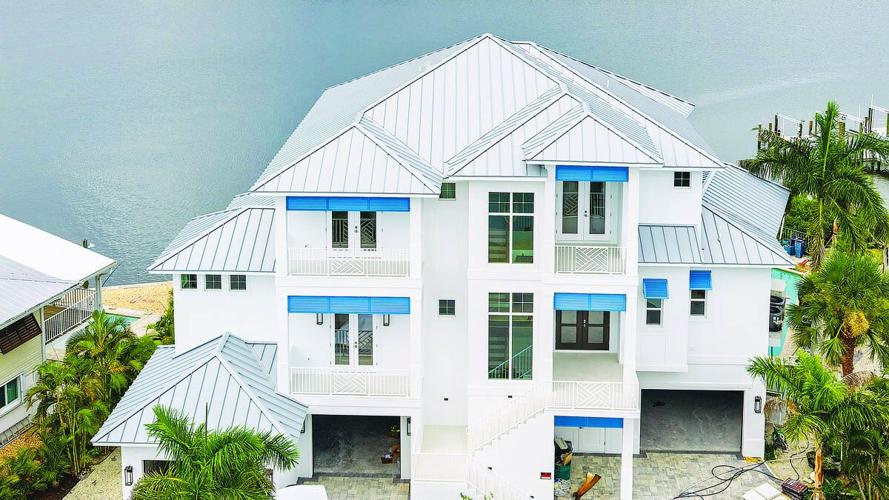
A newly constructed waterfront home on Fort Myers Beach reflects the island’s post-Hurricane Ian shift toward elevated, storm-resistant construction. New and substantially damaged buildings must meet current floodplain requirements, including elevation standards.
“We had to decide: What are we going to do? Are we going to clear it and sell the property? Or are we going to rebuild? And if we are going to rebuild, we’re going to rebuild so that this would never happen to us again.”
Through their architect, John Carsi of Palladian Design Studio, they met and chose Randy Stam of The Property Medic to rebuild their home. Other than where it sits fronting Estero Bay, it’s completely different from the original.
“The first 10 to 12 feet is unlivable space,” Stam says of the new home’s ground floor, which used to be the main living area. “We call it storage or a garage or whatever. The Mungers chose to enclose that space. They’ll use that as garage and storage space.
“There’s a set of exterior steps going up to what would look like the second level if you’re standing there on the street. Their living space starts about 12 feet up in the air. It’s concrete block all the way to the roof. They chose a full masonry structure, that’s not required. More commonly, it’s concrete up to the first-floor elevation and then wood the rest of the way up. It’s based on the owner and the kind of money they want to spend. They wanted concrete all the way up, so they never have to worry again. They have a bunker now. It is very solid.”
John Munger is the homeowner’s association president for their neighborhood, which comprises the south side of Madera Street to Estero Bay, with most of the homes facing a canal.
There are three empty lots fronting that canal that are for sale, and a fourth empty lot the HOA plans to develop into pickleball courts.
The issues with those three empty home lots — of developing them with resiliency but at rising costs — extrapolate into much bigger issues for three of the beach’s largest commercial lots. The Mungers are pondering the town’s future, as are members of the Fort Myers Beach Town Council.
“In today’s world, you have to build a hurricane-proof house if you want to own a house on a barrier island,” John Munger says. “Those kinds of builds are expensive. You need people who are willing to come in and spend maybe $2 million or more dollars. By the time you acquire the lot and then elevate the house and make it sufficiently strong, you’re talking $2 million to $3 million. Folks with that kind of money have choices. They’re choosing to invest in places other than Fort Myers Beach. That’s the perspective I’ve had in rebuilding on Fort Myers Beach.”

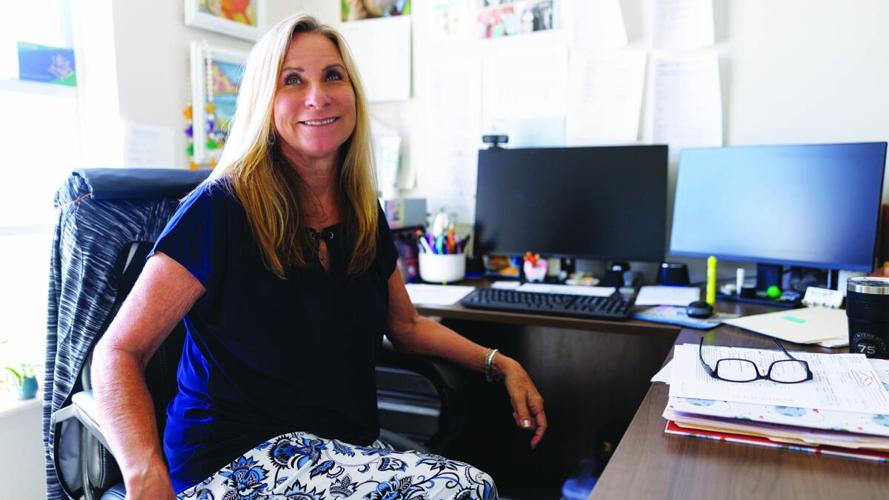
Fort Myers Beach Chamber of Commerce President Jacki Liszak has advocated for rebuilding the island’s business community while confronting the economics of redevelopment on her own Hurricane Ian-damaged property.
Making the Numbers Work
Jacki Liszak spends much of her time advocating for businesses as president of the Fort Myers Beach Chamber of Commerce. But when it comes to her own property, the math doesn’t work.
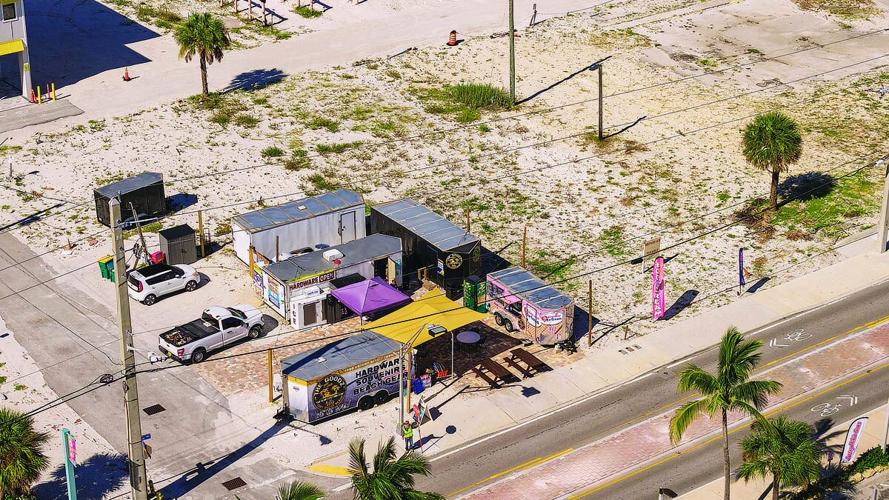
Hurricane Ian destroyed her five-room Sea Gypsy Inn at 1698 Estero Blvd. Since then, she has leased the property to The Goodz Inc., a hardware store.
“We had five rooms and a gift shop and 4,500 square feet,” Liszak says. “The question becomes: How do I justify a $4 million or $5 million rebuild with only four or five rooms?”
She can’t — not without building a business destined to lose money. To make the economics work, she’d need a height variance from the town and a public benefit to justify it.

The Goodz hardware store operates on the former Sea Gypsy Inn property along Estero Boulevard. Owner Jacki Liszak has said rebuilding the five-room inn would not make financial sense at today’s construction costs.
It’s the same dilemma facing some of Fort Myers Beach’s largest redevelopment proposals, including those by London Bay and Seagate Development Group, only on a much larger scale.
“The storms may come, but we’re not going to let them keep us down,” Liszak said during a groundbreaking ceremony. She made those remarks July 6 as fellow Fort Myers Beach landowner Terry Persaud commemorated the intended groundbreaking of Sunset Beach Resort. It will have at least six rooms and as many as 35 rooms fronting Times Square and the Gulf.
“We need the area back,” Liszak told the town’s elected officials and small gathering at the construction site. “We need businesses to get up and out of the ground.”
Navigating the Bottleneck
Soon after Will McKannay became town manager of Fort Myers Beach in May 2025, the Federal Emergency Management Agency placed the town on probation from its National Flood Insurance Program, which eliminated a 25% flood insurance discount and added a $50 fee for residents with policies. FEMA lifted the probation in November 2025.
“I came in when we had a challenge and an opportunity,” McKannay says. “FEMA came down with a list of properties; they inventoried the whole island. After that, we worked with FEMA to bring either the properties back into compliance or bring our town’s policies into standards to hold properties accountable to those standards.
“That was a watershed moment for us. That was when we really could start the redevelopment process. We had standards in place to work on with the developers.”
With FEMA compliance restored, projects that had stalled could once again begin moving through the approval process.
The result meant weekly “wins” for the community, as single-family homes began coming out of the ground again.
“We’re still at 65% to 70% of where we were before for accommodations,” Liszak says. “The houses are coming out of the ground fast.”
But the commercial projects are not. They’re not, in part, because the money math of building to code and monetizing it upon completion just doesn’t work, landowners have said.

Red Coconut RV Park’s 10-acre Fort Myers Beach site sold for $52 million in 2023 and is slated for a 141-unit redevelopment, including two 17-story towers and four single-family homes.
Two Islands, Two Strategies
On Sanibel Island, the government passed an ordinance in September 2024 doing away with a 49.8-foot absolute building cap in its Resort Housing District. Gulf-front resorts now can build up to 37 feet above base flood elevation. Because base flood elevations along the Gulf range from about 16 to 19 feet NAVD (North American Vertical Datum of 1988 — a standardized elevation reference based on mean sea level), the effective maximum building height ranges from about 53 to 56 feet NAVD, with an additional 8.3 feet allowed for a pitched roof.
The newly rebuilt Beachview Villas tops out at 56 feet NAVD, making it, for now, the tallest building on Sanibel. Shalimar Beach Resort tops out at 48 feet NAVD. At both resorts, the physical ground sits at about 6 feet NAVD, meaning Beachview Villas rises about 50 feet above actual ground level, and Shalimar rises about 42 feet.
Recognizing that homeowners couldn’t simply lift existing houses and still comply with the city’s height limits, Sanibel revised its ordinance to measure buildings from base flood elevation rather than ground level. The change maintained the island’s three-story character while giving property owners flexibility to rebuild.
“We wanted to stay at three habitable stories,” Sanibel Vice Mayor Holly Smith says. “We understand the importance of the rebuild and what it means for our economy.”

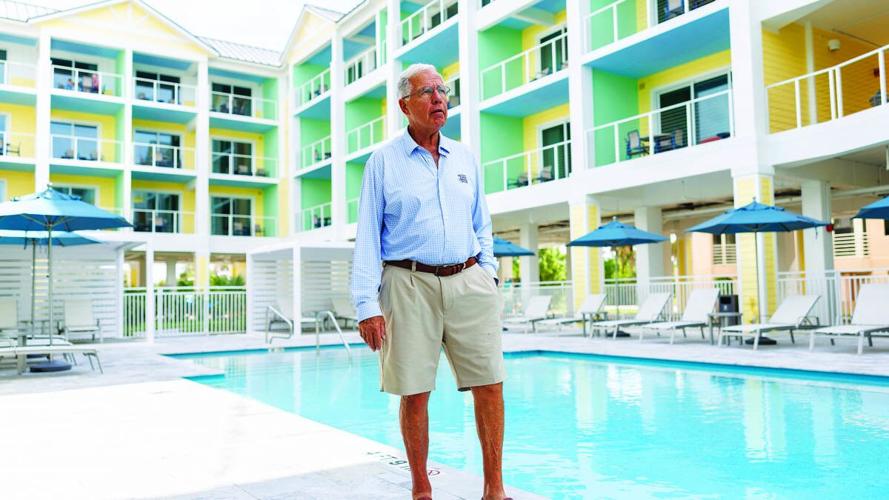
Tony Lapi stands outside the rebuilt Beachview Villas on Sanibel. The resort replaced 22 cottages destroyed by Hurricane Ian with an elevated building supported by about 300 concrete pilings.
On Fort Myers Beach, building heights are capped at three stories or 35 to 40 feet in residential and light commercial districts, and up to five stories or 70 feet in other commercial and resort districts.
Developers must ask for variances to build anything taller on Fort Myers Beach — a process that has stalled the larger projects.
Red Coconut RV Park’s 10-acre site at 3001 Estero Blvd. sold for $52 million to Seagate Development Group in September 2023. The town council approved two 17-story towers combining for 137 units, plus four additional units in the form of single-family homes. A lawsuit was filed protesting the variances, but a Lee County Circuit Court judge ruled the town followed proper procedures in granting them.
The Outrigger’s 3.6-acre site, formerly a 152-room hotel, sold to London Bay for $38.2 million in July 2023.
As this issue went to press, the fate of both sites remained in limbo. London Bay’s project had been twice rejected. A version of Seagate’s project was approved, but the land remains listed as for sale by Colliers.
“Here’s what I say to people who say ‘no’ to a project like London Bay,” John Munger says of the town council. “What is your plan? ‘No’ is not a plan. And that’s all I hear from these naysayers. We need a plan. We need people to roll up their sleeves and build homes on Fort Myers Beach that can withstand the weather.
“Fort Myers Beach is never going to look like a Miami Beach, because we just don’t have open spaces of that scale. Or also a Sanibel. We’re a little bit of both, a happy medium. We need enough retail, restaurants and development to support the people who live here.”
The Arches at Bayfront project, a 263-unit hotel with 75 wet-slips for boats near the Matanzas Pass Bridge, has been approved. But instead of sitting in development limbo, it’s in economic limbo.
Homeowners aren’t the only ones weighing the economics of rebuilding. Even after projects receive approval, developers must convince lenders and investors that the numbers still work.
Ben Freeland, a former car dealer who owns almost 5 acres, knows that calculation well.
“For a project like this, capital markets want to see the whole community moving forward. There’s some question right now as to where the direction of the island is going. We want to see everything on the island coming back and getting healthy,” he says.
“Construction costs are still super high. We were hoping interest rates would come down some more and get to the sweet spot. All those arrows have to turn to green to make it all work.”

After Hurricane Ian destroyed Beachview Cottages, Tony Lapi chose to rebuild with resiliency in mind. The new Beachview Villas rests on about 300 concrete pilings and features 22 units, including Gulf-front accommodations.
Rebuilding Hospitality
On Sanibel, Tony Lapi never could have rebuilt the tattered ruins of Beachview Cottages into the modern majesty of Beachview Villas at 3325 W. Gulf Drive had he not also owned ’Tween Waters Inn on Captiva Island. Owning both made the money math work.
“If we didn’t also own ’Tween Waters, we would have been in deep doo-doo,” says Lapi, who had owned Beachview Cottages since 1979. Hurricane Ian smashed all 22 of those cottages to pieces; some of them splintered apart in place, while some washed out across the street.
“Now we’ve renamed it, because they’re not cottages anymore,” Lapi says.
Lapi opted to rebuild but with resiliency, and hired Stevens Construction. Instead of building 22 cottages, it built an L-shaped building constructed with about 300 concrete pilings driven into the ground.
There are 11 suites with a bedroom, living room and kitchenette, 10 junior suites and one four-bedroom, four-bathroom unit fronting the Gulf with about 2,000 square feet of space.
“Think of it,” Lapi says. “On Sanibel, if you want a Gulf-front home, you have to rent it for a month. Because we are part of a resort district, we can rent it daily. We typically have a three-night minimum on that one.”
To fund the $16 million construction project, Lapi took out a loan from FineMark National Bank & Trust, using ’Tween Waters as collateral.
“That gave us the borrowing power to go to the bank and say, ‘Here’s what we want to do,’” Lapi says. “The power of ’Tween Waters with its equity position helped us. We already owned the dirt where Beachview was. We didn’t have to buy the land.”
Up next for Lapi will be rebuilding the 37-unit Castaways at Blind Pass, the western end of Sanibel, just before the bridge to Captiva Island.
“We have to have a plan submitted by the end of December,” he says. “Once the plan is approved, we can go for permitting.”

An aerial view looks along Fort Myers Beach as rebuilding continues nearly four years after Hurricane Ian. Residential construction has moved ahead while several major commercial redevelopment sites remain works in progress.
Financing the Recovery
As president and CEO of Sanibel Captiva Community Bank, Kyle DeCicco has a front-row seat to the rebuilding challenges on both barrier islands.
His bank has partnered with Charitable Foundation of the Islands on its Accelerate Loan Program. Funded by anonymous investors, it has provided 10 loans totaling $810,000 since Ian, helping small businesses return. The bank also has granted $130 million in condominium association loans.
That work has given DeCicco a firsthand look at the rebuilding philosophies on both islands.
“Sanibel is much more of a barrier island with a mentality that they are a sanctuary island,” DeCicco says. “They want to keep development as limited as possible.”
He said today’s building codes, interest rates and construction costs have forced owners and developers alike to rethink what should be rebuilt.
“Sometimes it doesn’t make fiscal sense to rebuild what was there. You see that in some of the projects on Fort Myers Beach and some of the projects on Sanibel. It’s not the highest and best use to put back into place a mobile home park, for example.”
Instead, he says, developers often work with local officials to find a use that better fits today’s economics and building requirements.
“What happens in that case is a developer comes in and has a tremendous vision of what can be done. And they work with the local lawmakers and decision makers to develop what makes the best sense for everybody.
“It takes time,” DeCicco says. “That’s what I’ve come to realize. That’s the unfortunate part of this. I would have hoped as a business owner or as CEO of the company, I would like to see a simpler process for investors and developers and residents to have a more common-sense approach to rebuilding and working together to rebuild these great islands.
“I’m a believer in the saying rising tides raise all boats.”
Developers, however, worry that patience has limits.
Justin Thibaut, CEO of LSI Companies, a Southwest Florida-based land brokerage company, said developers are becoming more reluctant to invest on the barrier islands because major projects have struggled to gain approval.
In a recent opinion-editorial he wrote on the issue, Thibaut concluded: “Nobody is asking Fort Myers Beach to approve every tall building that comes along. But there has to be a middle ground between reckless overdevelopment and regulatory paralysis. Because if the island continues making transformational redevelopment nearly impossible, the outcome probably isn’t some perfectly preserved version of Old Florida magically reappearing.
“The outcome is more likely to be stalled sites, delayed recovery, fragmented reinvestment and capital quietly choosing other coastal markets willing to move forward. It’s time for a mentality shift on the island, where new development activity is embraced versus villainized.”
(0) comments
Welcome to the discussion.
Log In
Keep it Clean. Please avoid obscene, vulgar, lewd, racist or sexually-oriented language.
PLEASE TURN OFF YOUR CAPS LOCK.
Don't Threaten. Threats of harming another person will not be tolerated.
Be Truthful. Don't knowingly lie about anyone or anything.
Be Nice. No racism, sexism or any sort of -ism that is degrading to another person.
Be Proactive. Use the 'Report' link on each comment to let us know of abusive posts.
Share with Us. We'd love to hear eyewitness accounts, the history behind an article.